
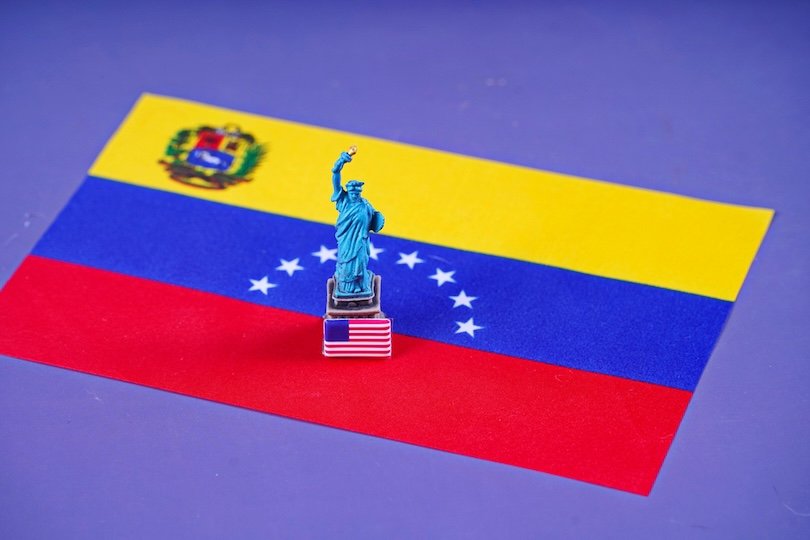
On 3 January 2026, the US carried out a surprise military operation in Venezuela, capturing President Nicolás Maduro and his wife, Cilia Flores. The US has made little effort to cloak its operation in either solidarist language, such as appeals to democracy promotion, human rights, or liberal peacebuilding – or in pluralist rhetoric emphasizing the preservation of international order. Instead, Washington has presented the action in largely instrumental and strategic terms, signalling a willingness to sidestep both dominant justificatory traditions within international society. While Maduro and Flores are charged with narco-terrorism conspiracy and cocaine importation conspiracy, international debates focus on the future of Venezuela’s oil (Poque González 2026). On 7 January administration officials said the US plans to effectively assume control over the sale of Venezuela’s oil “indefinitely” (Sherman 2026) and President Donald Trump confirmed that he expected the US to run Venezuela, insisting that the country’s interim government was “giving us everything that we feel is necessary” (Sanger et al. 2026).
Attention is fixed not only on Washington’s plans for Venezuela’s oil sector and control over its export revenues, but also on the replies from Moscow and Beijing, Maduro’s chief foreign backers and heavyweight players in energy politics. Consequently, this article asks two questions. First, to what extent does American control of Venezuelan oil threaten China’s and Russia’s energy interests? Second, what does the resulting US–China–Russia triangle imply for how energy security itself is being redefined? A constructivist perspective, recognizes that oil is an idea—valuable not only because it burns but because control over it symbolizes power and authority (Kuteleva 2021). Thus, when the US claims the right to supervise Venezuelan oil revenues, it is not only increasing leverage over barrels, but asserting the authority to define legitimate energy exchange itself. In this context, while the material threat is limited for China and already largely sunk for Russia, the symbolic, institutional and political threat is profound.
A straightforward constructivist interpretation of the US–China–Russia triangle centres on status. China had cultivated Venezuela as an “all-weather strategic partnership” (Ministry of Foreign Affairs of PRC 2025b) and major debtor, only to watch Maduro captured days after senior Chinese officials visited Caracas (Ministry of Foreign Affairs of PRC 2025a). In constructivist terms, this is an obvious status injury: China appeared present but powerless. China’s energy diplomacy had functioned as proof of its global influence, and the nullification of China’s energy ties with Venezuela by US force undermines China’s narrative as a protective patron for the Global South. Beijing accused Washington of “hegemonic thinking” (Liu and Chen 2026), “bullying” (Global Times 2026a), and violating Venezuelan sovereignty and “the rights of the Venezuelan people” (Global Times 2026b). This strong pluralist language is not incidental—it is a bid to reclaim moral authority and redefine the event as norm-breaking rather than capability-revealing.
Similarly, Russia’s involvement in Venezuela was never purely economic. Moscow saw the alliance with Venezuela as a way to advance its anti-American agenda and to signal that it could cultivate allies in Washington’s traditional backyard (Boersner Herrera and Haluani 2023; Gratius 2022; Herbst and Marczak 2019). It used Venezuela as leverage against the US, subsidised the regime during periods of domestic recession, and framed support as proof of great-power reliability. As senior Russian executives put it, “economic considerations took a back seat to political goals of taking swipes at the US” (Seddon and Stognei 2026).
US control of Venezuelan oil thus removes a symbolic platform on which Russia enacted its identity as an energy superpower and geopolitical spoiler. While Russia continues loud sovereignty talk, its demonstrated incapacity to protect partners pushes it toward opportunistic bargaining (“concert” deals, see Lemke 2023) rather than overt defense of UN-pluralist restraint. As such, Dmitry Medvedev (2026) bluntly claimed that the US special military operation in Venezuela all but justifies Russia’s own actions in Ukraine.
Venezuela is not a core supplier for China in volumetric terms. In 2025, Venezuelan exports to China averaged roughly 395,000 barrels per day—about 4% of China’s seaborne crude imports, according to Kpler data cited by the FT (Leahy and Moore 2026). China has diversified routes, strategic reserves covering at least 96 days of imports, and strong purchasing power in global markets (Downs 2025). Hence, from a narrow supply perspective, the loss of Venezuelan oil is manageable. That said, around one-fifth of China’s crude imports come from suppliers under US or western sanctions, primarily Iran, Venezuela and Russia, much of it disguised via transshipment near Malaysia (Downs 2025). Independent “teapot” refiners (Downs 2017)—who account for about a quarter of China’s refining capacity—are structurally dependent on this discounted, politically risky oil.
Consequently, Trump’s seizure of Maduro alarmed China not mainly because of Venezuela itself, but because it demonstrated Washington’s capacity to escalate from sanctions to physical control of an energy sector, and thus potentially to Iran. Here, constructivism reveals the problem: “sanctioned oil” is not simply cheaper crude; it is a political category—oil marked as illegitimate by a dominant legal-financial order. The US move signals that this stigma can be converted into coercive authority, turning commercial vulnerability into geopolitical dependence. This reclassification transforms Chinese domestic actors into security subjects. “Teapot” refiners are no longer just businesses; they become strategic vulnerabilities whose survival depends on US tolerance. Analysis warn that a cutoff of Iranian oil could force many to shut down entirely (Leahy and Moore 2026). In this context, US control of Venezuelan oil reshapes Chinese energy security discourse from one of diversification and market access to one of hierarchy and exposure to political permission.
Russia’s oil interests in Venezuela were largely written down years earlier. In 2020, Rosneft had sold most formal assets after pouring around $800m into loans and projects that produced little return (The Economist 2020). Much of the remaining exposure consisted of debts and shadow ownership arrangements. More important is the damage to Russia’s sanctions-evasion architecture. Russia had become the leading marketer of Venezuelan oil by trading crude as debt repayment and using banks partly owned by sanctioned Russian institutions, creating what the 2019 Atlantic Council report described as “a counter financial system to the one dominated by the West” (Herbst and Marczak 2019). The recent reporting on the US tracking a tanker linked to Venezuela, Russia and Iran illustrates how this counter-order is being contested operationally (Sheppard et al. 2026). The vessel sailed under false flags, was sanctioned for carrying Iranian oil, later re-registered under Russian jurisdiction, and became vulnerable to boarding under the UN Convention on the Law of the Sea because it was “without nationality.”
Such episodes show that energy security is increasingly constituted by maritime law, insurance rules, and surveillance practices. US control over Venezuelan oil expands this regime of enforcement, making Russia’s informal trading networks less viable. A constructivist approach suggests that American control of Venezuelan oil is best understood not as a supply shock, but as an act of social stratification in the international system.
Energy markets have always been hierarchical, but the hierarchy was largely implicit: reserve currencies, shipping insurance, futures exchanges, and contract law already privileged Western institutions. What is new is the explicit performance of hierarchy—the public demonstration that a great power can redefine ownership, legality, and access through coercion and administrative authority. This produces a stratified energy order: First, rule-makers – states whose legal systems, sanctions regimes, and corporate actors define what counts as legitimate oil (primarily the US and its allies). Second, rule-takers – states whose energy security depends on access to these institutions (most importers). And third, rule-evaders – states forced into informal networks (Russia, Iran, Venezuela) whose energy becomes socially “tainted.” China occupies an unstable middle category: economically powerful but institutionally dependent. Venezuela’s takeover publicly signals that material power is insufficient without normative control over legality.
References
Boersner Herrera, Adriana, and Makram Haluani. 2023. ‘Domestic and International Factors of the Contemporary Russo–Venezuelan Bilateral Relationship’. Latin American Policy 14 (3): 366–87.
Downs, Erica. 2017. The Rise of China’s Independent Refineries. Geopolitics. Global Energy Policy at Columbia University, School of International and Public Affairs. https://www.energypolicy.columbia.edu/publications/rise-chinas-independent-refineries/.
Downs, Erica. 2025. China’s Oil Demand, Imports and Supply Security. Global Energy Policy at Columbia University, School of International and Public Affairs. https://www.energypolicy.columbia.edu/publications/chinas-oil-demand-imports-and-supply-security/.
Global Times. 2026a. ‘China Condemns US Demands for Venezuela to Partner Exclusively on Oil Production as “Bullying,” Breaches of Intl Law: FM – Global Times’. Global Times, January 7. https://www.globaltimes.cn/page/202601/1352547.shtml.
Global Times. 2026b. ‘China’s Legitimate Rights and Interests in Venezuela Must Be Safeguarded, Chinese FM Responds to Claim about US to Sell Venezuelan Sanctioned Oil – Global Times’. Global Times, January 7. https://www.globaltimes.cn/page/202601/1352555.shtml.
Gratius, Susanne. 2022. ‘The West against the Rest? Democracy versus Autocracy Promotion in Venezuela’. Bulletin of Latin American Research 41 (1): 141–58.
Herbst, John E., and Jason Marczak. 2019. Russia’s Intervention in Venezuela: What’s at Stake? Policy Brief. Atlantic Council. https://www.atlanticcouncil.org/in-depth-research-reports/report/russias-intervention-in-venezuela-whats-at-stake/.
Kuteleva, Anna. 2021. China’s Energy Security and Relations with Petrostates: Oil as an Idea. Routledge.
Leahy, Joe, and Malcolm Moore. 2026. ‘Donald Trump’s Venezuela Action Raises Threat for China’s Oil Supplies’. Oil. Financial Times, January 8. https://www.ft.com/content/f64826fa-5c36-4fb3-8621-ee0b9d9a1ff5.
Lemke, Tobias. 2023. ‘International Relations and the 19th Century Concert System’. In Oxford Research Encyclopedia of International Studies.
Liu, Xin, and Qingqing Chen. 2026. ‘US Reportedly Sets Demands for Venezuela to Pump More Oil; Experts Say “Anti-Drug” Claims a Pretext, Exposing Neo-Colonialism – Global Times’. The Global Times, January 7. https://www.globaltimes.cn/page/202601/1352544.shtml.
Medvedev, Dmitry. 2026. ‘Год начался бурно’. Telegram, January 9. https://t.me/medvedev_telegram/626.
Ministry of Foreign Affairs of PRC. 2025a. ‘Foreign Ministry Spokesperson Lin Jian’s Regular Press Conference on January 5, 2026’. January 5. https://www.fmprc.gov.cn/eng/xw/fyrbt/202601/t20260105_11806736.html.
Ministry of Foreign Affairs of PRC. 2025b. ‘Xi Jinping Meets with Venezuelan President Nicolás Maduro Moros’. May 10. https://www.fmprc.gov.cn/eng/xw/zyxw/202505/t20250513_11619919.html.
Poque González, Axel Bastián. 2026. ‘Energy Security and the Revival of US Hard Power in Latin America’. E-International Relations, January 12. https://www.e-ir.info/2026/01/12/energy-security-and-the-revival-of-us-hard-power-in-latin-america/.
Sanger, David E., Tyler Pager, Karie Rogers, and Zolan Kanno-Youngs. 2026. ‘Trump Says U.S. Oversight of Venezuela Could Last for Years’. U.S. The New York Times, January 8. https://www.nytimes.com/2026/01/08/us/politics/trump-interview-venezuela.html.
Seddon, Max, and Anastasia Stognei. 2026. ‘How Russia’s Venezuelan Oil Gambit Went Awry’. Venezuela. Financial Times, January 9. https://www.ft.com/content/e09a6030-325f-4be5-ace3-4d70121071cb.
Sheppard, David, Chris Cook, and Jude Webber. 2026. ‘US Tracking Oil Tanker off UK Coast Linked to Venezuela, Russia and Iran’. Shipping. Financial Times, January 6. https://www.ft.com/content/a699169a-983a-4472-ab23-54bceb9dd2bd.
The Economist. 2020. ‘Why Putin’s Favourite Oil Firm Dumped Its Venezuelan Assets’. The Economist, April 2. https://www.economist.com/leaders/2020/04/02/why-putins-favourite-oil-firm-dumped-its-venezuelan-assets.
Further Reading on E-International Relations
