
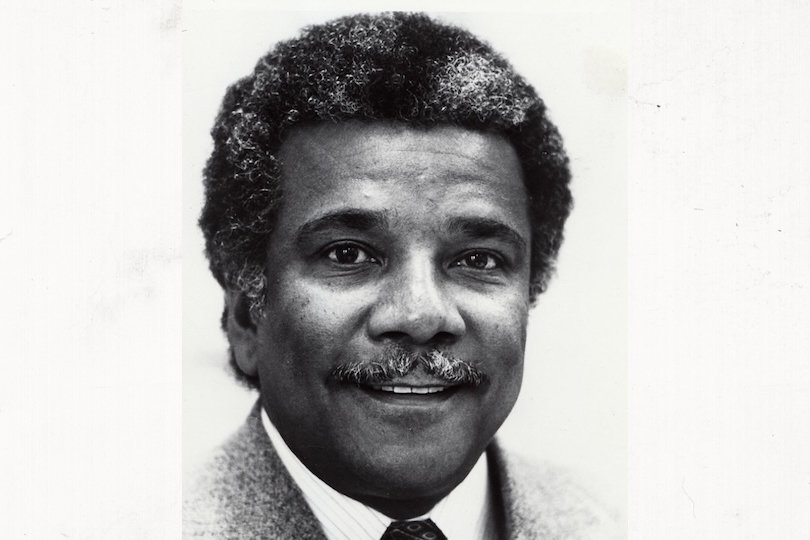
At different points in his intellectual journey, the Kenyan-born academic Ali Mazrui (1933-2014) had been described as “reactionary,” “radical,” “conservative,” “realist,” “liberal,” “idealist,” and even “extremist.” Such labels reflected both his intellectual eclecticism and his prominence in public debate. Yet they also revealed a deeper tension. The questions Mazrui chose to explore, and the methods he employed, often placed him at odds with the mainstream discipline. Nevertheless, he neither altered his intellectual agenda nor joined the positivist mainstream. This essay seeks to defend both Mazrui’s approach and IR by showing that, in important respects, Mazrui was ahead of his time.
More than half a century ago, John Nellis (1974: 831-32) observed in the 1970s that Mazrui was “frequently and severely criticized by radical social analysts who find his traditional scholarship irrelevant and his liberal principles infuriating. At the same time, many mainstream scholars regarded his work as lacking analytical rigor, seeing him more as a political essayist than a political scientist.” Yet what critics called “traditional scholarship” was Mazrui’s style of social inquiry that was grounded in historical analysis, skeptical of methodological fetishism, and accommodates ethical considerations by integrating questions of justice, legitimacy, and moral credibility into its concepts, and merges empirical theory (observation) with value theory (moral judgement). The criticisms directed at Mazrui in the 1970s closely resemble the contemporary divide between positivist and post-positivist approaches. In this sense, we may probably say that Mazrui anticipated debates that would later reshape the discipline.
The distinction often drawn between political scientist and political essayist is itself questionable. It assumes that erudition and disciplined inquiry are incompatible. Mazrui’s work suggests otherwise. From the mid-1960s onward, Mazrui cultivated an intellectual style that combined historical depth, conceptual innovation, and public engagement. He identified controversial issues, examined them dialectically, and exposed their internal contradictions (see, for instance, Mazrui 1980). His fascination with paradox and ambiguity bears a striking resemblance to approaches that later emerged under the broad rubric of post-structuralism.
Mazrui was also ahead of prevailing trends in substantive inquiry. In an article published in the American Political Science Review, Mazrui (1963: 88-97) explored questions of collective identity formation in the African context decades before identity and culture became central concerns in international relations. Throughout his career, Mazrui grappled with issues of culture, meaning, and intersubjectivity, even though he rarely employed the terminologies later associated with constructivist scholarship. What became fashionable in the discipline years later had already occupied Mazrui’s attention. Likewise, at a time when scholars often aligned themselves with a single grand theory or ideology, Mazrui openly advocated what he called “creative eclecticism” (Makinda and Leahy 2025). Today, methodological and theoretical eclecticism enjoy far greater acceptance within the discipline. Here again, Mazrui anticipated an intellectual trend before it became mainstream.
Perhaps most strikingly, Mazrui demonstrated an unusual capacity to anticipate major developments in world politics. This is noteworthy because he remained skeptical of prediction as a scientific enterprise, once remarking that “only a thin dividing line separates scientific prediction from fortune telling” (Mazrui 1969: 172). He made this observation long before international relations scholars were caught off guard by events such as the collapse of the Soviet Union and the rise of China.
Yet despite his skepticism, Mazrui’s record of foresight was impressive. Mazrui (1975: 6) warned that the international community lacked the capacity to prevent another Soviet intervention similar to that in Czechoslovakia: “…we are nowhere near an international police force strong enough to keep the Russians out of another Czechoslovakia.” Four years later, the Soviet Union invaded Afghanistan. And, in 2022, Russia invaded Ukraine. Mazrui (1973: 154) thus foresaw China’s rise: “…before long the question was bound to be asked whether China belonged to the ranks of the weak and underprivileged, or was about to join the ranks of the powerful.” This was years before Deng Xiaoping opened up China for business.
Taking further examples, Mazrui (1972: 20) predicted that an independent Rhodesia would almost certainly become Zimbabwe: “When the hold of the white minority in Rhodesia is one day broken, we will almost certainly have a country called Zimbabwe.” This prediction was fulfilled in 1980. He (1986) anticipated the end of white minority rule in South Africa during the 1990s: “…South Africa will be free from the White minority rule in the 1990s.” Apartheid collapsed in 1994. He also (1989: 158) suggested that the India–Pakistan rivalry could contribute to the nuclearization of the Islamic world: “If Islam gets nuclearized before the end of the century, two regional rivalries are likely to have played an important part in it…” Pakistan joined the nuclear club in 1998. Finally, a few months before the 9/11 attacks, Mazrui (May 2001) cautioned Americans against insulating themselves from dissenting international perspectives and warned of future international shocks: “If Americans are going to spend money only to listen to views which they regard as ‘balanced’, they had better brace themselves for international shocks in the future at least as ‘bewildering’ as the Iranian and Cuban Revolution!”
Critics may dismiss some of these observations as intuition, speculation, or even a sophisticated form of fortune telling. Yet such criticism misses the larger point. Mazrui’s insights emerged not from statistical models but from historical imagination, cultural literacy, and sensitivity to long-term civilizational trends. Whether or not one accepts all his conclusions, his work demonstrates that understanding world politics may require more than the tools favored by positivist inquiry.
The estrangement between Mazrui’s scholarship, of which there is a vast body (see Adem 2021), and mainstream IR need not continue. His writings contain a rich reservoir of concepts and hypotheses that can be subjected to systematic empirical analysis. Indeed, if concepts are the building blocks of theory, Mazrui has left behind an exceptionally fertile conceptual legacy for examining power, modernity, and culture from the perspective of the Global IR. After all, Amitav Acharya (2026)—whose scholarship did more than anyone else’s to establish Global IR as a major intellectual movement—has recognized Mazrui as “a founder of Global IR … who was ignored or underestimated by the mainstream discipline.”
References
Acharya, Amitav. 2026. Remarks at the roundtable “IR Theory from the Global South: Reflections on Ali Mazrui’s Cultural Paradigm of World Order,” 67th Annual Convention of the International Studies Association, Columbus, OH, 25 March.
Adem, Seifudein. 2021. Postcolonial Constructivism: Mazrui’s Theory of Intercultural Relations. London: Palgrave Macmillan.
Makinda, Samuel and Angela Leahy. 2025. “Eclecticism in World Politics: How an African Invention Has Contributed to the Reconstruction of International Relations.” Journal of World Affairs. Voice of the Global South. 1(1) [Online.]
Mazrui, Ali A. 1963. “On the Concept of ‘We Are All Africans.’” American Political Science Review 57 (1): 88–97.
Mazrui, Ali A. 1969. “Political Science and Political Futurology: Problems of Prediction.” Proceedings of the University of East Africa Social Science Council Conference. Makerere University, Kampala, Uganda, 1969.
Mazrui, Ali A. 1972b. Cultural Engineering and Nation-Building in East Africa. Evanston, IL: Northwestern University Press.
Mazrui, Ali A. 1973. “The Yellow Man’s Burden? Race and Revolution in Sino-African Relations.” In China and the World Community, edited by Ian Wilson. Sydney and London: Angus and Robertson.
Mazrui, Ali A. 1975. “World Culture and the Search for Human Consensus.” In On the Creation of a Just World Order: Preferred Worlds for the 1990s, edited by Saul H. Mendlovitz. New York: Free Press.
Mazrui, Ali A. 1980. The African Condition. New York: Cambridge University Press.
Mazrui, Ali A. 1986. The Africans: A Triple Heritage (Video), PBS/BBC, 1986. (“New Conflicts.” Program 5.)
Mazrui, Ali A. 1989. “The Political Culture of War and Nuclear Proliferation: A Third World Perspective.” In The Study of International Relations: The State of the Art, edited by Michael C. Dyer and Leon Mangasarian. London: Macmillan.
Mazrui, Ali A. 2001. “The Place of Documentary Films in Africana Studies: The Case of The Africans: A Triple Heritage.” Keynote Address to the Fourth Annual African Studies Student Research Colloquium, Bowling Green State University, 23 May, p. 7.
Nellis, John. 1974. Review of Cultural Engineering and Nation-Building in East Africa, by Ali A. Mazrui. American Political Science Review 68 (2): 831–32.
Further Reading on E-International Relations
