
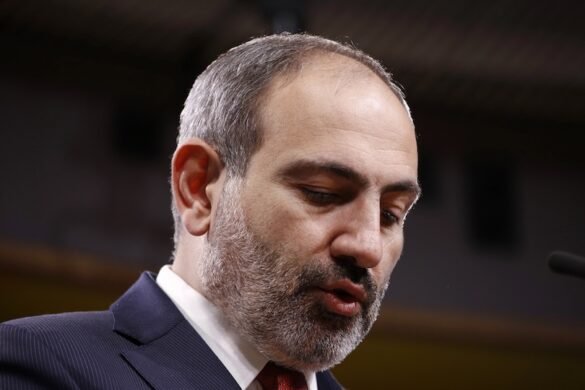
Armenia held a historic parliamentary election on June 7. The Contract Party, the party of the current Prime Minister of Armenia, Nikol Pashinyan, won. Pashinyan lost the war twice to Azerbaijan in 2020 and 2023, suffering territorial loss for Armenia. Still, about 50% of voters supported the Contract Party. Why? Can leaders lose a war and retain power? Surprisingly, in international relations, it sometimes happens that democratic leaders maintain power even after losing a war. But it is still intriguing that Pashinyan pulled it off twice and now, three times. The answer to his political survival appears to lie in the foreign alignment in Pashinyan’s playbook. It is the playbook many of the Eurasian countries play nowadays, so the case provides a general lesson for contemporary international politics.
The primary fault line in contemporary Armenian politics has been between the pro-West and the pro-Russia. Couched between big powers like Russia and the West, Armenia had a distant past under Soviet influence until the fall of the Berlin Wall. The West, in the Armenian context, is associated with the EU and the US. Pashinyan’s Contract Party has associated itself with the West. The opposition parties (Strong Armenia, Armenia Alliance, Prosperous Armenia, and a host of other parties) have been mostly aligned with Russia.
As in many elections, economic and security issues are on the agenda and what matters to the voters. In small states like Armenia, foreign alignment is acutely related to the state’s fate. Voters seem to be aware that Armenia’s economic and security are acutely tied to Armenia’s external relations. The Contract Party’s election slogan was “Stand for Peace.” The slogan reminds voters of the continuity in the absence of active conflict with Armenia and promises economic benefits if Armenia stays on the pro-Western path.
Opposition parties, on the other hand, are many and not coalesced. The most viable opposition leader of Strong Armenia, Samvel Karapetyan, was a business tycoon with Russian ties, who collected about 23% of the votes. Armenia Alliance was led by the former President Robert Kocharyan, who was in power until 2018, with the old guard ties with Russia. The leader of Prosperous Armenia, Gagik Tsarukyan, has had business relationships with Russia and was recently accused of intelligence cooperation with Russia.
A dark horse from the 2018 Velvet Revolution, Pashinyan ushered in the competitive election in Armenia. He lost the 2020 war against Azerbaijan, which involved the long-standing disputed territory of Nagorno-Karabakh. With the Turkish backing of Azerbaijan and a weak military, Armenia suffered substantial territorial loss. The snap election in 2021 conferred a landslide victory to Pashinyan, largely attributed to a fragmented and discredited opposition that voters associated with the pre-2018 old guard. The 2023 defeat to Azerbaijan’s capture of the enclave was also a blow to Pashinyan, causing a massive humanitarian crisis. Yet again, the defeat was framed as a success for Armenian sovereignty and stability. The Western pivot provided enough discrimination to the voters, most of whom have been disenchanted by Russia.
In early 2026, Pashinyan signed up for the Trump Route for International Peace and Prosperity (TRIPP), a transit corridor in the $5-billion joint venture with the United States. The Trump Route promises job creation, capital injection, and market access. We are reminded that Armenia is a landlocked state located in the middle of Azerbaijan, Türkiye, Georgia, and Iran, with no official relations and an open transportation route with the first two. The value of the Trump Route was thus touted as the regional stability and economic growth while retaining Armenia’s sovereignty. In May 2026, Pashinyan also met EU leaders (European Commission President Ursula von der Leyen and European Council President António Costa) to discuss strengthening security and economic ties. The timing of the Armenia-EU summit, held ahead of the June election, does not look like a coincidence.
The outbreak of the US-Israel-Iran war provided an unexpected final chapter to this electoral story. Pashinyan’s government neither condemned the US-Israeli campaign nor endorsed it, maintaining a studied neutrality consistent with Armenia’s “crossroads diplomacy” doctrine. More consequentially, Pashinyan was able to capitalize on Russia’s conspicuous failure to provide any meaningful support to Iran despite Moscow’s deep military ties with Tehran and years of partnership. The failure reinforced the central argument Pashinyan had been making to Armenian voters since 2021: that the Collective Security Treaty Organization (CSTO) and Russian security guarantees are structurally unreliable when tested. Pashinyan’s story is unique in some aspects, particularly the conflict context of Nagorno-Karabakh. Armenia is not alone, however, in terms of the political fates of small states that are small in size and influence.
Kazakhstan’s multi-vector foreign policy is a testament to many countries’ evolving statecraft in the region. After the power transition from Nazarbayev’s long rule, Tokayev staged a snap election victory to consolidate power while maintaining energy initiatives with Russia and securing the Belt and Road initiatives from China. In addition, Tokayev maintained economic and security ties with the West by remaining neutral in the Russia-Ukraine War.
Moldova, once the Soviet satellite country, is now pro-Western. Maia Sandu, elected in 2019, spearheaded the application for EU membership in 2022. She worked with the old guard, pro-Russian Socialist Party, to win the 2019 election, but still faces opposition from the former PM, Igor Dodon, who remains pro-Russia. The country is yet to join NATO and remains strategically and constitutionally neutral. As in the case of Armenia, domestic politics overshadows what Moldova does externally. In turn, external relations also heavily influence what Moldova experiences internally.
What Armenia, Kazakhstan, and Moldova share is a common playbook. Small states in geopolitically contested spaces have learned to convert foreign alignment choices into domestic political capital. The craft is to use the visible benefits of external partnerships as a central argument to gain electoral success and maintain power. What makes Pashinyan’s case distinctive is the sheer severity of the tests he has faced: two lost wars, a humanitarian catastrophe, and now a regional war on his southern border. For Armenian voters, the question in the June election was no longer whether Pashinyan won wars, but whether the alternative offered any credible path forward.
Disclaimer
This article was made possible in part by a grant from the Andrew Carnegie Foundation, formerly Carnegie Corporation of New York (G-PS-24-62004, Small State Statecraft and Realignment). The statements made and views expressed are solely the responsibility of the authors.
Further Reading on E-International Relations
