
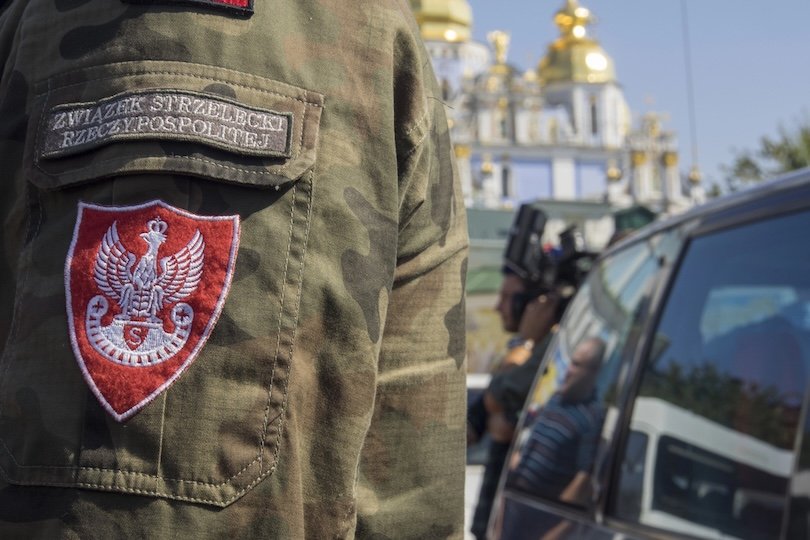
History and the politics of memorialising the past are never far from the surface in Central and Eastern Europe, particularly in the complex border regions of Poland and Ukraine. Since the full-scale invasion of Ukraine began in February 2022, Warsaw has been one of Kyiv’s strongest backers and has also emerged as one of Europe’s leading states in terms of defence spending. However, as the war has gone on, tensions have started to simmer again, from protests by Polish farmers and concerns over immigration, to now most critically, the veneration and naming of a military unit in Ukraine after the Ukrainian Insurgent Army (UPA). To many Poles, the UPA was responsible for collaborating with the Nazis to commit massacres against ethnic Poles and Jews in the regions of Volhynia and eastern Galicia in World War II. The pursuit of independence and the dark realities of World War II required some Ukrainian nationalists to align themselves with the Nazis and ‘overlook the fact that they had to wear uniforms and swear allegiance to Hitler’, in the words of historian David Marples.
The politics of memorialisation are not unique to Ukraine, however, and something Polish President Karol Nawrocki and the right-wing Law and Justice Party (PiS) which backs him, are particularly familiar with. Nawrocki previously served as director of Poland’s Institute for National Remembrance, a body responsible for researching and investigating crimes committed on Polish soil from 1917 to 1991. Nawrocki was also the director of the Museum of the Second World War in Gdańsk, which was subject to its own controversy over its politicisation by PiS. PiS has used Poland’s western neighbour Germany to exploit nationalist causes and increase its support ahead of elections, including on reparations and guilt over the Holocaust and atrocities committed by Nazis on Polish soil. Now, Nawrocki has accused Kyiv of providing Moscow with ‘a lot of oxygen for disinformation’ by glorifying the UPA, and he wants to take away Zelenskyy’s Order of the White Eagle, one of Poland’s highest honours.
This latest incident has repercussions not just for Ukraine but for Poland as well. It is a reminder that Poland’s status as a powerful state in Europe may have come from its integration towards the west, but its future as a state whole with its past and with its neighbours still comes from the east. Four years after what many assumed would be a lightning Russian operation to take Kyiv, Ukraine now has the confidence as a state to even consider dredging up controversial figures from the past in order to attempt to consolidate its position in the future. There is too much at stake for both nations to be hobbled by the deep-rooted disputes of nationalism.
Unlike the rise of nationalism globally, this dispute is not about providing future economic growth or the protection of borders and immigration, for which Poland is one of Europe’s strongest performers with a deep-rooted tradition of sovereignty. Rather it is a nationalism tied to the role and the legacy of historical figures and groups, something Poland is perhaps more cognisant of as its own position in Europe has grown more powerful. So long as a PiS-backed leader holds the presidency and the party can win the next parliamentary elections in November 2027, a more exclusionary and combative version of Polish nationalism will continue to fester alongside Poland’s strong history of Euroscepticism, which can be a constructive force. Both Poland and Ukraine will have to reconcile with the fact that their positions in a Europe whole and free rests on the resolution of disputes over history and the creation of new frameworks for integration in the east.
For Polish President Nawrocki and former President and Solidarność leader Lech Wałęsa to both condemn President Zelenskyy’s actions speaks to the gravity of his decision. For Zelenskyy, the decision is likely a raw political determination based on maintaining his support base within the Ukrainian armed forces, not too dissimilar to moves made by PiS in Poland in the past. It is not a long-term calculus but one that risks a sharp short-term deterioration of relations at a time when the risks of conflict spillover in Poland, Romania, and the Baltic states are at one of their highest points since the start of the war. Ukraine is by most accounts winning the battle to secure its territory and its place in Europe, drawing on recent positive developments such as the election of Peter Magyar in Hungary. Not just within the EU but further afield in Armenia, Russia’s influence is waning, with direct implications on votes in the EU related to Ukraine’s EU accession, further sanctions towards Moscow, and the delivery of critical weaponry to Kyiv.
For Ukraine’s allies in Europe and further afield, it is important to remember that there is no black-and-white, clean-cut version of history when it comes to the historical borderlands of Central and Eastern Europe that were torn apart by competing great powers. Ukraine, Poland, Russia, Belarus, and the Baltic states still have complex battles over identity and historical memory to settle that risk inhibiting their growth as a common region. Part of the answer may come from the easternmost large Polish city of Białystok, whose Sybir Memorial Museum reflects on the complicated role of geography, both physical and emotional, in fully reckoning with the past. ‘There must not be any iron curtain between Poland and the East, because Poland is also there, in the East’, says the museum’s director. ‘Many Polish names are uttered in the East with respect’, Polish cemeteries are there, the traces of Polish lives, descendants and ‘many of our compatriots are heroes shared by Russia, Ukraine, Belarus, and Lithuania.’
No one individual will have the same historical memory on either side of this complicated border region, but it is a shared emotional space deserving of a nuanced understanding of the flawed, collaborationist and even criminal characters who populate its stories. The memory wars in Poland and Ukraine will persist so long as the political and military dynamics on the ground continue to evolve and the events of the Second World War become more distant in the memory of both nations’ citizens. However, the war in Ukraine has increased the importance of resolving the memory wars as it has sharpened the intentions and the nature of the modern Russian state, which under Vladimir Putin can be seen as a direct descendant of previous brutal eras in Russian history. Crimes committed in Ukraine by Russia are not dissimilar to those committed by the Red Army during World War II, and many graves or potential mass grave sites in Russia and Belarus remain inaccessible to Poles so long as Moscow and Minsk are ruled by Putin and Lukashenko. This is a strategic and deeply personal goal that both Warsaw and Kyiv share, and a memory war that can help bind their common future.
As two democracies, one fully integrated with the formal institutions of Europe, and one still very early on in its path, Poland and Ukraine will contest these battles through vitriolic but ultimately peaceful means. Just like Poland, Ukraine’s strength as a European state will come from its accession to the EU, but reconciliation between both Ukraine and Poland will likely come from their respective capitals and not from Brussels. Warsaw would view an EU mediation role as meddlesome and an infringement on Polish sovereignty and history, coupled with the fact that bilateral or regional forums are now becoming more fashionable in Northern and Central Europe. However, the true path to reconciliation also rests with those nations that have not yet made the leap into constructively engaging in their shared historical space, namely Belarus and Russia. Until then, Poland and Ukraine will fight a battle that remains many years from its completion, but whose outcome will determine whether historical memory will be allowed to breathe and to be interrogated as a positive force that is ultimately for the benefit of all of Europe.
Further Reading on E-International Relations
