
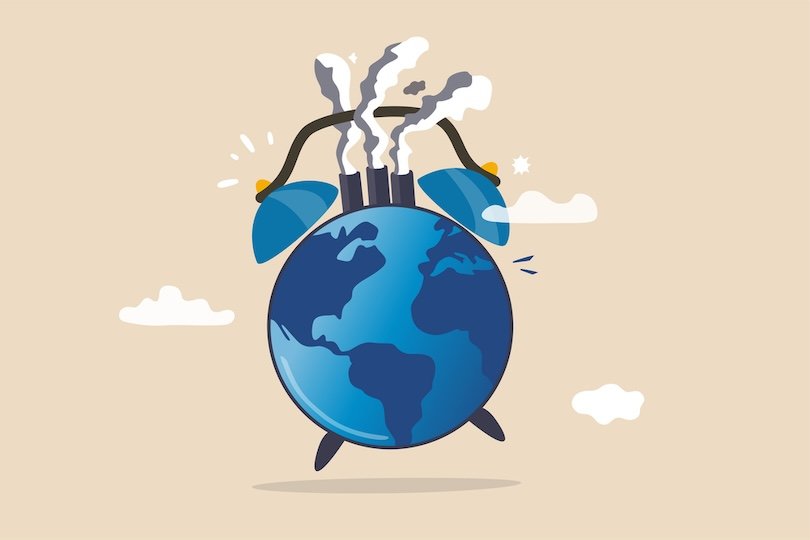
If there is a trading standards authority for concepts and what they promise, then the Anthropocene should be reported to them. The Anthropocene was so named to highlight that human action has impacted the planet to the extent that we are now so entangled with the natural environment that humanity is part of the problem as much as the solution. The Anthropocene was touted as being the closure of modernist illusions of progress, the end of a liberal telos of history, the problematisation of Anthropos (the human) as the centre of the world – a world that was no longer available to be instrumentalised as a resource or reserve. The world was no longer seen as being there ‘for us’, to provide the backdrop to human dreams of infinite growth and progress. Bruno Latour, amongst others, argued that the Anthropocene could achieve what critical theory could not, in providing a conceptual alternative to modernity.
The Anthropocene was to put the final nail in the coffin of disciplines such as International Relations, with their statist and anthropocentric biases. What happened? It seems that the more attentive governments and international authorities have been to the disastrousness of industrial modernity, the more enabled they are. Bringing the world back into governmental calculation works in ways that are counterintuitively opening rather than closing.
Take a typical Anthropocene story, a recent piece in The Guardian. The headline reads: ‘Bycatch has “shocking” toll on British marine life, first-ever analysis reveals’. A UK report revealed for the first time that sea floor dredging results in catastrophic levels of destruction to a wide range of sea-life and ocean ecologies – seabirds, including puffins, gannets and razorbills, porpoises, dolphins, seals, humpback whales, minke whales, salmon, sharks etc etc – are caught up in the shocking destruction of the industrialised fishing industry. This is very much in line with the Anthropocene sensitivities to the unintended consequences of ‘progress’, of entangled outcomes which are nonlinear products of complex interactions. We increasingly learn that, in the contemporary era, problems are being produced rather than resolved by modern modes of production and consumption. Attempts to maintain Western modernity, involve more and more sacrifices, of humans, non-humans, and of worlds and futures as yet unimagined.
This ongoing destruction of the planet is held to go largely unnoticed and unaccounted for. All the modern subject sees is a world of choices and availabilities, a cleansed supermarket world of fish arraigned and packaged, without the relations of violence and destruction. As botanist Robin Wall Kimmerer argues, in her work Braiding Sweetgrass, modernity presents a fictionalised world, a ‘Potemkin village of an ecosystem where we perpetrate the illusion that the things we consume have just fallen off the back of Santa’s sleigh, not been ripped from the earth’.
What to make of this story of the bycatch? Of this revelation that in industrial modernity the fishing industry was not just accidentally catching up dolphins in tuna but actually destroying infinite alternative worlds? The first thing is the ‘revelation’ itself, the recognition that the unintended consequences or externalities – the ‘bycatch’ – are as important as the intention – the ‘catch’. ‘Shocking’ as the revelation is, it adds to our knowledge of ourselves and our world. This discovery itself is a step forward that we should be proud of. The second point is that despite the ravages of the fishing industry, despite the rapaciousness of capitalist modernity, there are still other worlds, other biosystems still available. As the news registers of the gradual closing of the world in which rapacious extraction went unaccounted for, a new world opens where fishing will not just be alleged to be ‘dolphin’ free but also forced to account for biospheres as yet unnumbered. The world opens and expands at the same time as the violence of modernity and its reproduction come into vision.
We could, in this way, begin see our Anthropocene future as an inversing of Walter Benjamin’s observation that ‘every document of civilization is a document of barbarism’. Every document of barbarism, every revelation of unaccounted for violence or exclusion, every scientific survey of the Anthropocene, becomes a conveyor belt for reevaluating the past and present in ways that enable rather than undermine existing governmental regimes. This inversing of Benjamin can be read at a slightly deeper level too. For Benjamin, every claim for progress, for freedom, for democracy, could literally be read as its opposite: as a programme of environmental destruction, of Indigenous dispossession, of Jewish or Black exclusion, of new modes of division and differentiation. ‘Progress’, reassessed from the perspective of the future, appears as merely a constant realm of destruction and devastation. But, for Anthropocene thinkers, like the More Worlds Collective, we escape the pessimism of Benjamin. Yes, every document of colonial modernity is a document of barbarism but there is an infinite number of histories that are available in the present with which to world other worlds.
The Anthropocene itself appears to bring to the fore, to make available, this excess, this world beyond the world of modernity’s fixed grid of time and space and linear causal reasoning. Thus, the Anthropocene begins to transvalue the destruction and degradations of industrial modernity, turning every act of barbarity into the potential for alternative possible futures. Every avowal of responsibility for the externalities and unaccounted consequences of modernity is recycled into its reproduction.
Thus, new modes of governing emerge, not on the basis of hiding the barbarisms and atrocities of the past and the present but through bringing them to the fore. This process of transvaluing atrocities into potentialities provides a useful lens for reappraising critical thinking of the entanglements of the Anthropocene. An early example is Ulrich Beck’s work on ‘emancipatory catastrophism’. Beck brings to the fore the mechanism whereby the Anthropocene produces new futures and disavowals at the same time as nominally accounting for and recognising the barbarism of capitalist modernity and its reproduction. The example he uses is the ‘racial floods’ of Hurricane Katrina in 2005. How is the violence of Hurricane Katrina recouped to provide further futures? Precisely through understanding the flooding and its catastrophic consequences as an entangled and emergent phenomenon, bringing together structures of racial and economic inequality and failures of environmental management.
For Beck, the catastrophe, just like the report on ‘bycatching’ analysed above, makes possible new relations and understandings. The Anthropocene thus brings the future into the present, through always and forever restarting the clock. As highlighted above, the Anthropocene reveals unseen or unrecognised problems, entanglements and inter-relations, expanding our worlds and our opportunities for becoming otherwise. Rather than delivering on its promise of modernist closure, the Anthropocene becomes a rich field, generative of imaginaries of infinite open futures.
Further Reading on E-International Relations
