
(RNS) — Child orator. Farmhand. Agnostic.
Only one of those titles would be commonly guessed to describe the Rev. Martin Luther King Jr.
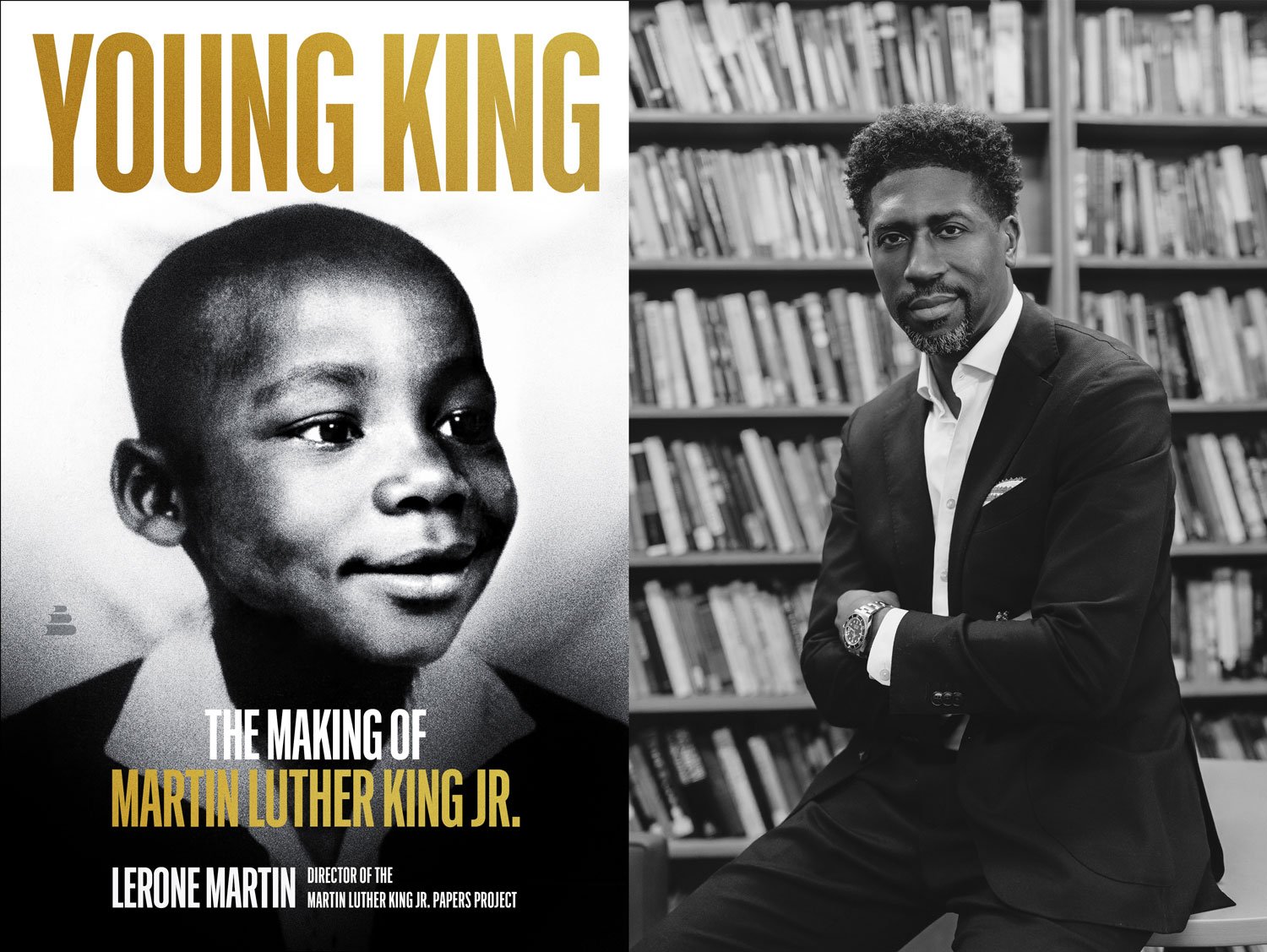
But a new 420-page book by scholar Lerone Martin reveals those and other little-known pieces of King’s history. In “Young King: The Making of Martin Luther King Jr.” — which will be released Tuesday (May 5) — he describes the family, friends and educators who helped shape King into the man who would one day draw some 250,000 people to the 1963 March on Washington.
Martin, 46, is the director of the Martin Luther King Jr. Research and Education Institute at Stanford University. To write the book, he delved into resources such as King’s letters to his parents, hit tunes on the jukeboxes during his college days and a health examination to determine the future civil rights leader’s 5-foot-7 height.
The interview with Martin was edited for length and clarity.
Why did you decide to explore the Rev. Martin Luther King Jr’s early life?
There were two reasons — the first was professional. Starting the new job in January of 2022 as director of the King Papers Project at Stanford University, I started encountering things that I had never read in my entire life of studying Martin Luther King Jr. One of the main things that I encountered was the letters he sent home from Connecticut when he was working on the farm. I never knew that he had these revelations (explained in the letters). On a personal side, I was driven to this because of my family. This is the first book I’ve ever written as a dad, and so I started asking lots of questions about what goes into raising young people so that they’re committed, they want to serve their community, they have a sense of faith.
RELATED: Moms of Martin Luther King Jr., Malcolm X and James Baldwin portrayed in new book
When you say his farm experience, what are you referring to?
In summer of 1944, Martin Luther King Jr. joins a group of about 100 Morehouse (College) men who are in Simsbury, Connecticut, picking shade tobacco to try to make money for college. It’s his first time outside of the segregated South. He’s 15 years old. It’s the summer that he says he begins to explore the idea of being called to ministry. Up until that point, he not only refused to go into the ministry because he wanted to be different than his father, he also had expressed being agnostic and harboring a great deal of resentment towards white Americans because of the racism he had suffered up to that point in his life.
In addition to his time in Connecticut introducing him to many other things, it introduced him to interracial worship.
Yes, it’s the first time that he goes to an all-white church, and he writes home and says: Mom and Dad, you won’t believe it. Negroes and whites worship together here in Connecticut.
How would you describe the influence of his preacher father — known as “Daddy King” — who, you wrote, believed a Black father’s job is to “prepare a child for a world where death and violence are always near”?
Daddy King, in both his published and unpublished autobiographies, talks a great deal about the desire to protect his kids because of the random, naked violence that occurred across the Jim Crow South. And part of his frustration with his middle child, Martin Luther King Jr., is that King doesn’t like to fight. You have a father who’s concerned about his children being able to protect themselves and being willing to fight, but it was from a place of love.

Martin Luther King Jr. and his sister, Christine, in 1930. Photo courtesy Richard Kaplan Collection, State Historical Society of Wisconsin, Madison
You write of how Martin Luther King Jr. received a standing ovation as young as age 4 for singing at his father’s Ebenezer Baptist Church and Baptist conventions. What is another example that reflects his ability to appear before an audience early in his life?
In 1944, 15 years old, he competes in an African American fraternal order oratorical contest, and he wins the contest at his high school — the only African American high school in Atlanta at the time, Booker T. Washington High School, with roughly about 5,000 students. At this time, he’s convinced he’s going to be a lawyer, and so he’s working on how to present himself before a jury, and so he dresses up. He starts wearing suits to high school, practicing in the mirror as a way to move juries towards a verdict of racial justice.
At 9, you write that he flung himself out of a window when he thought his grandmother had died, and again three years later when she did die after a heart attack. Could either of those be described as a suicide attempt?
I do think those are attempts at self-harm. Both of those times, King thought it was his fault that his grandmother had passed away. They were very close. When she did die, King was supposed to be at church, but he was playing hooky. He had gone downtown to go see a parade, and he got word that while he was away, she died. In his 12-year-old mind, King thought it was his fault. He thought God was punishing him for having disobeyed his parents. While that may be shocking because we are thinking about Martin Luther King Jr., we have to recall this is before he is famous. He’s just a child who for the first time lost someone who’s the closest to him, and he was just totally distraught by the loss of his grandmother.
It’s a different picture than we might normally have. As a teen he also went through a period when he was agnostic. What prompted it — his grandmother’s death, or something else?
I think he already had questions, but then his grandmother’s death just kind of pushed him even further into that period. He describes going to Sunday school and doubting the bodily resurrection of Jesus. Scandalous, right? This is the son of the pastor of the church who’s questioning a core doctrine of Baptist faith. And he starts questioning every single thing that he’s ever been taught. And by the time he gets to Morehouse, he starts taking college-level science classes and questioning everything from creation to animals that talk in the Bible, seas that spread. He questions all of these things and doesn’t think that the Bible holds up to modern scientific scrutiny.
What turned him back to the church and Christian faith?
Two things: The trip to Connecticut, for sure. This is the place where he sees a life outside of the segregated South — first time he’s able to walk around freely and enjoy public accommodations, and he starts to tell his friends, This must be God’s country. This must be what God would like for all of us to explore. The (farmhand) community he’s with chooses him to be their devotional leader. And this is the first time we know that King ever preaches. The second thing, of course, is Morehouse, (which) helped to transform him and see that he can be a minister and believe in modern science.
You write of how King came to see Christianity as a means to help “push the nation to its founding documents.” How does that relate to the 250th celebration of the United States?
It reminds us that we have to be careful not to think that America as it is today, that it was inevitable. It took 250 years, and we’re still working towards forming a more perfect union. As King will remind us, in 1963, the “Letter from Birmingham Jail,” time is neutral. There’s nothing about time that tells us things are going to get better, but it’s the tireless work and effort of people of faith and others who are willing to be co-workers with God, to push the country to be closer to its founding documents.
Do you see a difference between how some might relate Christian nationalism to the 250th and how King would look at it?
Yes. For many folks, they want to say we’ve always been a Christian country. It’s always been an amazing, perfect place. And I think from King’s perspective and the perspective of people of color, perspective of women and other minorities, that America has often been found lacking. The 250th is a moment for us to reflect, for sure. We can celebrate the beautiful ideals, but we have to be honest with ourselves and point out where we have failed to live up to those ideals, which is often more times than not.
Near the end of your book, you write of his vision statement upon arriving at Dexter Avenue Baptist Church in Montgomery, Alabama. It included “that every member of Dexter must be a registered voter.” As the Supreme Court has just hollowed out a vision of the Voting Rights Act, what do you see as his legacy on that topic that might influence next steps for Black churches?
King would say in a speech in 1967 at Stanford University that there’s nothing new about a backlash, that America has never had an abiding commitment towards racial justice. It’s always one or two steps forward and then a couple steps backward. I think first and foremost, he would tell us not to be surprised by this, that if we’re students of history, we should recognize there’s going to be a backlash. I think secondly, what we can learn from King is the importance of local organizing. So much of what pushed through the Voting Rights Act were local groups organizing, registering voters, college students, ministers and others really engaging in service to make sure folks had access to the ballot.

Martin Luther King Jr. and his mother, Alberta, circa 1951. Photo courtesy Richard Kaplan Collection, State Historical Society of Wisconsin, Madison
When you were writing about King’s dating life — a totally different subject here — you note that his family long expected Juanita Sellers to be his wife, but in the end, he married Coretta Scott. How was that decision made?
King, when he decided he was going to go into ministry, he knew he needed to have a life partner. In fact, Coretta tells us that King tells her, early on, women can do anything a man can do, but I expect my wife to be at home waiting for me. And Coretta was willing to sacrifice her own career to help walk beside him in ministry.
What would you say about the role of women in King’s life?
There’s so many women who shaped him to the point that by the time he meets Coretta, he is accustomed to learning from women. In addition to his mother and his grandmother, there is his aunt, Ida, who reads to him encyclopedias, newspapers and dictionaries. When he meets her, Coretta is a more advanced activist than he is.
What is next for you?
We’re going to work on a graphic novel of this book for young adults to be able to read. My kids, you hand them a book, they turn their nose up. You give them a graphic novel, they’re excited, and you don’t hear from them for hours. I think that there is an age group that would really enjoy this, reading about King when he was their age.
RELATED: King’s last full year of life: Protest, praise, ire, incarceration
