
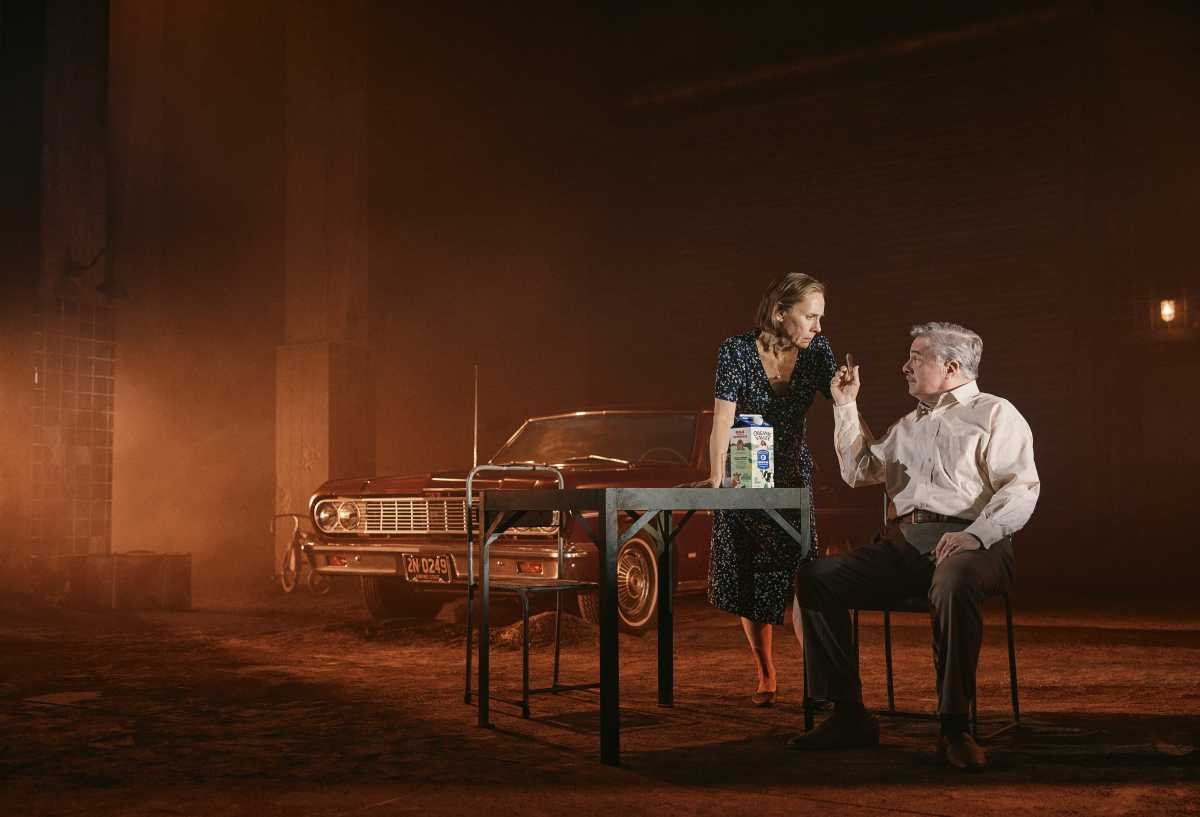

Laurie Metcalf and Nathan Lane.
Photo by Emilio Madrid
Another Broadway revival of “Death of a Salesman,” just a few years after a widely praised 2022 production, didn’t exactly feel necessary. Yet, this one—directed by Joe Mantello and starring Nathan Lane—lands with startling force, driven by a performance so alive and volatile that it makes the play feel newly dangerous.
Mantello’s concept invites skepticism. The Lomans no longer inhabit a modest Brooklyn home but a vast, vaguely industrial void—a warehouse, a garage, somewhere in between. A vintage 1960s Chevrolet sits onstage the entire time, an emblem of Willy’s life on the road and the mid-century promise of mobility and success. It makes for a striking opening image, as Willy rolls forward inside it. After that, it mostly just sits there, one of the few concrete objects in an otherwise stripped-down world.

That bareness turns out to be the point. Arthur Miller wrote the play as a kind of psychological landscape, with scenes overlapping and the past bleeding into the present. Mantello leans into that structure rather than imposing it. Time slips. Scenes collide. The play unfolds everywhere at once, just as it’s written. What first feels conceptual gradually feels inevitable. You stop asking where you are. You just follow Willy.
The production reinforces this dislocation with costumes that jump decades. Willy, in his business suit, looks frozen in time. Everyone else looks contemporary. Biff and Happy wear gym clothes, chains, and undershirts. Howard reads as a modern corporate type in a fleece vest, casually brushing Willy aside while clutching what might as well be a Starbucks cup. Willy doesn’t just seem outdated. He looks like a relic.
Mantello’s most effective device is doubling the sons and Bernard with younger actors who appear alongside their adult counterparts. The effect is fluid and haunting, as if memory has taken physical form. It recalls the musical “Follies,” with past and present colliding—and reinforces the sense that Willy is trapped inside his own recollections.
Mantello also keeps the action moving with unusual fluidity, the transitions arriving almost before you register them, which underscores how tightly Miller constructed the play’s shifting timelines. The language itself, shaped here with clarity and momentum, feels less like a period artifact than a living, breathing argument.
At the center is Lane, delivering one of the most electrifying performances of his career. He doesn’t play Willy as a quiet, worn-down man. He plays him as a live wire—sarcastic, pleading, combative, tender, often within a single line.
What’s most striking is the musicality of his voice. This isn’t a musical, and yet it often feels like one when he speaks. Lane shapes Miller’s language as if he’s singing it, or delivering a Shakespearean soliloquy—each phrase carefully pitched, rising and falling with rhythm and intention. He pivots in an instant from buoyant, almost giddy enthusiasm to naked self-pity, then back again, without strain. The shifts are seamless and mesmerizing.
Watching him, you can’t help but think of figures like Mamma Rose and King Lear—characters driven by grand illusions and undone by them. Lane channels that same mix of bravado, delusion, and unraveling into a portrait that is expansive, expressive, and deeply human. When the shifts come, they hit like lightning.

Laurie Metcalf matches him beat for beat. Her Linda is not passive or resigned but active, raw, and visibly straining to hold everything together. She doesn’t just endure Willy—she fights for him.
As Biff, Christopher Abbott keeps things contained until he suddenly doesn’t. His breakdown lands with unusual urgency. Ben Ahlers’ Happy is all restless energy and hollow bravado—sleazy, shameless, and aggressively immature.
Jonathan Cake gives Ben real stature, with a streak of coldness that makes Miller’s point unmistakable: the ones who succeed are often the least humane. Michael Benjamin Washington’s Bernard is composed and fully grown, almost gently amused as he looks back on the past. John Drea’s Howard is prissy, annoyed, and quietly cruel—his indifference cuts deeper than anger.
The production isn’t without quirks. The car, despite its symbolic weight, feels underused. The mash-up of time periods takes a moment to settle. But once it does, those questions fall away. What remains is the play—still devastating, still unsettling, and, right now, uncomfortably relevant.
Willy Loman is a man who has been outpaced, discarded by a system that no longer has use for him. In an era where entire professions feel one technological shift away from extinction, that idea doesn’t feel distant. It feels immediate—and a little too close to home.
