
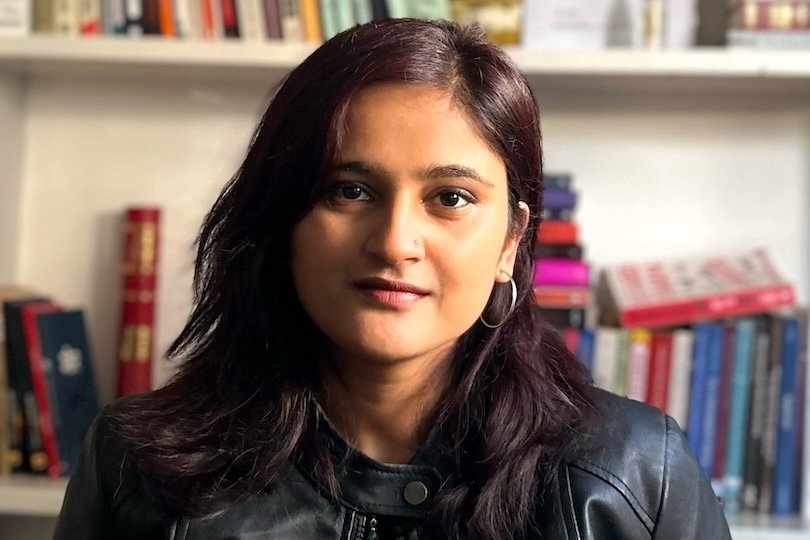
Niharika Pandit is Lecturer in Sociology in the School of Society and Environment, Queen Mary University of London. She co-runs Insurgent Knowledges, an anticolonial feminist political education collective, and co-convenes BISA’s Colonial, Postcolonial, Decolonial working group. She is the author of Occupying the Everyday: Militarisation and Gendered Politics of Living in Kashmir (Oxford University Press 2026).
Where do you see the most exciting research/debates happening in your field?
My research is located in political sociology, gender and feminist studies, post/decolonial theory, and critical international relations. It is driven by a central intellectual commitment: to reconceptualise power, violence, and resistance by foregrounding liberatory thought from the margins of the Global South. I am interested in analysing contemporary formations of coloniality and carcerality as social processes of everyday life while insisting that marginalised communities are active producers of critical theory. My first book draws on and contributes to Critical Kashmir Studies, which has radically shifted how Kashmir needs to be understood as a context of military occupation and settler colonial governance, and beyond the nation-states of India and Pakistan and their assimilatory or nationalist narratives that erase Kashmiri demands for self-determination. Within gender and feminist studies, there are ongoing debates, especially post-2023 genocide in Gaza, about feminist complicity in settler, imperial, and fascist projects and how liberatory queer feminisms must consider questions of coloniality – whether of gender (binary), postcolonial nation-states, or settler entities. I am interested in these debates and engage with critical lines of thinking across disciplines to understand the logic and circulation of contemporary coloniality and people’s ongoing resistance to it.
How has the way you understand the world changed over time, and what (or who) prompted the most significant shifts in your thinking?
My work is contemporary in nature, and I am interested in understanding how peoples at the margins of political formations understand oppressive power and organise in resistance to it. Within gender and feminist thought, I have been inspired by black, third-world, and queer thinkers who refuse to untether questions of imperialism, class struggle, and anticolonialism from gender and sexual freedoms. The feminism I think of is liberatory: it is insistently anticolonial, antiracist, anti-caste, trans-inclusive, and anti-capitalist. Over the years, I have been asking broader questions about social and anticolonial liberation and have placed them at the centre of gender and feminist studies because there can be no feminism without anticolonialism, and no anticolonialism without feminism. I am also inspired by abolitionist thinkers because they insist that we think creatively and imaginatively beyond the conditions of life that are present and considered possible today. Abolition contains a wide array of possibilities and hopes that push us to do away with the logics of carcerality, punishment, control, and reform (of oppressive structures and institutions) that abound in our personal and collective lives. I am keen to extend these conversations to wider political structures beyond prisons and think with marginalised political communities and spaces.
Your book Occupying the Everyday conceptualises militarisation in Kashmir as a “logic of coloniality.” How does this challenge dominant IR understandings of militarisation and the postcolonial state?
I began this project, which was my PhD, as an analytical mapping of India’s militarisation in Kashmir. But soon enough, I realised how dominant understandings of militarisation – including feminist ones in the Western academy – do not pay sufficient attention to coloniality and imperialism. Their overemphasis on the militarisation of everyday life without attending to its entanglements with structural power and violence (for instance, capitalism, nation-state, developmentalism) did not fully account for the brutal and abject violence conditioning our world today. As such, thinking with Kashmir made it imperative to centre how people living under occupation conceptualise their conditions of oppression and to use these conceptualisations to sharpen my analysis. Through ethnographic mapping and attention to my interlocutors’ experiences, I argue that militarization is a logic of coloniality in postcolonial states like India, especially as it unfolds in Kashmir, where military-led occupation, control over land and resources, control over movement, and control over everyday life are aimed at domesticating resistance in the service of the nation-state. This shift challenges the idea that militarisation is an exceptional mode of power or an aberrant force. Instead, logics of militarisation are built into modern/colonial formations like the state. This approach also shows how postcolonial states are replicating and reinventing colonial logics and violence against dissident communities, and, as such, what is really post about the postcolonial. In addition to the book, I have developed this argument in my article here.
Much of your work centres the “everyday politics of living” under occupation. What does focusing on the everyday allow us to see that more conventional analyses of conflict and resistance might miss?
Rather than being a sterile, unimportant, or passive site, feminist and Marxist thinkers have shown us how the everyday is where structural power takes hold, but this is also where violence can be mended. I draw on Ilana Feldman’s idea of politics of living through which she destabilises simplistic representations of people surviving dispossession, settler coloniality, or military occupation as either victims or resistors. I locate this politics of living in everyday Kashmiri life by mapping spatial militarisation, checkpoints, military camps, siege-like lockdowns, communication bans, and encounters with armed soldiers in markets, shops, shrines, and intimate spaces like the home. This frames the everyday as a site of myriad possibilities, complexities, and ongoing negotiations with asymmetrical power, demonstrating how occupation structures daily routines and how people navigate, refuse, and resist militarised state discourses and practices. Through the everyday politics of living, we can begin to see how the colonial project of occupation, while inflicting violent oppression, is not yet total but, rather, ongoing, where people constantly navigate militarised spaces and devise survival practices while remaining steadfast, even in silence, in their desire for self-determination.
In your research, gender, sexuality, and racialisation are central to how occupation is experienced and resisted. How do these lenses reshape our understanding of political agency in militarised contexts?
Given my location in anticolonial feminisms, it is imperative to locate gender, sexuality, and racialisation not as an afterthought but as organising both colonial domination and violence as well as resistance to it. As such, I think about social relations and resistance in insistently interlocking ways where class, gender, sexuality, racialisation shape how people experience occupation and are able to organise (or not) in defiance of it. I also analyse how the state uses discourses of gender and sexual freedoms to justify the occupation of Kashmir, whose majority Muslim people are racialised as homophobic, misogynist and suspect. If we do not pay attention to gender, sexuality, and racialisation as organising state power, we miss how this power infuses materially and in everyday life – through military practices of cordon and search, blowing up of civilian homes, spatial militarisation, and carceral practices of sexual violence, disappearance, mass killing, and blinding. Thinking of social relations in interlocking ways, we can sharpen our understanding of how power works – for example, coloniality and militarisation widen asymmetrical gender relations – and how scripts of resistance are grounded in specific social contexts. Such an analysis enables us to resist the exceptionalisation of Muslim communities as overtly patriarchal or homophobic while attending to how coloniality and other structural forces intensify existing social oppressions.
You have written about anti-gender politics and rising authoritarian or fascistic tendencies in India. How do you see the relationship between these developments?
This book chapter, co-authored with my dear friend Nolina Minj, offers the first sustained analysis of anti-gender and anti-feminist politics in contemporary India, arguing that we cannot separate the rise of anti-gender politics from the global rise of fascism. It makes an urgent contribution to transnational feminist scholarship by challenging Eurocentric genealogies of ‘anti-gender’ discourse and situating India as a key site through which contemporary anti-gender politics is produced and reconfigured through right-wing fascism. Through a detailed mapping of recent policy, legislative, and socio-political developments affecting gender, queer, and trans communities, alongside an analysis of the ideological formations of the Bharatiya Janata Party (BJP), the chapter demonstrates how anti-feminist politics are deeply embedded in Hindutva nationalism. It shows how these dynamics are operationalised through state surveillance, disciplining of dissent, and normalisation of violence against Muslims, Christians, Dalits, and those in the borderlands, including Kashmir, thereby linking gender governance to broader regimes of exclusionary citizenship and authoritarian statecraft. This has proven empirically prescient. For instance, in 2026, the Indian state passed the Transgender Persons (Protection of Rights) Amendment Act, limiting the definition of trans to social groups legible in the Hindu ways of being, insisting that gender policing is entangled with authoritarian state power.
What are you currently working on, and what can we expect from your future research?
I am currently working on a project that maps feminist imaginaries of anti‑militarism and anti‑capitalism. Through a series of workshops, I have been collaborating with artists and activists involved in South Asia and doing anti-militarism work – we are currently finalising a zine, which explores how militarism infiltrates everyday life and imagines futures beyond it. As part of this project, I am also thinking through the entanglements of militarism and contemporary fascism. My next monograph will focus on carceral sites in the Global South and how we can think beyond the contemporary and increasingly colonial and capitalist nation-state as an inevitability.
What is the most important advice you could give to young scholars of International Relations?
We are at a conjuncture of heightened violence in all forms. I don’t think we can continue to produce knowledge that is untethered from the communities we work with, are accountable to, and the wider social and political struggles. The stakes of cultivating knowledge are high, so it is really important for young scholars to think about what we are creating knowledge for; who is represented or unrepresented; who we think with; who we are aligned with – whether with power or with oppressed communities; and what our collective responsibility as scholars is. These questions, I strongly believe, must guide our intellectual commitments regardless of what stage of the journey we are at. And of course, be curious, attentive, and imaginative!
Further Reading on E-International Relations
