
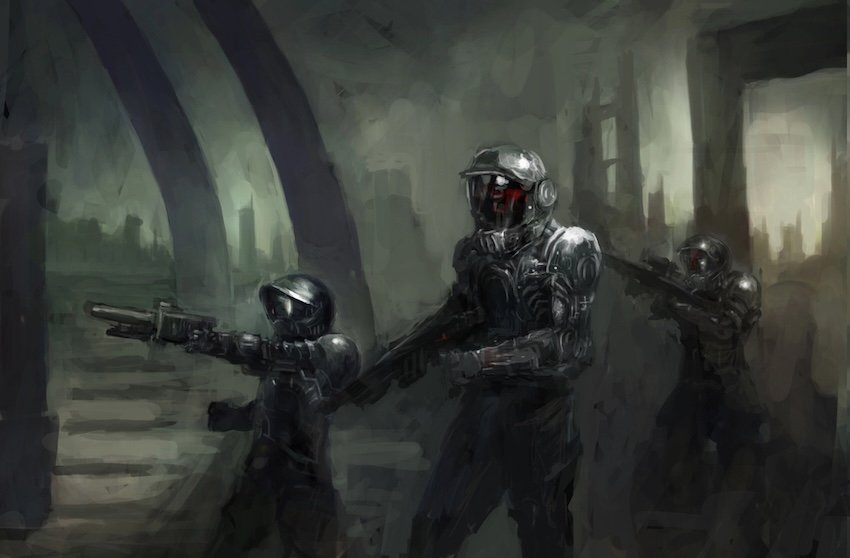
Imagining futures of war and peace has always been a core concern for the discipline of International Relations (IR). Over the last decade several IR scholars have been inspired by conceptual insights from the field of Science and Technology Studies (STS) to examine how these visions are being shaped by the accelerating pace of technological change in fields including Artificial Intelligence (AI), human-enhancement, quantum computing, robotics, directed-energy weapons, hypersonics, space technology, additive manufacturing and ‘clean’ energy. Of particular interest has been the concept of sociotechnical imaginaries which, as first developed by scholars including Sheila Jasanoff and Sang-Hyun Kim,describes how collectively held understandings of (un)desirable futures associated with science and technology are formed, overcome resistance, and gain institutional support to shape policy decisions (Jasanoff & Kim, 2009; Jasanoff, 2015a).
One area of sociotechnical imaginaries research that has remained largely overlooked by IR scholars concerns the contribution science fiction stories make to shaping how audiences understand new technological developments and their impact in the world. We recently started to address this important gap in IR scholarship by co-editing collection of short interventions in the journal Critical Studies on Security (McCarthy, 2026b; Ruppert, 2026; Watts, 2026b; Watts & Depledge, 2026; Zhang, 2026). We were inspired to do so by conversations with policymakers who had directly referenced works of science fiction when discussing their expectations of future war(fare)
We are aware that we are not the first group of IR and Critical Security Studies (CSS) interested in science fiction (Carpenter, 2016; Daniel & Musgrave, 2017; Kiersey & Neumann, 2015; Weldes, 2003). This genre has also received considerable attention within the wider social sciences with some accounts also drawing from the concept of sociotechnical imaginaries (Alonso, 2026; Belsunces, 2025; Tutton, 2021). What made our exchange original was our focus on studying how the stories presented in science fiction may contribute toward (de)stabilising sociotechnical imaginaries of future war. By examining this issue from a range of empirical perspectives, we highlight the continued importance of science fiction as a repository of popular thinking about war at a time of rapid geopolitical, technological, and environmental change. Extending the insights developed in recent studies (Depledge, Santos and Hobson, 2025; Watts, 2026a), we also show the many contributions which the concept of sociotechnical imaginaries can make to the study of future war.
Building on the themes explored in this exchange, this article has four aims. We begin by outlining what distinguishes science fiction from other forms of imaginative storytelling before introducing some of the vast literature on this genre. The second section introduces the concept of sociotechnical imaginaries and outlines how this concept can contribute toward IR scholarship by providing an analytical framework for studying science fiction as a repository of background understandings which various audiences can draw from to imagine the future conduct of war. The final two sections of this article summarise how our collection of interventions contributes to the literature on sociotechnical imaginaries and future war and identify several areas for future research.
Science Fiction and Future War
Works of science fiction are designed to both challenge and entertain their audiences. Whilst the question of how to define this vast genre of imaginative storytelling remains unsettled (Roberts, 2006: 1-36; Weldes, 2003: 8), all works of science fiction involve the depiction of alternative social realities which differ from our lived experiences based on a substantial difference in science and technology. This is underpinned by the process of cognitive estrangement involving a clear break from an audience’s everyday reality (e.g. an “estrangement”), which is caused by a loosely plausible scientific discovery or technology (e.g. “cognition”) (Suvin, 1972). Understood in these terms, science fiction can be distinguished from other forms of imaginative storytelling such as fairytales through the use of a “novum” as a plot device which fundamentally reorganises the universe in which the story is told (Suvin, 1972).
The motifs presented in science fiction have been subject to longstanding debate (Sontag, 1965). Within IR scholarship, the genre has been studied as providing a window into “imagined futures” whose narrative content can tell us a great deal about contemporary concerns and anxieties (Weldes, 2003: 1). The stories told in works of science fiction can provide audiences “synthetic experiences” of imagined worlds that can shape their interpretations and expectations of real-world politics (Daniel & Musgrave, 2017). Science fiction has also been studied as a social resource that different actors can use to shape wider political norms and ideas. Charli Carpenter (2016), for instance, has used the methods of elite interviewing and participant-observation to trace how science fiction references have impacted the global governance debates on autonomous weapon systems, arguing that references to works of science fiction have helped shape the social context in which these technologies are discussed.
The capacity of science fiction to influence collectively held visions of what war is, and how it will be fought in the future, has been widely recognised. Some defence analysts argue that reading science fiction “can nurture the imaginative mindset in the military and national security professional” (Ryan & Finney, 2021). Works in this genre are promoted as helping “inspire divergent thinking about advanced technologies and how to apply them in concert with new ideas and new organizations” (Ryan & Finney, 2021). Consistent with these understandings, science fiction writers have been recently hired by military establishments to help anticipate future technological, geopolitical, and environmental trends (Paccalin, 2023; Pomerleau, 2017).
Reflecting these real-world developments, the use of science fiction as a tool of strategic foresight (Roussie, Adam-Ledunois & Damart, 2024) has received scholarly attention. What has been subject to less debate in IR scholarship, however, has been how works of science fiction that are not expressly written for the purpose of directly informing policymaking, but which nonetheless circulate through everyday culture, may also perform important political work. This matters because, as with other forms of popular culture, engagement with works of science fiction can be a “key way that society builds trust and sets rules for technology” (Alonso, 2026: 1). This gap, we argue, can be productively addressed through the concept of sociotechnical imaginaries.
Sociotechnical Imaginaries and Future War
The term ‘sociotechnical imaginaries’ describes “collectively held, institutionally stabilized, and publicly performed visions of desirable futures, animated by shared understandings of forms of social life and social order attainable through, and supportive of, advances in science and technology” (Jasanoff, 2015a: 4). A key feature of sociotechnical imaginaries is that they provide a normative set of “background understandings” that help their audiences understand what does and does not constitute legitimate forms of technology and scientific knowledge (McCarthy, 2026a: 4). These background understandings can help legitimise specific visions of what role science and technology should play in war.
During the past decade, the concept of sociotechnical imaginaries has been increasingly used by IR scholars (Biegon, Ølgaard & Watts, 2026; Csernatoni, 2022; Depledge, Santos and Hobson, 2025; Mawdsley & Martins, 2025; McCarthy, 2026a; Watts, 2026a). Largely absent from the growing IR and CSS literatures on sociotechnical imaginaries, however, has been a detailed consideration of how the various social resources contained within works of science fiction can be mobilised by actors struggling over what expectations and visions of the future to take seriously. This is a surprising oversight because Sheila Jasanoff (2015a), one of the two original architects of the sociotechnical imaginaries’ framework, has highlighted the relevance of science fiction to the study of sociotechnical imaginaries. According to Jasanoff (2015a: 4), Mary Shelley’s Frankenstein and George Orwell’s Nineteen Eighty-Four, amongst other texts, are “fabulations of social worlds, both utopic and dystopic” that offer a window into the social anxieties of the times in which they were written (Jasanoff, 2015a: 1). More recently, scholars from across the social sciences have drawn from the concept of sociotechnical imaginaries to examine the relationship between science fiction stories and a range of subjects including the visions of human space travel promoted by Silicon Valley entrepreneurs (Tutton, 2021) and public expectations of what constitutes appropriate AI governance (Alonso, 2026).
Despite these contributions, much of the existing defense and security orientated scholarship on sociotechnical imaginaries published by IR has been largely inattentive to the productive power of science fiction (for an exception to this trend, see Watts & Bode, 2024). For the most part, this literature has drawn from the detailed empirical study of official governmental publications and statements. These studies make an invaluable contribution to our understanding of the (un)desirable visions of technological futures held by policymakers. Nonetheless, they are generally inattentive to how works of science fiction may shape the many background understandings that other audiences draw from to evaluate what constitutes legitimate visions of future war. The current lack of attention given to works of science fiction is analytically significant because, as Rudek (2022: 228) argues, “[s]earching for imaginaries of progress and future only in state documents, media coverage, or expert knowledge and at the same time avoiding pop culture products limit the range of answers about the circulation of sociotechnical imaginaries in the public sphere as well as their origins”.
Contributions Made by Our Exchange
Our collection of recently published interventions aims to broaden the range of empirical artefacts studied within the IR scholarship on sociotechnical imaginaries to include a greater focus on various works of science fiction including the Ironman (Ruppert, 2026), Matrix (McCarthy, 2026b), Terminator (Watts, 2026b) and The Three-Body Problem (Zhang, 2026) franchises. It also contributes to IR scholarship on sociotechnical imaginaries by bringing these debates into greater dialogue with Michel Foucault’s concept of the “archive” (Ruppert, 2026), the social science literature on monsters (Watts, 2026b), and utopian social theory (McCarthy, 2026b).
To summarise some of the contributions made by the interventions in our collection, Ruppert’s (2026) text explores how some NATO members reference the Iron Man franchise to legitimise their preferred forms of human enhancement while distancing themselves from the “killer robot” imaginaries popularised in The Terminator. Sharing a focus on The Terminator franchise, Watts’ (2026b) intervention challenges the popular misperception that responsibility for Judgment Day in these films lies solely with the malign superintelligence Skynet rather than with the human policymakers who designed, activated, and subsequently abandoned this system. Zhang’s (2026) account examines The Three-Body Problem and The Wandering Earth I and II franchises to highlight some of the similarities between American and Chinese sociotechnical imaginaries of future war. Concluding our collection, McCarthy’s (2026b) piece makes a wider methodological contribution to the study of sociotechnical imaginaries. It demonstrates how Frederic Jameson’s four-fold methodology of literal, allegorical, moral, and analogical textual interpretations can help researchers situate representations of future war within the wider sense-making processes which audiences rely on to make sense of their social reality.
When taken as a whole, our collection makes three wider sets of contributions to IR and CSS scholarship. First, building on the earlier IR literature on this genre (Carpenter, 2016; Daniel & Musgrave, 2017; Kiersey & Neumann, 2015; Weldes, 2003), we demonstrate the continued relevance of science fiction as a subject of serious object of academic inquiry. Second, through our study of science fiction as a distinct genre that “carries with it its own memory” (Kiersey & Neumann, 2015), this collection helps situate the recent wave of imaginative thinking about future war within its wider historical context. At a time when many long-held assumptions about war are being challenged by geopolitical and technological trends, we highlight how the study of science fiction provides a set of resources for studying how visions of military futures are shaped by the concerns and anxieties of the present. And third, through our shared use of the sociotechnical imaginaries’ framework, this collection provides an alternative, conceptually informed account of how science fiction helps audiences “experience the future long before we reach it” (Coker, 2015: 21). In this respect, our collection addresses the recognized need for new approaches to studying future war at a time of rapid technological and geopolitical change (Gruszczak & Kaempf, 2024; Lacy, 2023).
Conclusion: New Avenues for Critical Security Studies Research?
As outlined in this article, our collection of recently published interventions in the journal Critical Studies on Security has examined the processes through which visions of future war emerge, spread, overcome resistance, and can become “institutionally stabilised” (Jasanoff 2015a, 4). Through these contributions, our exchange highlights how the visions of future war depicted in science fiction can inform how various audiences anticipate the future. In addition to those we have discussed elsewhere (Watts & Depledge, 2026), our exchange points to three areas of future research for IR and CSS researchers interested in contributing toward the debates on sociotechnical imaginaries, future war, and science fiction.
First, future scholarship could look beyond the films and television shows examined in this collection to explore how future war is depicted in the many other types of science fiction that were not examined by the contributors to our exchange. Amongst others, these could include works of anime, novels, comics, video games, board games, and tabletop games. Examining how and to what extent stories told about future war vary across these media provides a framework for examining whether the medium through which audiences interact with visions of future war can influence the (de)stabilization of sociotechnical imaginaries. It also invites more detailed study of whether audiences have developed distinct expectations about what are considered appropriate depictions of future war in these mediums and how these have possibly evolved over time.
Second, the findings of our collection of interventions highlight the need for more detailed research into the processes through which audiences reconcile the many (and often competing) stories told about future war within the same science fiction franchise (Watts, 2026b). This apparent puzzle invites further refinement of the methods used to study the social processes through which sociotechnical imaginaries of future war come to be (de)stabilised. For instance, future studies could make use of semi-structured interviews with policy officials to develop a more granular understanding of how policymakers have interpreted the meaning of certain science fiction stories and how these understandings may have, in turn, shaped specific defence initiatives. Building on the use of focus groups within the popular culture and IR literature (Pears, 2016), future studies could similarly employ focus groups with members of the public to develop a more sophisticated understanding of how and when depictions of future war in science fiction come to be “collectively held” (Jasanoff, 2015a: 4).
And third, future research could adopt a self-consciously “critical” approach to the study of sociotechnical imaginaries to better understand which individuals, groups, or organisations benefit when science fiction is used to stabilise or destabilise visions of future war. As others have also argued (Taşkale, 2026), public references to science fiction are not politically neutral acts. Speaking in January 2026 for instance, Elon Musk described the ambition of his SpaceX company as wanting to make the “Starfleet Academy” featured in the Star Trek franchise “[r]eal, so that it’s not always science fiction, but one day the science fiction turns to science fact” (Musk quoted in Taşkale, 2026). Referencing science fiction in this way serves a clear instrumentalist purpose: building support for Elon Musk’s optimistic vision of space travel (Tutton, 2021) and continued orders for his company (Taşkale, 2026). As the influence of Big Tech companies like SpaceX on defence planning continues to increase, developing a more conceptually sophisticated understanding of the various forms of power associated with public figures reference science fiction becomes even more timely. This is because struggles over which sociotechnical imaginaries are taken seriously shape not only visions of desirable futures, but also the allocation of resources needed to make those futures possible.
Ultimately, the study of future war can play a major role in “[…] preventing armed conflict and to ensuring that nations and their militaries are prepared to respond to threats and resolve crises at the lowest possible cost in blood and treasure” (McMaster in Coker, 2015: vii). Both the concept of sociotechnical imaginaries and the genre of science fiction can support these efforts. When brought into greater dialogue, they provide IR scholars with new resources for studying the processes through which audiences learn about, make sense of, and sometimes challenge visions of future war. At a time of rapid technological, geopolitical, and environmental change, we hope science fiction continues to receive detailed empirical and conceptual attention.
Bibliography
Belsunces, A. 2025. “Sociotechnical Fictions: The Performative Agencies of Fiction in Technological Development.” Science & Technology Studies, 1-21 [Online First].
Biegon, Rubrick, Daniel Møller Ølgaard, and Tom F. A. Watts. 2026. “Interrogating the Imaginary Turn: Technology, War, and World Politics in an Era of Great Power Competition.” Contemporary Security Policy 47 (2): 241–272.
Carpenter, C. 2016. “Rethinking the Political/-Science-/Fiction Nexus: Global Policy Making and the Campaign to Stop Killer Robots.” Perspectives on Politics 14 (1): 53–69.
Coker, C. 2015. Future War. New York: John Wiley & Sons.
Csernatoni, R. 2022. “The EU’s Hegemonic Imaginaries: From European Strategic Autonomy in Defence to Technological Sovereignty.” European Security 31 (3): 395–414.
Daniel III, J. F., and P. Musgrave. 2017. “Synthetic Experiences: How Popular Culture Matters for Images of International Relations.” International Studies Quarterly 61 (3): 503–516.
Depledge, Duncan, Tamiris Santos, and Tom Hobson. “The UK Ministry of Defence,“Low-Carbon Warfare,” and the struggle to construct novel sociotechnical imaginaries of future war.” Contemporary Security Policy 47, no. 1 (2026): 139-165.
Gruszczak, A., and S. Kaempf, eds. 2024. The Routledge Handbook of the Future of Warfare. New York: Routledge.
Jasanoff, Sheila, and Sang-Hyun Kim. “Containing the atom: Sociotechnical imaginaries and nuclear power in the United States and South Korea.” Minerva 47, no. 2 (2009): 119-146.
Jasanoff, Sheila. 2015a. “Future Imperfect: Science, Technology, and the Imaginations of Modernity.” In Dreamscapes of Modernity: Sociotechnical Imaginaries and the Fabrication of Power, edited by Sheila Jasanoff and Sang-Hyun Kim, 1–33. Chicago: University of Chicago Press.
Jasanoff, Sheila. 2015b. “Imagined and Invented Worlds.” In Dreamscapes of Modernity: Sociotechnical Imaginaries and the Fabrication of Power, edited by Sheila Jasanoff and Sang-Hyun Kim, 321–341. Chicago: University of Chicago Press.
Kiersey, N. J., and I. B. Neumann. 2015. “Worlds of Our Making in Science Fiction and International Relations.” In Popular Culture and World Politics: Theories, Methods, Pedagogies, 74–82.
Lacy, M. 2023. “Predicting the Future of War in the 21st Century: A Future War Studies?” In The Routledge Handbook of the Future of Warfare, edited by A. Gruszczak and S. Kaempf, 21–30. New York: Routledge.
Mawdsley, J., and B. O. Martins. 2025. “War Economy vs European Silicon Valley? The EU’s Competing Sociotechnical Imaginaries of Defence Innovation and Industry.” Contemporary Security Policy 47 (2): 299–323.
McCarthy, D. R. 2026a. “A ‘Journey to Trust’ for AI: Civil–Military Relations and Epistemic Authority in American Socio-Technical Imaginaries of Artificial Intelligence.” Contemporary Security Policy 47 (2): 273–298.
McCarthy, Daniel R. 2026b. “Utopia, Dystopia and Method: Science Fiction Imaginaries of War and Political Order.” Critical Studies on Security, 1–7 [Online First].
Paccalin, 2023. “Why Macron Is Reading Sci-Fi Thrillers to Prepare for the Wars of the Future.” France 24. https://www.france24.com/en/france/20230606-why-macron-is-reading-sci-fi-thrillers-to-prepare-for-the-wars-of-the-future
Pears, L. 2016. “Ask the Audience: Television, Security and Homeland.” Critical Studies on Terrorism 9 (1): 76–96.
Pomerleau, M. 2017. “Marines Study Sci-Fi to Plan for Future Battlefield Needs.” C4ISRNET. https://www.c4isrnet.com/it-networks/2017/01/11/marines-study-sci-fi-to-plan-for-future-battlefield-needs/
Roberts, A. 2006. Science Fiction. New York: Routledge.
Roussie, M., S. Adam-Ledunois, and S. Damart. 2024. “What Is Foresight-Designed Science Fictions Made Of?” Technovation 138: 103111.
Rudek, T. J. 2022. “Capturing the Invisible. Sociotechnical Imaginaries of Energy: The Critical Overview.” Science and Public Policy 49 (2): 219–245.
Ruppert, L. 2026. “Imagining the Enhanced Soldier: Science Fiction and the Future of the Human Body in War.” Critical Studies on Security, 1–7 [Online First].
Ryan, M., and N. K. Finney. 2021. “Science Fiction and the Strategist 3.0.” The Strategy Bridge. https://thestrategybridge.org/the-bridge/2021/10/20/science-fiction-and-the-strategist-30.
Sontag, S. 1965. “The Imagination of Disaster.” Commentary 40 (4): 42-48.
Suvin, D. 1972. “On the Poetics of the Science Fiction Genre.” College English 34 (3): 372–382.
Taskale, Ali Riza. “Billionaires in Borrowed Costumes: How Silicon Valley Loots Science Fiction to Justify Its Power Grab.” Untold Magazine. https://untoldmag.org/silicon-valley-science-fiction-power/?
Tutton, R. 2021. “Sociotechnical Imaginaries and Techno-Optimism: Examining Outer Space Utopias of Silicon Valley.” Science as Culture 30 (3): 416–439.
Valdivia Alonso, D. 2026. “Imagining AI Futures in Mainstream Cinema: Socio-Technical Narratives and Social Imaginaries.” AI & Society: 1–11 [Online First].
Watts, Tom F. A. 2026a. “The Offset Imaginary: Great Power Competition, Security Imaginaries, and the Making of Artificial Intelligence in American Defense Planning.” Contemporary Security Policy 47 (2): 384–414.
Watts, T. F. A. 2026b. “Monsters of Our Own Making? Skynet, Sociotechnical Imaginaries, and Nuclear Risk in Today’s Era of Great Power Competition.” Critical Studies on Security [Online First].
Watts, T.F.A., and I. Bode. 2024. “Machine Guardians: The Terminator, AI Narratives and US Regulatory Discourse on Lethal Autonomous Weapons Systems.” Cooperation and Conflict 59 (1): 107–128.
Weldes, J. 2003. Popular Culture, Science Fiction, and World Politics: Exploring Intertextual Relations. In To Seek Out New Worlds: Science Fiction and World Politics, edited by J. Weldes, 1–27. New York: Palgrave Macmillan.
Zhang, Q. 2026. “Sociotechnical Imaginaries of Future War in Chinese Science Fiction.” Critical Studies on Security, 1–6 [Online First].
Notes
Disclosure statement: Dr Watts’ contribution to this work was supported by a Leverhulme Trust Early Career Research Fellowship (ECF-2022-135). His contribution to this work was also supported by the European Union’s Horizon 2020 research and innovation programme under grant agreement No. 852123 (AutoNorms).
Further Reading on E-International Relations
