
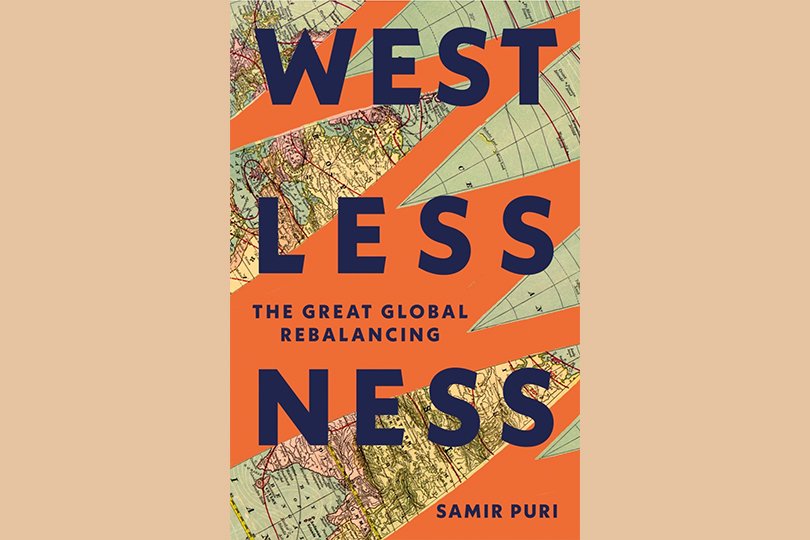
Westlessness: The Great Global Rebalancing
By Samir Puri
Hodder & Stoughton, 2024
Samir Puri’s Westlessness engages with a key debate in international relations: whether the weakening of Western dominance indicates systemic decline, hegemonic transition, or structural normalization. The central question is diagnostic: how and why is Western centrality becoming diluted across multiple domains of global order? Puri’s use of “westlessness” is not purely idiosyncratic; it explicitly echoes the term’s policy lineage. The concept gained prominence at the Munich Security Conference (2020, p. 6), which framed the idea that “the world is becoming less Western” and that “the West itself may become less Western, too.” Puri’s contribution is to translate that agenda-setting diagnosis into a longer historical account of “westfullness”, a period in which Western power saturated the institutions and norms of globalization, and then to track how that saturation is thinning. The book positions itself less as a prediction of Western collapse and more as an attempt to name a structural condition: Western authority persists, but alternative centers of legitimacy and rule-making increasingly contest it.
The book unfolds through a conceptual introduction followed by four thematic parts, each designed to illuminate a different mechanism through which Western centrality becomes increasingly contested. ‘Westfull World’, reconstructs the historical foundations of Western predominance. Puri traces how geographic advantages, maritime expansion, colonial extraction, and industrialization collectively enabled European powers and later the United States to shape the architecture of globalization. He emphasizes that this concentration of influence was “far from inevitable”, thereby challenging narratives that portray Western leadership as a natural endpoint of political development (Puri, 2024, p. 37).
In ‘People’, Puri treats demographic redistribution as a slow but decisive driver of geopolitical change. He draws on UN population projections to show that “whereas in 1950, almost 30% of humanity lived in Europe, North America and Australasia, this is projected to drop to just 12% by 2050” (p.122). His point is not that population size translates directly into power, but that the long-term arithmetic of human capital, labor markets, and consumer demand is gradually pulling economic gravity away from the transatlantic core.
The ‘Power’ section tracks how material and strategic capabilities are diversifying beyond the traditional Western core. Puri pays particular attention to middle powers such as Turkey, India, and the Gulf states, which increasingly pursue hedging strategies and transactional partnerships rather than aligning with Western security frameworks. He cites projections that the E7 (China, India, Brazil, Russia, Indonesia, Mexico, and Turkey), the largest emerging economies, “are expected to overtake the G7 in economic size during the 2030s” (p. 206).
Finally, Planet extends the analysis to climate governance and resource competition, arguably the section in which “westlessness” poses the sharpest practical dilemmas. Puri argues that Western-led frameworks like the Paris Agreement require buy-in from states whose interests often run counter to them. He is blunt that “the climate debate will have to change from an adult-to-child tone towards a more adult-to-adult tone if the Western countries want to have credibility in engaging with the Global South countries” (Puri, 2024, p. 309). In other words, westlessness is not simply multipolarity; it is multipolarity combined with weakened presumptions of Western rule-setting.
The institutional resilience argument holds that cooperation can outlast hegemonic dominance because rules and expectations become embedded and self-reinforcing. However, more recent work stresses that the liberal international order is experiencing not merely power diffusion but deeper legitimacy contestation. For example, David A. Lake (2026) argues that the order is now “deeply contested,” emphasizing challenges to the authority of rules themselves. Puri’s formulation of contested Western influence fits squarely within this emerging literature. The picture that emerges is not one of coordinated resistance to Western leadership but of fragmented, interest-driven calculation, states making case-by-case judgments about where alignment serves them and where it does not. This is a more textured and persuasive account than the familiar “rise of the rest” narrative because it avoids treating the Global South as a coherent bloc and instead foregrounds the messiness of a system in which no single center of gravity commands reliable followership.
One of the book’s most significant scholarly contributions lies in its implicit challenge to Eurocentric security frameworks. Rather than treating Asia, Africa, and the Middle East primarily as passive arenas of great-power rivalry, Puri consistently portrays actors across these regions as strategic agents operating within an increasingly fluid international environment. Living and working outside the West, Puri reports hearing perspectives ranging from ‘abject fear that the West might retreat’ to ‘all-out ranting in which the West can do no right’ (Puri, 2024, p. 89). This deliberate engagement with non-Western viewpoints aligns closely with contemporary debates on postcolonial security and strategic autonomy. The empirical chapters substantiate this repositioning. Puri’s discussion of the China-US rivalry illustrates how contemporary bipolar tensions unfold within a structurally plural landscape rather than a tightly ordered hierarchy. Similarly, the examination of global football politics surrounding Russia 2018 and Qatar 2022 (Puri, 2024, p. 29) demonstrates how symbolic authority, legitimacy, and soft power are increasingly contested in arenas no longer monopolized by Western hosts or narratives.
For Global South actors, Puri stops short of suggesting that rebalancing produces a fundamentally more equitable international order. Instead, he depicts an emerging system that remains structurally uneven even as Western dominance becomes more contested. As he acknowledges, “nothing is guaranteed in the forward passage of emerging economies,” even as the broad trajectory points toward economic decentralization (Puri, 2024, p. 213). This analytical restraint ultimately strengthens the book’s credibility. By avoiding both declinist pessimism and multipolar romanticism, Westlessness offers a nuanced framework that speaks directly to current debates on structural inequality, the transformation of global governance, and the evolving strategic agency of the Global South.
The book is most useful for shifting the conversation from whether Western-built institutions will survive to what political bargains they will need to strike. Keohane’s work on institutional resilience assumed a world in which participants broadly internalized the leading state’s preferences; Puri’s contribution is to ask what happens when that internalization breaks down, but the institutions remain standing. However, two concerns remain.
First, the diagnosis of rebalancing is persuasive, but the book provides limited guidance on what durable security cooperation might look like under conditions of persistent contestation. If Western leadership is thinning but institutional frameworks remain formally intact, the mechanisms sustaining collective action require fuller theoretical development. This gap is particularly notable given Keohane’s emphasis on institutional adaptation during hegemonic decline. The answer, which the book gestures toward without fully developing, is that institutions become sites of negotiation over terms rather than mechanisms for implementing a settled consensus, a condition that demands analytical tools different from those offered by either hegemonic stability theory or straightforward liberal institutionalism.
Second, the concept of “the West” can at times lack clear analytical boundaries. At different points, it appears geographic, institutional, and civilizational, creating a degree of conceptual elasticity that weakens the measurement of “westlessness” across cases. If “westlessness” is now a durable condition, the hard question is not whether diffusion is occurring, but what institutional designs can sustain cooperation when legitimacy is pluralized and ‘the West’ itself is internally contested. Because the argument ultimately hinges on the West’s relative position within the global order, greater definitional precision would strengthen the framework’s explanatory clarity and enhance its utility for comparative security analysis.
Westlessness makes a serious intervention in how we think about the Global South’s place in international security. Puri grounds his analysis in historical contingency, treats non-Western actors as agents rather than objects, and insists that order is contested rather than collapsing. The book would be sharper with greater definitional precision around “the West” and more on what cooperation looks like when legitimacy is no longer concentrated in Western hands. Nevertheless, “westlessness” as a concept does genuine analytical work; it forces a move past triumphalism and declinism toward a harder question: how do states cooperate when power is diffusing but inequality is not?
References
Ikenberry, G. J. (2018). The end of liberal international order? International Affairs, 94(1), 7–23. https://doi.org/10.1093/ia/iix241
Kennedy, P. (1987). The rise and fall of the great powers: Economic change and military conflict from 1500 to 2000. Introduction. Random House. https://cheirif.wordpress.com/wp-content/uploads/2015/08/paul-kennedy-the-rise-and-fallofthe-great-powers-19891.pdf
Keohane, R. O. (2012). Hegemony and after: Knowns and unknowns in the debate over decline. Foreign Affairs, 91(4), 114–118. https://www.jstor.org/stable/23218044?seq=1
Lake, D. A. (2026). The end of the liberal international order? Globalization, deep contestation, and the future. Chinese Journal of International Politics, 19(1), 10–24. https://doi.org/10.1093/cjip/poaf016
Morey, M. (2025). Review of Westlessness: The great global rebalancing, by Samir Puri. International Affairs, 101(1), 344–346. https://academic.oup.com/ia/article-abstract/101/1/344/7942173
Munich Security Conference. (2020). Munich Security Report 2020: Westlessness (PDF). https://securityconference.org/assets/user_upload/MunichSecurityReport2020.pdf
Puri, S. (2024). Westlessness: The great global rebalancing [Kindle edition]. Hodder & Stoughton. https://www.hodder.co.uk/titles/samir-puri/westlessness/9781399714091/
Rodriguez, J. L. & Thornton, C. (2022). The liberal international order and the global south: A view from Latin America. Cambridge Review of International Affairs, 35(5), 626–638. https://www.tandfonline.com/doi/full/10.1080/09557571.2022.2107326
Further Reading on E-International Relations
