
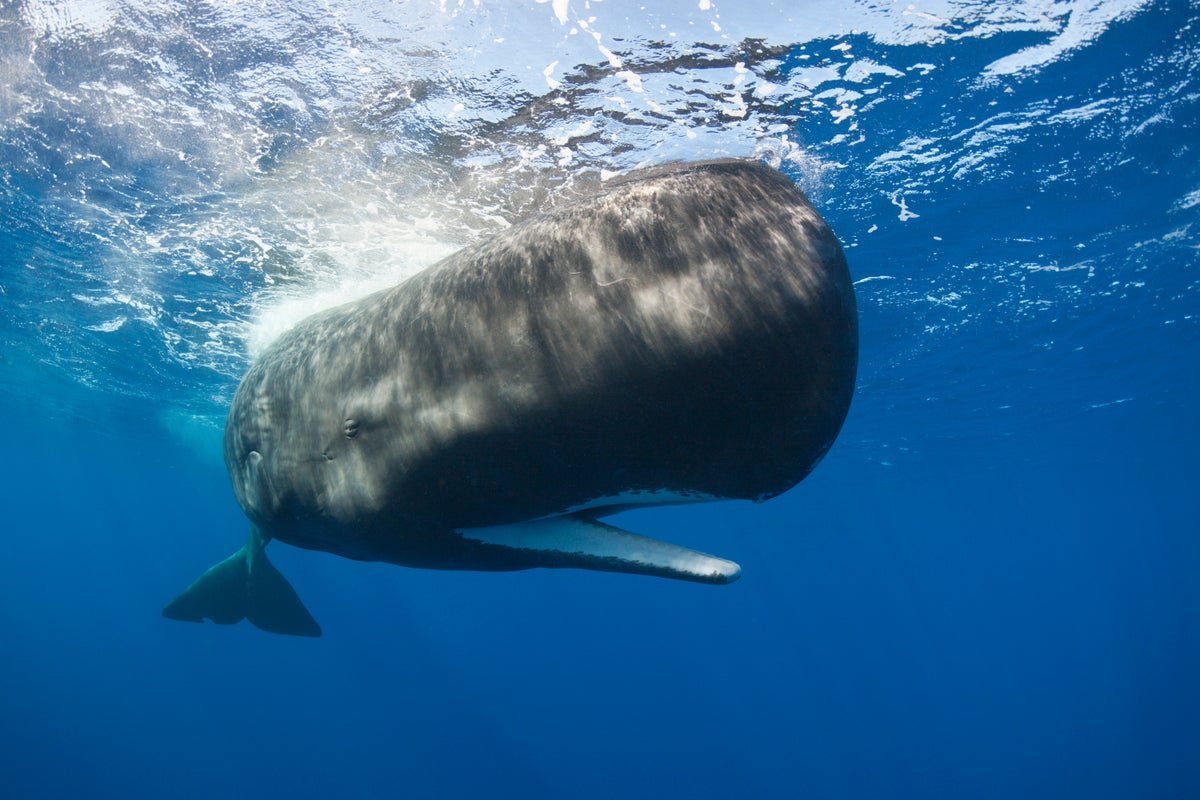

Sperm whales may make their own vowel sounds, similar to human language
Sperm whales, which make clicking sounds to communicate, use different “vowels” in ways similar to human speech
Reinhard Dirscherl/Getty Images
Sperm whales’ click-based communication system has patterns that echo how human languages use vowels, according to a new study published today in Proceedings of the Royal Society B: Biological Sciences.
“On the surface, [these vocalizations] sound like this alien, ocean intelligence that has nothing to do with us,” says lead author Gašper Beguš, a linguist at the University of California, Berkeley, who works with Project CETI, a nonprofit that is dedicated to studying sperm whale communication. “But when you actually look at it closely, you realize, ‘Oh, we’re way more similar.’”
Sperm whales flap “phonic lips” (a structure akin to human vocal cords) in their nose to create clicking sounds. They combine these clicks into rhythmic series called codas, which can vary from whale clan to whale clan. In the past, scientists trying to make sense of their communication have tended to focus on the rhythm of these patterns, almost as if deciphering morse code.
On supporting science journalism
If you’re enjoying this article, consider supporting our award-winning journalism by subscribing. By purchasing a subscription you are helping to ensure the future of impactful stories about the discoveries and ideas shaping our world today.
But last year researchers at Project CETI discovered a whole new dimension of sperm whale communication. These clicks come in two different types based on the relationship between the different frequencies present in the sound—a feature that is technically known as a “formant.” In human languages, formants determine each vowel’s distinct sound.
In the following recording of a whale named Pinchy, both whale “vowel” types are present.
The vowel-like differences in sperm whale clicks are hard to hear with the human ear unless they are sped up.
Here are the two types of sounds alternating in real time. Can you notice the difference?
This subtle difference between the two “vowels” shows up clearly on spectrograms—graphs of the frequencies present within a sound. These graphs can be used to distinguish between vowel sounds in recordings of human speech, too. For a given sound, the graphs show which bands of frequencies are resonating within the vocal tract. We humans can change this resonance to make a different vowel sound by changing the shape of our mouth and throat; whales appear to do the same thing by changing the shape of a structure inside their nose called the distal air sac.
Project CETI scientists (somewhat arbitrarily) called the newly identified sperm whale vowel types the “a-coda” and “i-coda.” But it remained a mystery how the whales use these different vowel types to communicate. If both types were just peppered at random throughout the whales’ communication, that might suggest that the sound changes weren’t intentional. But that doesn’t seem to be the case: there appear to be extensive patterns in how these vowel types are used, the new study found.
One rhythmic pattern with timing that the new paper described as “click … click … click-click-click” employed an even split of a– and i-codas, while other patterns used mainly a-codas and rarely i-codas. The a-codas tended to be shorter than the i-codas overall, while the latter had both short and long forms. Such patterns show up in human languages when we pair different speech sounds, too. For example, languages such as Arabic distinguish between vowels based on their length; changing the length of a vowel can alter the meaning of the word.
The new results suggest that the whales are actively controlling which type of click to use according to a system. But why they employ different clicks in specific patterns remains a mystery. “We don’t know for certain whether they carry meaning,” says Beguš, adding that this ability likely has evolved for some purpose, even if we don’t yet know what that is.
In principle, distinguishing between different vowel-like sounds could give whales more ways to carry meaning in their communication, says Mason Youngblood, who studies songbird and whale communication at Stony Brook University and was not involved in the new study.
“These sounds are able to convey more information than we previously thought. And I think that, in and of itself, is undeniable,” he says.
It’s Time to Stand Up for Science
If you enjoyed this article, I’d like to ask for your support. Scientific American has served as an advocate for science and industry for 180 years, and right now may be the most critical moment in that two-century history.
I’ve been a Scientific American subscriber since I was 12 years old, and it helped shape the way I look at the world. SciAm always educates and delights me, and inspires a sense of awe for our vast, beautiful universe. I hope it does that for you, too.
If you subscribe to Scientific American, you help ensure that our coverage is centered on meaningful research and discovery; that we have the resources to report on the decisions that threaten labs across the U.S.; and that we support both budding and working scientists at a time when the value of science itself too often goes unrecognized.
In return, you get essential news, captivating podcasts, brilliant infographics, can’t-miss newsletters, must-watch videos, challenging games, and the science world’s best writing and reporting. You can even gift someone a subscription.
There has never been a more important time for us to stand up and show why science matters. I hope you’ll support us in that mission.
