
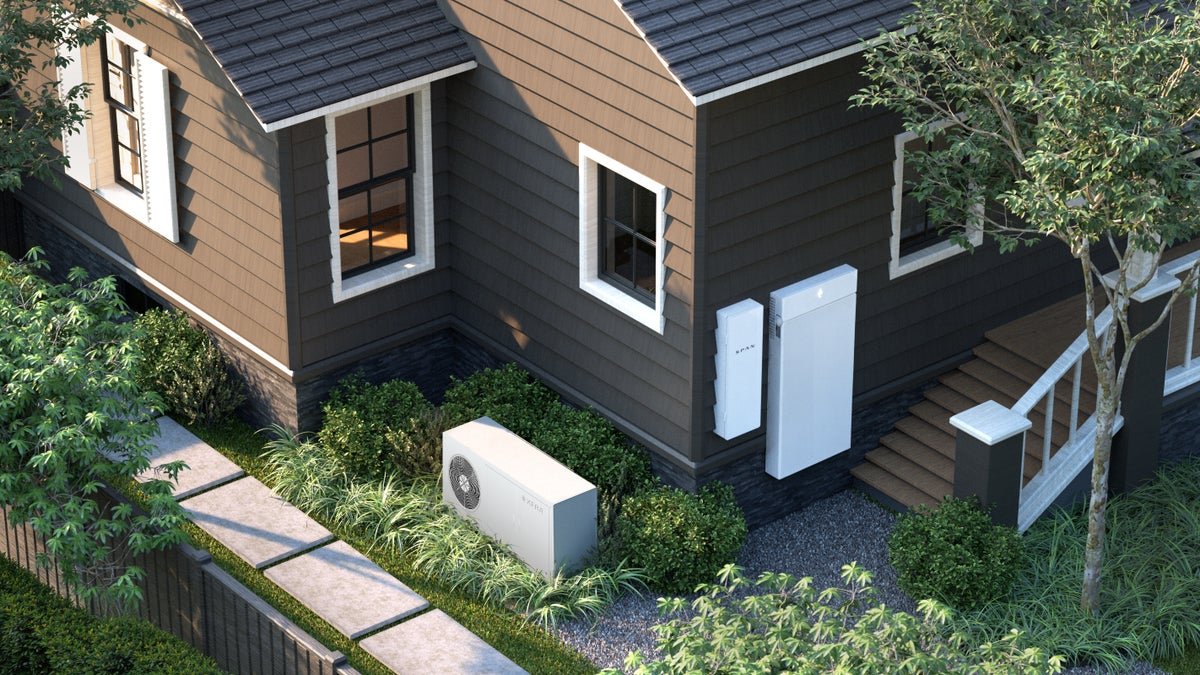
A unit about the size of an air conditioner, mounted in the side yard, could soon be humming away on artificial intelligence tasks, drawing power from your home’s energy supply and earning you discounted electricity and Internet in exchange.
That’s the pitch for XFRA, a distributed network of miniature AI computing units that was recently unveiled by smart-electrical-panel start-up Span in partnership with Nvidia. Span, which started in San Francisco in 2018, already sells hardware to help homes manage electrical loads, and the new technology applies the same basic control system to powering AI compute. It arrives just as access to electricity has become one of the AI industry’s biggest constraints, with utilities unable to connect power-hungry data centers to the grid fast enough. Substation upgrades to support a 100-megawatt data center now take four to seven years in most parts of the U.S., and more than 2,060 gigawatts of generation and storage capacity sat in interconnection queues as of late 2025, according to Lawrence Berkeley National Laboratory.
Span’s system is designed to route around this problem: instead of building a single large data center that requires its own substation upgrade or on-site gas turbines, it spreads compute across thousands of homes that are already connected to the grid.
On supporting science journalism
If you’re enjoying this article, consider supporting our award-winning journalism by subscribing. By purchasing a subscription you are helping to ensure the future of impactful stories about the discoveries and ideas shaping our world today.
Whether the approach can meaningfully alleviate the AI power crunch—and what it might do to the residential grid in the process—remains unclear.
“They say it’s about speed to market for data center equipment, and it’s true there are bottlenecks to building large facilities nowadays,” says Jonathan Koomey, a longtime data center energy researcher, who was formerly at Berkeley Lab. But “the benefits of this new approach need to be big enough to outweigh the economies of scale for standard purpose-built data centers.”
Each XFRA node contains 16 Nvidia graphics processing units (GPUs), four central processing units (CPUs) and three terabytes of RAM. “That’s pretty beefy,” says Mahadev Satyanarayanan, a computer scientist at Carnegie Mellon University, who is known for his work on distributed and edge computing. “Even a modest-size large language model could run on a 16-GPU cluster.”
Each node draws about 12.5 kilowatts at full power, says Chris Lander, XFRA’s vice president. That means roughly 8,000 XFRA nodes match the power demand of a medium-sized 100-megawatt data center. For context, an XFRA node running at full power would consume as much energy in three days as the average U.S. household uses in a month.
Lander says this capacity is hiding in plain sight. Most newer single-family homes are wired for 200 amps of service but typically use closer to 80 at peak, he says. Even setting aside a 40-amp buffer, he adds, that leaves roughly 80 amps of headroom “that’s just on the table, and it’s never used.”
Utilities, in other words, size local infrastructure for peak demand and end up with unused capacity for most of the year. XFRA nodes turn that capacity into distributed computing power for AI cloud providers.
But the extra capacity serves a purpose, says Rich Brown, who spent more than 30 years researching energy technologies at Berkeley Lab. “Utility operators and planners depend on diversity of loads to average out peaks and valleys,” he says, and distributed data centers “would eliminate some of the benefits of that diversity by filling in all the valleys and perhaps creating new peaks.”
Today’s headroom may also not be there tomorrow, Koomey adds. “Planning for these installations would need to account for growth in behind-the-meter solar, as well as electrification of heat, water heating and vehicles,” he says.
The power equation isn’t the only unknown. Many AI workloads depend on fast communication between chips connected by high-bandwidth networking. Spreading nodes across homes won’t be practical for all AI tasks. “If you try to blindly take what a data center does and use a collection of XFRA nodes for it, it will not work very well,” Satyanarayanan says. Sending the right workloads to the right places will be key.
The dividing line runs between training and inference. Training frontier AI models requires thousands of chips to exchange huge amounts of data in near real time and still demands centralized, high-speed infrastructure. Inference, when trained models answer queries or generate content, requires far less coordination between processors. Many requests can be processed independently and routed to whichever node is closest to the user. “We know we can support the vast majority of inference compute for chat, for enterprise, for coding, for agentic AI,” Lander says.
That proximity is the upside. For tasks that depend on a fast back-and-forth, such as voice assistant functions, live translation and augmented reality, putting compute closer to the user can ease congestion on long-distance networks and trim response times. “The proximity of the node matters a lot,” Satyanarayanan says. “What the user sees are the benefits in performance.”
For its first commercial rollout, Span is working with PulteGroup, one of the largest U.S. home builders, to install XFRA units in newly built communities. They’ve already tested prototype nodes with paying customers. And this fall they plan to deploy units in 100 homes totaling about 1.2 megawatts of compute capacity, in the southwestern U.S., a region where the system’s thermal management will be put to an immediate test. Homeowners who install the units pay nothing for the hardware, pay a flat fee for power and Wi-Fi and earn compensation based on how much compute and energy the network uses. Span hopes to eventually scale the network to more than one gigawatt of capacity.
Unlike the fan-driven air cooling that is typical of hyperscale data centers, XFRA units are liquid-cooled, with a heat pump pulling heat from a closed loop; no water is used. “We expect them to be quieter than your standard HVAC [heating, ventilation and air-conditioning],” Lander says.
Each unit includes a backup battery in case a power outage occurs or a home’s power demand surges at the same time its XFRA node is running at full power. Span can also throttle nonurgent workloads or transfer them to other nodes in the fleet. “We have a number of dials we can turn to make sure the customer experience for the home is untouched,” Lander says.
Satyanarayanan thinks that the cost of moving workloads around, as well as other expenses such as repairs, may be higher than Span is anticipating—and that these factors will determine whether XFRA scales or remains a clever concept. “There are a lot of unknowns on the business side,” he says. On the technical side, though, he is “completely convinced of the feasibility and the value.”
