

NASA’s Artemis II moon mission is gearing up for its lunar flyby
NASA officials and the crew are starting to prepare in earnest for Monday’s lunar flyby—while also trying to fix the toilet
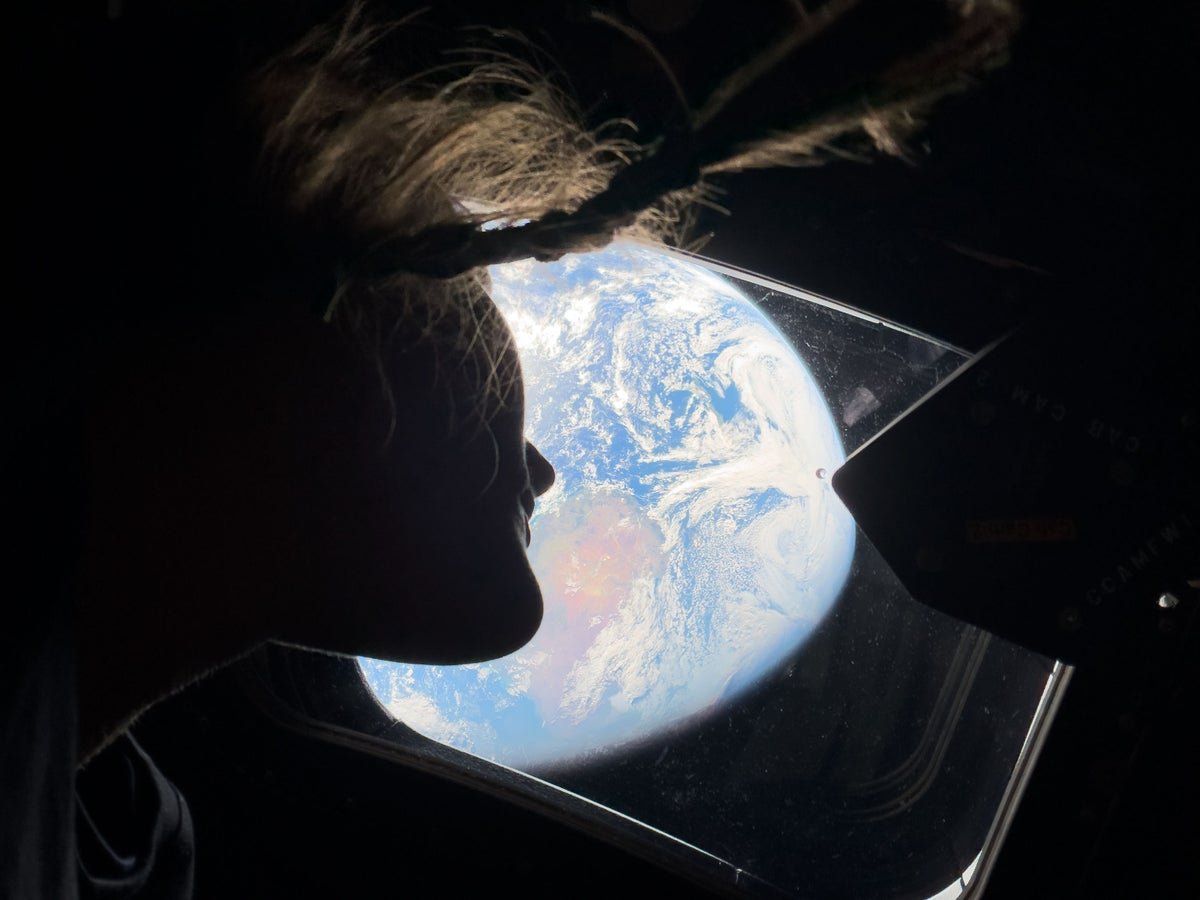
Astronaut Christina Koch gazes upon her receding home planet out the window of Orion as the spacecraft continues its journey towards the moon.
NASA has launched four astronauts on a pioneering journey around the moon—the Artemis II mission. Follow our coverage here.
NASA’s Artemis II mission is well past the halfway point on its journey to the moon, and already, space agency officials and the crew are looking forward to and preparing for the lunar flyby. In this five-hour long period on Monday, April 6, the astronauts will have the chance to observe the moon’s far side, including features humans have never seen with their eyes.
The four-astronaut crew—Victor Glover, Jeremy Hansen, Christina Koch and Reid Wiseman—crossed the halfway mark around 9 A.M. EDT on Saturday.
At a press conference on Saturday, Kelsey Young, the lead of NASA’s Science and Explorations Directorate for the Artemis II mission, said that scientists are eagerly awaiting the lunar observations. Only when the spacecraft has made it to the moon will it be entirely clear what the astronauts will be able to see, but among the potential targets she is most excited about is the Orientale basin—an impact crater three times as wide as Massachusetts.
On supporting science journalism
If you’re enjoying this article, consider supporting our award-winning journalism by subscribing. By purchasing a subscription you are helping to ensure the future of impactful stories about the discoveries and ideas shaping our world today.
“This is an impact basin that has is played such a critical role in not just lunar science, but in planetary and solar system science,” she said. “It’s the type impact basin we use to understand impact processes across the solar system, which is one of the most ubiquitous processes across the entire solar system. And we’ve never had human eyes on by far the majority of it.”
The astronauts are spending part of Saturday reviewing potential targets for observations. The opportunities for science abound, such as the spectacular sight of a solar eclipse when the moon fully obstructs the sun from view. The crew will also spend much of the flyby taking photos of the moon’s far side, many features of which they’ll be the first humans to see by eye (earlier manned flybys coincided during the lunar night).
Young explained that the crew have been extensively trained to observe the moon’s far side features and the science objectives. Among the most critical, she said, are observing different colors and topography that satellites might miss. The crew have spent the past several months studying flashcards the science team made them for identifying key lunar features on sight, she added.
At the same event, manager of the Space Launch System, the rocket that lofted Artemis II into space, John Honeycutt touted the precision of the SLS launch and positioning of the Orion crew capsule into Earth orbit. “It did that—with 99.92% accuracy,” he said. “That was a big bullseye, and I’m very happy about that.” Since leaving Earth orbit, Orion has been able to stay on its trajectory to the moon with surprising accuracy.
The capsule’s toilet, however, is not doing as well. An overnight wastewater dump seemed to cut off too early, as if the line were clogged with ice due to the cold environment. “We think it’s probably been seeing more shadow than anticipated,” said Orion deputy program director Debbie Korth at the same event.
The capsule was tilted to try and give the wastewater system a warm bath in the sun’s blistering rays—with middling success. “By heating it up, we were able to get some of the urine out, but it clearly didn’t solve the whole problem,” said Korth.
In the meantime, the crew is using their “collapsible contingency urine devices,” to avoid introducing more wastewater into the tank until the lines are clear (they’re still using the toilet for number two). Korth pointed out that ice is a perennial plumbing issue for moon missions going back to NASA’s shuttle program.
Toilet troubles aside, in an interview with CBS on Saturday, the astronauts spoke about the mission’s symbolic importance for all those watching from Earth.
“When I saw Earth for the first time on its own out the window, I was struck by the blackness around it,” said Koch. “It leads me back to gratitude—that out of this huge universe, we get to live together on planet Earth, and what an anomaly that is.”
It’s Time to Stand Up for Science
If you enjoyed this article, I’d like to ask for your support. Scientific American has served as an advocate for science and industry for 180 years, and right now may be the most critical moment in that two-century history.
I’ve been a Scientific American subscriber since I was 12 years old, and it helped shape the way I look at the world. SciAm always educates and delights me, and inspires a sense of awe for our vast, beautiful universe. I hope it does that for you, too.
If you subscribe to Scientific American, you help ensure that our coverage is centered on meaningful research and discovery; that we have the resources to report on the decisions that threaten labs across the U.S.; and that we support both budding and working scientists at a time when the value of science itself too often goes unrecognized.
In return, you get essential news, captivating podcasts, brilliant infographics, can’t-miss newsletters, must-watch videos, challenging games, and the science world’s best writing and reporting. You can even gift someone a subscription.
There has never been a more important time for us to stand up and show why science matters. I hope you’ll support us in that mission.
