
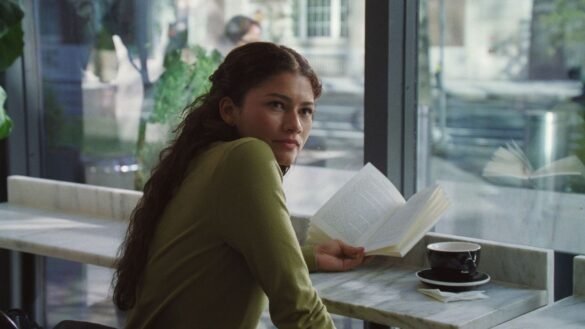
Is her professionalism an obstacle to risk? Fatal to artistry? She speaks matter-of-factly about her relative privilege in the industry. She is not “only” an actress; she is a producer, which dates back to her time on “K.C. Undercover.” As a cultural figure, she strikes me as a code-switcher. She is not the crossover case, who distances herself from Black Hollywood. The prognosticators on the industry podcast “The Town” hand-wring over her box-office pull, but they might not register the meaning of her attending the Essence Black Women in Hollywood Awards, in vintage Caché initially worn by Whitney Houston. Zendaya is biracial—her mother is white German Scottish, her father, African American. She knows she benefits from colorism, being what she has called “Hollywood’s acceptable version of a Black girl.” She is not playing the faux naïf; she deliberately capitalizes on her industry’s trend toward race-blind casting. She was open about her tactics securing her role as M.J., the latest iteration of Mary Jane Watson, in “Spider-Man,” a character that had most recently been played by Kirsten Dunst. The character had been written as white, but Zendaya tried out anyway; her auditioning called the bluff of liberal Hollywood.
Now Zendaya is everywhere, and everything: she is the tennis star puppeteering two lovesick adversaries in “Challengers”; she’s the emperor’s mistress in the “Dune” series; she is the neglected girlfriend of a hotshot director in “Malcolm & Marie.” That film, directed by Sam Levinson—who first worked with Zendaya on “Euphoria,” the series that won her a Golden Globe and an Emmy—is total shlock, but it does provide the id moment in her career. Zendaya’s character, Marie, a depressive addict, who finds herself at complete unease in the Hollywood bestiary, claws at Malcolm, played by John David Washington, who is nothing more than a vessel for Levinson’s entitled auteur grievances. Still, it is the one film in which Zendaya inhabits a Black heterosexual world, because Malcolm is a Black man, even if he’s a double for Levinson, a white filmmaker.
How Zendaya’s film characters are “raced” is almost always an outgrowth of their romantic or sexual worlds, which are almost unilaterally with white men. An extremely fragile veneer of post-racial logic blankets these spiky romances, which take place in conspicuously progressive cities. Tashi Duncan sneering “I’m taking good care of my little white boys,” in “Challengers,” is a perfunctory gesture—really, a tell—in a film that had no use for her psychology elsewhere. Because Zendaya plays young women, these women still have parents, and the actors cast to play her parents—which is to say her history, the expository reasons for her Blackness—typically flit in and out of the background, there to signify and do nothing else. It can often feel as if Zendaya has been added to a preëxisting story, like salt on a finished dish. The ostensible fear is that of identity hardening into a cudgel, foreshortening a character’s emotional palette. But why can’t it expand that palette?
Her latest role, Emma, in Kristoffer Borgli’s wedding-disaster movie “The Drama,” is the one that I keep thinking about. We live in the age of the oppressive publicity campaign. Zendaya did her style-as-cosplay thing, in the weeks leading up to the film’s release, looking modelesque in bridal looks across the globe. In the actual movie, Robert Pattinson’s Charlie, a mussed Englishman, spins out after he learns that Emma, his fiancée and dream girl, once planned to carry out a school shooting when she was a bullied, unhappy teen in Baton Rouge, Louisiana. Charlie prods Emma incessantly, digging for a reason that could justify her adolescent rage, though he never asks if her sense of isolation stems from being different. Because the film has banished acknowledgment of race from its quarters, the scenes can make you feel insane. The only catharsis is in the actress Jordan Cuyet, who plays the younger version of Emma, whom we see doing target practice in the woods, and basking in the computer glow of incel chatrooms. But even this Emma is largely a figment of Charlie’s imagination; when we see her point a shotgun at a dog, which she ultimately doesn’t shoot, it’s unclear whether the scenario is one that he concocted in his head. For the film to sustain itself as an elongated question about how well you really know your partner, Emma’s interiority has to be put on the pyre; she must be rendered a void. As Rachel, her maid of honor—a woman whom Emma met through Charlie—notes in a nasty reception speech, she doesn’t even have friends. Where are her people? Borgli isolates Emma, stranding her in a mostly white world, because it’s the only way his movie can make conceptual sense.
