
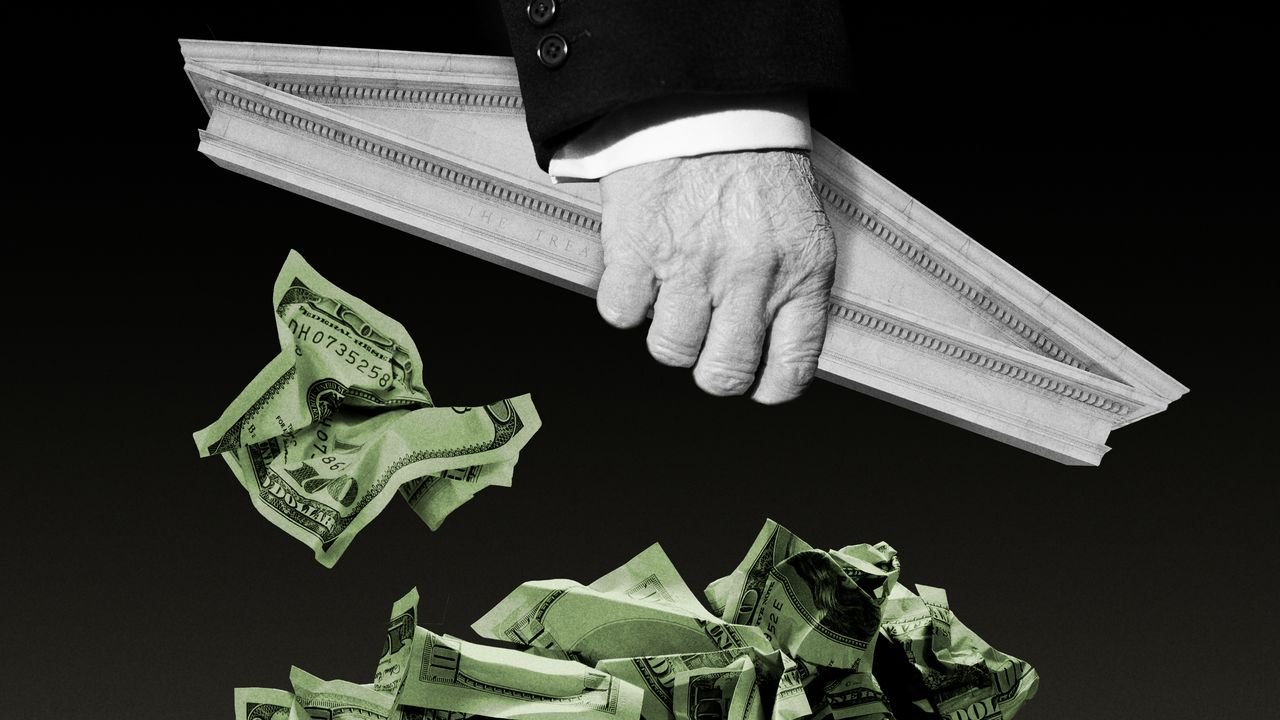
The day after the Justice Department announced the creation of an enormous “Anti-Weaponization Fund” to recompense self-proclaimed victims of government overreach, a Florida-based Republican operative named Michael Caputo filed what is believed to be the very first claim, for $2.7 million in damages, that Caputo says he and his family suffered at the hands of the Biden Administration. “The machinery of government was clearly politically weaponized against my family from July 2016 to December 2025,” Caputo wrote to Todd Blanche, the acting Attorney General, last Tuesday, May 19th. Over the years, Caputo has been, variously, an ally of the Trump adviser Roger Stone (he was once Stone’s driver); a media consultant to the Russian state-owned energy conglomerate Gazprom; and the Trump Administration’s chief spokesman for the Department of Health and Human Services. (He went on medical leave in September, 2020, after using his personal Facebook page to accuse government scientists of “sedition” against Donald Trump.) In his letter to Blanche, which was also posted on X, Caputo claimed he had been a target of the F.B.I.’s investigation into Russian meddling in the 2016 election, and a separate probe into his 2020 documentary, “The Ukraine Hoax: Impeachment, Biden Cash, and Mass Murder,” for the One America News Network. “This nine-year assault,” he wrote, “drained our savings, destroyed our peace of mind, ruined my career, wrecked my health, and wreaked far more havoc on our family. They found nothing; we lost everything.” When I spoke with Caputo later that day, he mentioned the significance of the fund, whose size was set at the politically resonant amount of $1.776 billion. “Without this fund,” Caputo said, “the political, weaponized assault on thousands of families would go uncorrected, and it will just happen again.”
Not everyone greeted the creation of the fund with similar expressions of joy, and for good reason: the entire arrangement reeks of self-dealing on a scale impressive even for Trump, an in-plain-sight raiding of the Treasury to reward the President’s allies. The mechanism for the payouts is a little-known entity known as the Judgment Fund, which allows the government to sidestep the ordinary congressional appropriations process and dip into an unlimited pool of money to settle lawsuits against it. In this case, the lawsuit was President Trump’s ten-billion-dollar claim against the government for the leak of his tax returns to the Times and ProPublica; the leaker, Charles Littlejohn, had worked for an I.R.S. contractor. As Trump acknowledged, the fact that he serves as the chief executive of the government he was suing was more than uncomfortable; the federal judge overseeing the case demanded that the parties explain how the case met the requirement of two sides with interests adverse to each other. (This is not a legal nicety but a constitutional mandate; the Constitution authorizes federal courts to hear cases or controversies, not to bless back-scratching.) The Justice Department might have had meritorious arguments to defeat the lawsuit: it was arguably filed too late, for one thing; for another, it was not clear that the I.R.S. could be held liable for the conduct of its contractor, which, as it happens, occurred during the first Trump Administration. Instead, Justice settled with the President to whom it answers, and arranged for an astronomical sum, one with no factual basis in the sparse court record, to flow to unknown—indeed, unknowable—parties with no connection to the underlying litigation. (Trump also agreed to drop two other claims seeking two hundred and thirty million dollars from the federal government to compensate him for the 2016 election and classified-documents investigations.)
“This is an outrageous, unprecedented slush fund,” Senator Chris Van Hollen, a Democrat from Maryland, lectured to Blanche at a contentious Senate Appropriations Committee hearing last Tuesday. Senator Patty Murray, of Washington, the ranking Democrat on the committee, termed the deal “nothing short of the sitting President of the United States looting from the Treasury.” Two police officers who were at the Capitol on January 6, 2021, filed a lawsuit that described the fund as “the most brazen act of presidential corruption this century;” Trump could use it, they warned, “to finance the insurrectionists and paramilitary groups that commit violence in his name.” The legal challenge faces hurdles—most significantly whether the officers have standing to sue—but the assessment of Trump’s audacity is spot on.
Notably, more than the usual number of Republican lawmakers expressed unhappiness about the fund, particularly as details emerged: federal privacy laws might mean that the recipients of the payouts would go undisclosed and, as part of the settlement, the I.R.S. would be “forever BARRED and PRECLUDED” from auditing the Trump family and its businesses over any returns they had filed before the date of the settlement. In fact, the Trumps’ immunity from government action is phrased even more broadly; it covers “any matters currently pending or that could be pending (including tax returns filed before the Effective Date) before Defendants or other agencies or departments.” Majority Leader John Thune cited “blowback” from the plan and described himself as “not a big fan.” Susan Collins, of Maine, who chairs the Appropriations Committee and is facing a difficult campaign for reëlection, said that she did not support the fund “as it has been described,” adding, “I do not believe that individuals who were convicted of violence against police officers on January 6 should be entitled to reimbursement for their legal fees.” Thom Tillis, of North Carolina, a frequent Trump opponent who has chosen not to seek reëlection, was even more tart: “This is just stupid on stilts.” More surprising was the criticism from some of Trump’s reliable enablers. Ron Johnson, of Wisconsin, called the move a “galactic blunder.” Following an acrimonious session between Blanche and Republican senators on Thursday—Ted Cruz, of Texas, reported “fireworks at an epic level”—Thune was forced to abandon plans to vote on funding for immigration enforcement; he began the Memorial Day recess early. Trump, for his part, spun the Fund as yet more evidence of his magnanimity. “I gave up a lot of money in allowing the just announced Anti-Weaponization Fund to go forward,” he posted on Truth Social. “I could have settled my case, including the illegal release of my Tax Returns and the equally illegal BREAK IN of Mar-a-Lago, for an absolute fortune. Instead, I am helping others, who were so badly abused by an evil, corrupt, and weaponized Biden Administration, receive, at long last, JUSTICE!”
