
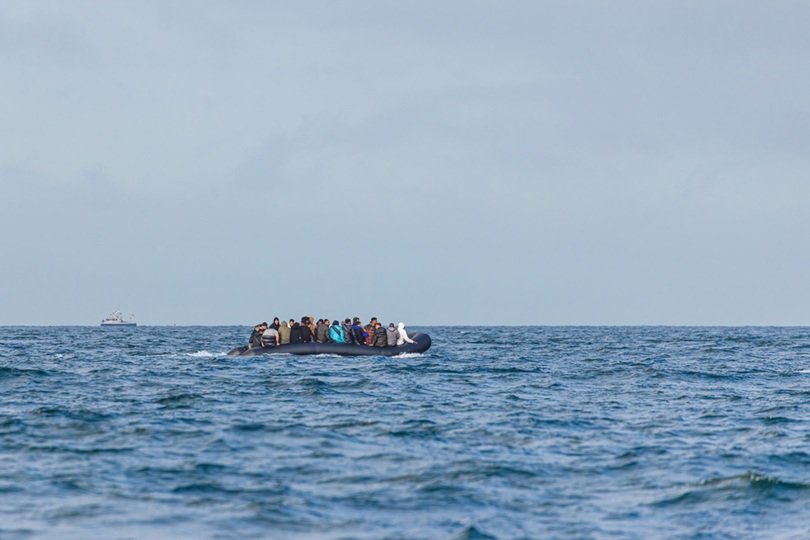
Public acceptance and tolerance of refugees have become increasingly politicised across the Western world, with refugees often portrayed as a threat to states’ way of life. Refugees are framed within a dichotomy of security threat versus a humanitarian issue (Devereux, 2017), and their right to seek asylum has become increasingly contested under UK government plans. This research explores how small-boat refugees are routinely demonised in political narratives and the subsequent impacts that these pose on refugee policy. Acknowledging the theoretical purposes of these political actions is key to understanding how framing can be an ideological tool. By using a postcolonial approach, this research aims to understand how irregular refugees are systematically targeted by threat narratives and integration concerns perpetuated by politicians. It addresses the following research question: How do political narratives shape the framing of refugees in the context of the UK’s small-boat ‘crisis’?
This research explores three interconnected themes. Firstly, it examines the dominant political narratives employed by politicians to frame refugees arriving via small-boats. It then investigates how these narratives construct and reinforce the concept of ‘otherness’ and will consider the purpose behind such portrayals. Finally, it assesses the political implications of these narratives, particularly their influence on refugee policy and wellbeing.
It is important to note that throughout this research, the term ‘refugees’ is used to refer to individuals arriving in the UK via small-boats, despite the broader and often interchangeable use of ‘migrants’ that is frequently seen in political and media discourse. This choice is deliberate and reflects the fact that many of these individuals arriving in the UK are fleeing conflict, persecution, or other circumstances that qualify them for protection under the 1951 Geneva Convention (UNHCR, 2025). While the term ‘migrant’ and ‘immigrant’ is often seen in political discourse to delegitimise these journeys, this research adopts the term refugees to challenge such framing and to acknowledge the legal and humanitarian realities facing those seeking asylum. This distinction resists reductive and problematic narratives that obscure the rights and experiences of people crossing via small-boats. The research findings would remain the same if the term ‘migrant’ were used instead of ‘refugee.’
Literature Review
This literature review outlines the key debates surrounding UK refugee discourse, drawing on research about political framing, securitisation, and postcolonial theories of otherness. It establishes the conceptual foundation for analysing how small‑boat refugees are represented in political narratives and why these portrayals carry significant social and policy implications.
Contextualising Refugee Discourse
The global movement of refugees has long been a point of political contention since the introduction of the Aliens Act 1905, which imposed sanctions and restricted entry for ‘undesirable immigrants’ (Bashford and McAdam, 2014), as well as Margaret Thatcher setting it on the political agenda of the 1979 election (Francis, 2017). The Geneva Convention 1951 defines a refugee as someone who has a well-founded fear of being persecuted for reasons of race, religion, nationality, membership of a particular social group or political opinion, and is outside their country unable or, owing to such fear, unwilling to return to it (UNHCR, 2025). Refugees are entitled to certain rights enshrined in international law such as the right to non-refoulement, non-discrimination and most importantly, the right to cross through irregular means without punishment (UNHCR, 2025).
Narratives surrounding displacement are influenced by broader ideological, political and security concerns and often portray marginalised groups as threats (Loescher, 2002). In the UK, the arrival of refugees via small-boats has become a focal point of political and media discourse (Parker et al., 2021). This movement is often framed as a ‘crisis’, evoking nationalist sentiments, moral panics and spreading damaging rhetoric. The UK’s small-boat crisis has been a significant issue since around 2018, though irregular crossings have been happening for much longer through other means (UK Government, 2023). After the 2015 European Migrant crisis, the influx of refugees and migrants to Europe reached significant levels, consequently dominating media headlines and prompting intense political discourse (Spindler, 2015).
A focus on the link between refugees and national security has been heightened by governments’ repeated scapegoating of refugees following terror attacks (Klein, 2021). The conflation of refugees with Muslims has become more apparent, specifically after the 2015 and 2016 Paris terror attacks (Hewitt, 2015). There has been a backlash against refugees amid fears of Islamist terrorists exploiting refugee channels to enter Europe, as well as an upsurge in a populist nationalism and anti-Muslim hostility following recent UK terror attacks (Abbas, 2020).
A key example is Nigel Farage stating that ‘UK Mediterranean boats will bring 500,000 Islamic State terrorists to Europe’ (Barnett, 2015). This characterisation intertwining refugees and Muslims conflates the Muslim refugee with a terror suspect, and therefore is undeserving of UK support (Abbas, 2020). Bull, Weinberg, and Coen (2024) analysed five speeches delivered by Farage at annual UKIP conferences between 2010 and 2015 and found that the then UKIP leader exemplified and illustrated populist discourse targeting migrants and refugees. Langlois (2024) found that Farage’s rhetoric was based on a nationalist populist campaign that aimed to create a culture war during and post Brexit. It resurrected an ‘existential threat’ of migrant groups taking over and replacing native groups, which Langlois named ‘cultural engulfment.’
In 2024, 36,816 people were detected making the journey across the English Channel. The highest figures were in 2022 when 45,755 people arrived through irregular means (BBC News, 2025). Despite sounding a considerable number, this equates to 0.05% of the UK population (Office for National Statistics, 2024).
Theoretical Framework: ‘Otherness’ and Securitisation
Scholarship on migration and refugees has explored the processes through which displaced populations are othered. It often draws from the work of Edward Said in Orientalism (1978), which explains how refugees are an ‘outgroup’ and are viewed as inferior to the dominant Western ideals. People from the ‘East’ and those from Islamic cultures are perceived as being drastically different from the West in both culture and mindset. Said asserts the tendency of Westerners to explain every facet of Eastern/Muslim societies in light of the Muslim religion, as if there were no other reality or influence on these societies but Islam (Akram, 2000). The conflation of the East with Islam correlates with the perceived interconnectedness of refugees and Islam, ignoring cultural differences and the unique, varied experiences of refugees from across the globe.
Frantz Fanon (1952) further builds on this idea of the other through his exploration of how the colonised subject is stripped of agency, constructed as an ‘other’ and frequently dehumanised. Fanon’s notion of the colonial other provides a critical lens for understanding how refugees are racialised, marginalised and politicised in society. Policies of deterrence, deportation and deportation can be seen as forms of Fanon’s ‘colonial project,’ whereby border force practices reinforce colonial histories and create hierarchical race divides at a neo-colonial border (McNeill, 2023).
Furthermore, Bauman (1995) discusses the idea of ‘the stranger’ in modern society and highlights how refugees impact the ideas of a nation-state. National identity is reinforced by defining migrants and refugees as external ‘others’ (Doty, 1996). Political discourse constructs migrants and refugees as existential threats to Western societies (Wodak, 2015), thus justifying the exclusionary and so-called ‘protection’ policies put in place.
The framing of refugees as a security threat has become more apparent after the events of 9/11. The legislative landscape has been characterised by increasing securitisation, which conceives asylum and migration movements as security threats (Sáenz-Pérez, 2023). According to securitisation theory, political issues are constituted as extreme security issues when they have been labelled as ‘dangerous’ or ‘threatening’ by a ‘securitising actor’ who has the social and institutional power to move the issue ‘beyond politics’ (Eroukhmanoff, 2018). Security issues are not fixed notions; they are constructed and acted upon by governments when they are either an objective threat or a perceived threat.
Gagnon’s (1994) work on Ethnonationalism in Serbia can be helpful to understand how manufactured threats can play a key role in electoral politics. Gagnon (1994) argues that the ruling elites provoke tension along ethnic lines and employ a narrative which portrays certain groups as threats to the state. This allows them to position themselves as protectors of the state, ensuring electoral support. The malleable nature of political narratives mean that crises can be manufactured to aid ideological aims and broader interests, such as Europe’s wide scale scapegoating of migrants and refugees (Delapre, 2024).
Political Narratives and Framing of the Small-boat ‘Crisis’
The political sphere upholds several narratives and notions about refugees, which vary in accuracy and accountability. Mainstream media coverage tends to frame refugees as a collective ‘other’, perpetuating narratives that silence and marginalise those being discussed (Kumar and Hooda, 2024). Individuals seeking refuge in Britain have been called meaningless and derogatory terms such as ‘illegal refugee’ and ‘asylum cheat’ (Kundnani, 2003). The terms ‘immigrant’ and ‘asylum seeker’ are synonymous in the eyes of the public rather than as distinct terms to accurately convey the status and situation of individuals (Kundnani, 2003). The media has wielded significant power in shaping public opinion using this rhetoric and defining political discourse; showing an undeniable link in the mainstream media and UK politics (Rahi, 2024).
Through a mixed method approach combining corpus analysis, media analysis, and political discourse analysis, Piemontese (2025) explains how political discourse creates a false binary of good versus bad migrants. They state that the figure of the ‘illegal migrant’ serves as a strategic counter-image to ‘legal’ and ‘skilled’ migrant workers. The report also demonstrates how the politics of ‘deservingness and desirability’ are constructed and contested across media, politics, and civil society (Piemontese, 2025). This report provides a comprehensive analysis of refugee discourse but could use more critical approaches to challenge these state-centred issues.
Many narratives portrayed in political discourse are based upon the spectacularisation of small-boats, whereby politicians conduct the performance of crisis and the mobilisation of moral panics to call for ‘sovereign hard-hitting action’ (Dobbernack, 2025). In the Stop the Boats campaigns, Suella Braverman and the Conservative party produced significant social visibility of the small-boat issue. They mobilised resentment by utilising crisis performances, while portraying British ‘culture war’ politics and defending any criticism of the Illegal Migration Act as left-wing lunacy (Dobbernack, 2025). This article draws on statements on immigration policy by Sunak and Braverman and explores ninety-seven newspaper articles, demonstrating both a strong methodology and a unique exploration into manufactured performances of crisis and production of visibility.
Enoch Powell’s Rivers of Blood speech in 1968 has become infamous and influential in UK politics, with its racist and divisive content continuing to inspire rhetoric today. Powell stated that continuous immigration would lead to violence and prejudice towards ‘native’ British citizens (Esteves, 2022). The speech was a warning that unchecked immigration would lead to a racial and cultural divide that could erupt in violence, a future that would descend into chaos and bloodshed. These ideas have remained pivotal in how both immigrants and refugees are viewed and treated. The sentiments have been echoed by Prime Minister Keir Starmer, who stated that the UK risks becoming an ‘island of strangers’ (Syal, 2025). The Prime Minister was accused of pandering to the far-right and using their rhetoric, which often wages a culture war and creates social divides between ‘us and them’ (Duffy et al., 2021).
The rhetoric of security threats and integration concerns are often intertwined, positioning the refugee as both an outsider who must assimilate into British culture, while simultaneously framing them as threats who should not be welcomed (Gray and Franck, 2019). During the EU refugee crisis, the securitisation of migration relied on mutually reinforcing representations of the racialised, masculinised threat and the racialised, feminised vulnerability, both embedded within colonial modernity (Gray and Franck, 2019). With men making up 87% of small‑boat arrivals in the year ending March 2023 (Home Office, 2023), this gender imbalance amplifies the perceived masculinised threat and contributes to a more hostile environment toward male refugees. These contradictory narratives also appear in social policies, which simultaneously call for refugee integration while promoting deterrence, reflecting an ideological dilemma (Parker et al., 2021). As a result, refugees face conflicting expectations about how they should behave and integrate, leaving them in a no‑win situation.
Why Are Refugees Negatively Framed? The Purpose of ‘Othering’
Rather than a mere consequence of fear or ignorance, the negative framing of refugees operates as a strategic discursive tool that serves multiple functions. Divisive rhetoric can shape public opinion, reinforce existing power structures, and justify harsh policies, all in service of broader ideological agendas (Howard, 2021).
The relationship between political narratives and public opinion is a well-researched area. Political leaders shape the preferences of public opinion by proposing a political vision, relevant political goals and how they will perform better than others in leading policies achieving these ends (Capano, Galanti and Barbato, 2023). The primary goal of a political narrative is a political consensus; this ensures electoral support in the future. Stating that a host country is overwhelmed creates a scapegoating effect where refugees can detract from the real-world issues facing a state, such as economic turmoil and the mishandling of state institutions (Migrants’ Rights Network, 2025).
Gagnon (1994) states that ruling elites shift the debate around important social issues towards certain ethnic groups and implement the idea of an alleged threat to the masses, which reinforces their political power and reduces pressure on their power bases. Media reporting often exaggerates the scale of refugee arrivals, even though asylum applications have fallen to around half the number recorded in 2002 (Pickard-Whitehead, 2022). Britain exists in an ‘imaginary state of crisis’ about immigration; the Conservatives created a notion of a migrant siege whereby the UK is overrun, and they are the only party who can stop it (Malik, 2022). Scapegoating a vulnerable group after the troubles of Brexit has been highly beneficial for the Conservatives to maintain their electoral support and position themselves as ‘protectors of the masses’ (Gagnon, 1994).
Political narratives have played a pivotal role in shaping policy regarding asylum (McCann, Sienkiewicz and Zard, 2023). The UK has implemented a series of reforms to reduce migration and limit the rights of asylum seekers. The 2012 ‘hostile environment’ policy aimed to create an environment that would dissuade asylum seekers from settling in the UK by limiting their access to basic services (Sáenz-Pérez, 2023). Additionally, the 2022 Illegal Migration Act aimed to deal with small-boat crossings in the English Channel and remove those who irregularly entered the UK to their home country, or a ‘safe’ third country, such as Rwanda (The Law Society, 2025). Introducing harsh legislation relies on the political consensus given by the public and by framing refugees as an ‘other’, it allows new processes of exclusion and dehumanisation (Powell, 2017).
This section outlines the research methodology, justifies the use of Critical Discourse Analysis, and explains the case‑study selection. Case studies involved in this research are government press releases, House of Commons speeches and news articles from Labour and Conservative politicians as well as Reform MPs. By using a broad selection from all sides of the political sphere, this research will allow a deeper understanding of narratives portrayed in UK politics and how these work to influence a hostile environment for refugees.
Due to the understanding that political narratives play a key role in shaping public understanding and influencing policy, discourse analysis was identified as the most appropriate method for examining how refugees are framed. This thesis adopts the qualitative method of Critical Discourse Analysis (CDA) and takes a critical realist approach exploring the complex relationship between discourse and actions, as well as the ‘internal relations’ of dialogue (Fairclough, 1995). This methodology allows vital insight into how refugees are portrayed in mainstream society and the methods that politicians use to portray them in a certain narrative. Fairclough (1995) believes that language is not just a tool of communication but as a form of social practice whereby it is shaped by wider power relations and ideologies.
This thesis will analyse articles from a variety of outlets, as well as statements from the UK Government, looking specifically at how different political figures frame refugees. This research will focus exclusively on comments and speeches from politicians, rather than the subjective reporting of refugees in mainstream media. The cases have been selected for their comments on small-boat crossings from 2020 to 2025, the period in which the issue was most actively framed as a crisis. Much of the problematic rhetoric has been shared by right-wing politicians such as Rishi Sunak, David Cameron, Nigel Farage, Suella Braverman and Priti Patel, who are all noted in this research.
A shift in left‑wing narratives has emerged since Labour’s 2024 election, but the dataset remains comparatively small, though still analytically significant. Press releases from Prime Minister Keir Starmer and Home Secretary Yvette demonstrate how Labour is still following in the tracks of the Conservative governments. From 2015 to 2024, the Conservative Party governed the United Kingdom, therefore, this research primarily examines right-wing politicians and policy developments within Conservative-led governments during this period, particularly the Stop the Boats campaign.
Cases have been selected based on their relevance to the research aim of understanding how refugees are discursively framed in UK political rhetoric. Strategic sampling was employed to explore the most polarising or divisive cases in UK politics, examining the language used by politicians, for example, referring to refugees as a ‘swarm’, ‘invasion’ and as security threats. Each article was coded by lexical choices and the narratives and metaphors that it portrays, while also accounting for its broader links with societal structures and legislation. While this method can raise concerns about researcher bias with both the sample selection and analysis, measures have been taken to make sure that all political parties are studied with equal levels of scrutiny.
Key Narratives and Findings
This chapter presents a critical discourse analysis of ten public statements made by UK politicians between 2021 and 2025, focusing on representations of small boat refugees. The statements include both right- and left-wing politicians, though the sample leans toward Conservative sources due to their leadership between 2010 and 2024 and their role in the Stop the Boats campaign. Drawing on Fairclough’s (1995) three-dimensional model and the concepts of othering and securitisation, the analysis identifies four key themes and rhetorical strategies used to construct refugees as political ‘others’.
Dehumanisation of Refugees
Dehumanisation was a recurring feature across the discourse analysed. It involves representing individuals as less than human and reducing diverse experiences into homogenous, object like categories (Deffenbaugh, 2024). This theme is particularly prevalent in discourse relating to the Stop the Boats campaign in 2022.
In most speeches and press releases during the stop the Boats campaign, former Prime Minister Rishi Sunak referred to people who cross the channel as ‘illegal migrants’ regardless of their experiences or asylum eligibility (Sunak, 2023). The use of the term ‘illegal’ pre‑emptively criminalises refugees despite their legal right to seek asylum through irregular means. This framing ignores the fact that almost 70% of asylum claims from small‑boat arrivals were granted (Migration Observatory, 2023).
Even the campaign slogan ‘Stop the Boats’ has negative connotations and dehumanises vulnerable people into an indistinguishable mass, named as the vehicle they use to cross the channel. ‘Stopping the boats’ ignores the individual experiences of people seeking asylum and creates an image of an object, a boat, rather than that of people. It successfully deprives them of their humanity and invokes a sense of prohibition rather than support.
Sunak (2024) also announced in a press statement that he will ‘start the flights and stop the boats’, furthering a sense of dehumanisation and grouping refugees together as a collective entity, ignoring the individual people and the circumstances that they seek to escape from. As Fairclough (1995) argues, language is a site of ideological struggle and here, Rishi Sunak aims to create a strong binary between those perceived as legal versus illegal, reinforcing an unjustified ‘other’ both between citizens and between migrant and refugee groups.
Former Home Secretary Suella Braverman was heavily criticised for the way that she used dehumanising language and problematic metaphors when referencing small-boats. In a speech in the House of Commons, Suella Braverman referenced small-boats to be an ‘invasion’ on the shores of Kent and was ‘utterly serious about ending the scourge of illegal migration’ (Braverman, 2022). Nigel Farage has mirrored these sentiments referring to a ‘flood’ of Albanian men coming to the UK (Cleary, 2022). The term ‘flood’ provokes ideas of uncontrollable damage and a force that cannot be stopped, highlighting how they are seen as a security threat to the UK. Referring to crossings as an ‘invasion’ creates a threatening narrative, framing refugees as a security threat that seeks to take control of the country.
The invasion narratives seen around the small-boat crisis show how refugees are simultaneously portrayed as a generalised group lacking humanity and as a dangerous force detrimental to national security. Similar language has been frequently seen in right-wing extremist groups such as Britain First, who have patrolled the Kent coast and spread disinformation about asylum seekers on social media (Hubbard, 2022). Invoking invasion metaphors is particularly dangerous as it depicts refugees as an army and as an aggressive force aiming to take over the country. Small-boat refugees are portrayed as an ‘other’ to the UK landscape; an uncontrollable wave of dangerous people that are undeserving of support and unwelcomed by UK citizens.
The implications of dehumanisation are highly significant as it ‘is this type of language that stigmatises refugees, migrants and other people on the move, which gives legitimacy to a discourse of racism, hatred and xenophobia’ (Bevan Foundation, 2023). The dehumanisation pushes a narrative that those seeking asylum are inherently illegal, and this has consequences for racist attitudes and behaviours. Language has causal links to racially motivated violence and there is evidence of a rise in far-right extremism and anti-asylum protests that is enabled by dehumanising language and behaviour (Bevan Foundation, 2023).
Questioning the authenticity of refugees was another consistent theme across the discourse. Political actors frequently cast doubt on whether those arriving by small-boats are genuinely fleeing danger or instead seeking to exploit the asylum system.
Then Home Secretary during the Stop the Boats campaign, Priti Patel, claimed that ‘70% of individuals on small-boats are single men who are effectively economic migrants’ and asserted that ‘they are not genuine asylum seekers’ (Taylor and Syal, 2021). This narrative contradicts evidence, which shows that 91% of people arriving via small-boats come from countries with well‑documented human rights abuses (Immigration Advice Service, 2021). Although many small‑boat arrivals are men, this often reflects the risks associated with the journey, with women and children more commonly arriving later through family reunification routes. Patel’s statement therefore reinforces the racialised, masculinised threat that Gray and Franck (2019) describe, framing male refugees as incompatible with vulnerability and therefore undeserving of support.
Rishi Sunak similarly stated that small-boat asylum seekers make a ‘multitude of asylum, modern slavery and spurious human rights claims to frustrate their removal’ (Sunak, 2023). Such language portrays refugees not as individuals facing persecution, but as opportunistic actors manipulating the system. The word ‘spurious’ highlights how politicians do not view small-boat asylum seekers as people who have experienced systemic human rights issues, but rather a group of people attempting to ‘play’ the system. The tone of these ideas suggests that people crossing the channel are trying to manufacture fake circumstances to ensure their asylum claims are successful and aim to cheat the system to ‘frustrate’ their removal.
Questioning the authenticity and situations of small-boat refugees is a political talking point because it serves as a strategy to delegitimise asylum claims, erode public sympathy and justify increasingly hostile policies. Political figures frame individuals not as genuine refugees but rather bogus cheats who do not deserve protection. This framing of small-boat crossings reproduces a colonial hierarchy of worth whereby non-white and non-European people are racialised and viewed as inherently less credible than those perceived as ‘good refugees,’ who manage to enter the UK via a regular route.
Integration of refugees into UK society
Another prominent theme found in this critical discourse analysis is integration concerns and the ‘othering’ of people who cross via irregular routes. The ability of refugees to successfully assimilate into UK society is often brought into question.
During the Stop the Boats campaign speeches, integration featured heavily by Rishi Sunak. He stated in a 2023 press release that ‘individuals just disappear into the black economy’ referring to how refugees fail to integrate when they arrive in the UK (Sunak, 2023). He presents this group as people who do not want to assimilate into the UK but will slip through the cracks and engage in criminal activity or work illegally without reporting to formal institutions like HMRC. Sunak further states that ‘it’s unfair on the people who have come to this country legally to see others skipping the queue’ highlighting the hierarchy between refugee groups who come here ‘legally’ through traditional, approved routes rather than irregular channel crossings.
Segregating refugee groups based on their method of entering the UK draws a distinction between acceptable versus unacceptable refugees, creating a further ‘other’ group within an already ostracised subsection of society. Sunak fails to acknowledge the legal safeguarding that allows people to enter to the UK via irregular channel crossings, an action enshrined in international law under the 1951 Geneva convention (UNHCR, 2025). This could be viewed as manufactured ignorance; the Prime Minister has a duty to respect and understand legal safeguards but may make a deliberate choice not to follow them to pursue individual ideological aims that furthers his own immigration agenda.
Labour Prime Minister Keir Starmer faced heavy criticism for his speech likened to that of Enoch Powell. He stated, ‘in a diverse nation like ours…we risk becoming an island of strangers, not a nation that walks forward together’ (Syal, 2025). The quote initially presents itself as inclusive, acknowledging the diversity of the UK and expresses a desire for social cohesion. However, the swift call for a rules-based order suggests that diversity is only acceptable if it aligns with the dominant social norms. The metaphor of an ‘island of strangers’ invokes ideas of social fragmentation, framing difference as a potential threat to national unity and social cohesion. Starmer implicitly draws a boundary between those who seem to belong and follow the rules, and those who do not align explicitly, rendering them ‘different’. Such phrasing affirms an ‘us versus them’ binary under the guise of unity, creating a group that are seen as opposition to the social order.
The language of risk used by Starmer frames diversity as a threat without proper governance and state intervention; legitimising the right to harsher asylum policies to protect the foundations of the UK. This manner of language can invoke moral panics, creating a sense of fear among communities that they will be overtaken by refugees and will lose their sense of identity and culture. The use of inclusive language and the imagery of social values soften the implications of social control by legitimising it as normal and the way to protect the country; it is a UK wide issue that every person is responsible for solving.
The implication of integration as a political talking point is important because it shifts responsibility for social cohesion onto refugees themselves. Rather than exploring the structural inequality behind why refugees may struggle to integrate into the UK, the discourse presents integration as a test of commitment where refugees must earn their place in society.
War Narratives
A dominant narrative emerging from the discourse around irregular channel crossings is the construction of a ‘war on refugees’, in which refugees are not framed a hostile invasion that must be stopped from coming ashore. Echoing what scholars have called the ‘securitisation’ of migration (Eroukhmanoff, 2018), the language used by political actors draws on war metaphors to characterise refugee arrivals as an unwanted invasion needing radical intervention.
The sentiments of war have been shared by many people on both ends of the political spectrum. Home Secretary Yvette Cooper announced ‘a renewed crackdown on those attempting to undermine the UK’s borders’ with a ‘UK-wide blitz on illegal working’ in a statement regarding Labour’s Border Security, Asylum and Immigration Bill (Home Office, 2025b). While not directly aimed at small-boat refugees, Cooper remarks on those who have ‘undermined the UK’s borders’, hence referring to the illegal working of those who have crossed via irregular.
Words like ‘crackdown’ and ‘blitz’ evoke militaristic, combative imagery, suggesting that irregular refugees are a threat akin to an enemy force. The term ‘blitz’ is historically associated with wartime Britain and invokes national trauma and a sense of urgency, legitimising aggressive state intervention to tackle the issue of small-boat crossings. The notion of “undermining the UK’s borders” frames the border not just as a geographical line, but as a symbolic marker of national sovereignty and security. This securitised discourse presents irregular migration as a direct threat to the state, which permits the introduction of harsh asylum and migration policies.
Furthermore, the dichotomy of ‘us versus them’ is apparent in Cooper’s words with the idea that good citizens support the crackdown in a ‘UK-wide’ of collective consensus, reinforcing a binary between the law-abiding citizen and the outsider who threatens national order.The erasure of structural power relations is apparent in these notions shared by the Home Secretary. The focus on ‘illegal working’ ignores the exploitative employers who use strict policies to employ people under the radar in inadequate conditions. The role of the state and capitalism in producing precarity for refugees and migrants is overlooked; simply focusing on the so-called choices of refugees themselves.
The narrative that Britain has ‘lost control of its borders’ is frequently seen in both the Labour and Conservative party (Harris, 2025). This suggests that borders are inherently a site of control and this language contributes to the securitisation of migration and framing it as a crisis that requires immediate and authoritarian practices. The use of crisis discourse by both parties serves as a rhetorical weapon, reinforcing narratives of state failure while positioning the speaker as the solution, furthering long term ideological aims.
One solution to fixing the issues at the border proposed by Lee Anderson MP of the Reform UK party, is to cut ties with the European Convention on Human Rights (ECHR) to get a ‘grip’ on the issue (Harris, 2025). This proposition is extremely problematic and suggests that the UK should ignore international conventions around refugee law and human rights legislation to introduce barbaric actions to stop channel crossings. This is a blatant disregard for refugees to be treated as a vulnerable group requiring help and strips them of their humanity, dignity, and basic human rights.
The Labour government’s assertion that “enforced returns are up 24%… and Britain’s streets have been made safer with the removal of 2,580 foreign criminals” reveals how political discourse constructs migration through a securitised and punitive lens (Home Office, 2025a). The coupling of statistical increases with claims of improved public safety legitimises coercive state practices, such as detention and deportation, as rational and morally justified. By labelling those deported as “foreign criminals”, the language conflates non-citizens with criminals. This reinforces a binary between the law-abiding British public and a racialised, foreign “other” whose presence is portrayed as inherently dangerous.
The term ‘racialised migrants’ encompasses diverse migrant groups that share the common experience of being systemically assigned a racialised status (Reynolds, Erel and O’Neil, 2024). Racialised migrants are subjected to more racism and hostile treatment than those who are perceived as migrants closer to the White British norm. The government facilitated faster access and some form of settlement rights to Ukrainian refugees racialised as white European (Miller et al., 2022). However, those who are non-white and often conflated with Islam, are met with harsher policies and widespread dehumanisation. Racialised citizens do not have to be migrants but if they are construed as such, they are treated unjustly. This can be seen in the Windrush scandal, whereby over 500,000 people who arrived in the UK from former Caribbean Commonwealth nations before 1971 ended up being wrongfully classed as illegal immigrants, and as a result denied healthcare and social welfare rights as well as being threatened with deportation (Reynolds, Erel and O’Neil, 2024).
The purpose of war narratives is important as they frame refugees as a security threat posing a danger to society, rather than a humanitarian crisis. By invoking language that is traditionally associated with war and invasions, politicians can successfully construct refugees as an enemy force that does not align with the UK. War narratives may aim to militarise migration governance and justify policies like detention and deportation, while rallying nationalist sentiments due to the connection between the public and World War
Discussion and Implications
This discussion will contextualise the discursive strategies analysed in the previous section within broader theoretical and socio-economic frameworks. This chapter will look at the analysis of the four key narratives and the further implications that these have had in UK society, such as crime and far-right mobilisation.
The analysis revealed that refugees were persistently framed through war metaphors, securitised fearmongering and language that questioned their authenticity and rights to be in the UK. These distinct discourses reflect both state interests in terms of preserving and so-called protecting the UK but also reproduce colonial ideas of racial exclusion and the systematic othering of those who enter the UK through irregular channels. By situating these narratives in relation to Fanon’s (1952) and Said (1978), it is evident that the political language acts to maintain both physical and symbolic national borders. Fanon (1952) reflects on how the other is frequently dehumanised and stripped of agency. This is visible in how refugees are framed as an indistinguishable mass, labelled as their mode of crossing rather than as people and referred to as a collective enemy force with complete disregard for their unique and troubling experiences that make them vulnerable.
As Doty (1996) argued, national identity is constructed and reinforced by the creation of an external other. British culture is often perceived as the normative standard, against which those who arrive in the UK through irregular routes are presented as an enemy to ‘Britishness.’ Conversely, those individuals who actively express concerns about integration and the erosion of British norms, are often labelled as ideal citizens who are upholding national values. Political discourse constructs migrants and refugees as existential threats to Western societies (Wodak, 2015), often situated as an ‘othered’ enemy group and a force detrimental to the wellbeing of national identity. This is apparent in war narratives and integration concerns expressed by Keir Starmer and Yvette Cooper, as well as a key talking point in the Stop the Boats campaigns.
The implications of problematic refugee discourse are seen in an increasing manner across the UK. Language has causal links to racially motivated violence, and this is manifesting in many forms across many demographics (Bevan Foundation, 2023). According to the UN High Commissioner for Refugees, language that stigmatises refugees and other migrants gives a foundation for racism and hatred and legitimises its existence (Amnesty International, 2020). According to ONS, 62% of the total recorded hate crime in England and Wales was racially motivated and there has been a 35% increase in overall hate crime since 2020/21 (UK Government, 2022).
In the UK there is evidence of a rise in far-right extremism, and anti-asylum protests. In 2023, police officers were hit with missiles during violent clashes between protesters outside a hotel providing refuge for asylum seekers (Mathers, 2023). This occurred after a far-right anti-refugee group Patriotic Alternative stoked local racial tensions and used leaflet headlines like ‘5 Star Hotels for Migrants While Brits Freeze’ (Quinn, 2023). Stirring social divisions is apparent in public discourse around refugees and is sometimes believed to be a result of a deliberate strategy to divide people into ‘other’ groups by political figures.
A key event in relation to refugees is the Southport race riots, whereby the perpetrator of a mass stabbing was wrongly named as ‘Ali al-Shakati,’ a Muslim migrant new to the UK. A community-organised vigil for the victims was hijacked by far-right rioting, mobilised through anti-Muslim and anti-migrant narratives (ISD, 2024). Between 30 July and 7 August 2024, an estimated twenty-nine anti-immigration demonstrations and riots took place across twenty-seven towns and cities in the UK (Downs, 2024). Many of these were violent, with participants attacking mosques and hotels housing asylum seekers. Over 1200 people were arrested in the most significant rioting since 2011 (Downs, 2024). A House of Commons committee report states that the riots were ‘violent disorder’ rather than politically or racially motivated protests even when mosques and asylum seeker housing were targeted (House of Commons Committee, 2025). Despite academic and media evidence depicting the riots as a race issue, the government believes that it was just merely criminal disorder not linked to any race or political belief. This demonstrates how the government contributes to the normalisation of the demonisation of refugees, as rioters were not perceived as bad for their beliefs but their violent behaviour.
The analysis demonstrated that political discourse across the UK consistently constructs small‑boat refugees through themes of dehumanisation, contested legitimacy, integration anxieties, and securitisation. These discourses collectively contribute to systematic othering within British politics. Future research could build on this Critical Discourse Analysis of political discourse by combining it with ethnographic research on the lived experiences of refugees who are directly affected by these narratives. Understanding how we can be more welcoming to refugees and helping them to assimilate is incredibly important and should be a priority for the government to ensure a fair and just society for all, regardless of background.
Conclusion
The central aim of this thesis was to investigate how political narratives shape the framing of small-boat refugees, exploring the ways that refugees are discursively constructed as an ‘other’ group and a threat to UK society. This study has sought to understand how refugees are portrayed and the potential reasons behind this. Language is not objective, but a strategy used by all political affiliations to present ideas and shape public opinion, construct beliefs and create distinct groups in society.
This research has examined the ways in which refugees are constructed as ‘others’ through critical discourse analysis, which examined how small-boat refugees have been presented during the last five years and the methods that political figures have utilised to portray them as inferior, threatening and detrimental to the security and wellbeing of the UK. This method has explored the ‘internal relations’ of dialogue to unpack the social practice and ideological aims of refugee discourse (Fairclough, 1995). While the sample could be improved by increasing the number of press releases that are examined, the findings of this study are expected to remain the same regardless of sample size. Expanding the scale could create new distinct categories of language that would further the arguments presented in this study.
This research first explored previous literature on the topics of UK refugee discourse, postcolonial theory of Fanon and Said, common political narratives on refugees and the reasons why politicians routinely target refugees. This comprehensive review gave a broad overview of how refugee discourse takes place and informed the route of this research. Based upon the findings of the literature, critical discourse analysis was selected to be the most appropriate method, and ten case studies were selected based on their ability to meet the aims of the research question. These cases were studied, coded and analysed in relation to their language, tone, and perception of small-boat refugees.
The analysis revealed a systemic issue with language surrounding small-boat refugees and other migrant groups, conflating them with security threats and dehumanising them and their struggles. Key themes emerged in the analysis particularly war metaphors, security concerns, and questions around the authenticity of refugee claims, which are employed to dehumanise refugees. These ideas were presented by both Labour and Conservative politicians, showing that problematic language expands party boundaries and is a widespread political issue that affects all sides of the spectrum. While right-wing politicians are typically believed to be the main perpetrators of these narratives, this study has shown that left-wing actors are equally as liable for maintaining refugees as an external ‘other’.
The findings highlight the role that language plays in constructing refugees as an enemy group, an external ‘other’ to British society and a threat to the sovereignty and security of the UK. Across the analysis, it is evident that the language used by political actors is in contrast with the rights set out by the 1951 Geneva Convention. Even though refugees are protected under international law, the discourse shown in this research demonstrates that national legislation is beginning to override international law, whereby a sovereign state is choosing its own border control and laws over guidelines set out by the United Nations. This is a concerning route for the UK and undermines international safeguards put in place to protect the rights of refugees across the world.
This research has contributed to discussions around safeguarding refugees who enter via irregular channels while also highlighting the continued importance of academic scholarship on Othering. Given the increasing politicisation of migration and the real-life consequences of divisive discourse such as far-right mobilisation and hate crimes, this research contributes to urgent debates surrounding national identity, the governance of another group, and the ethics of hostile language in contemporary Britain.
It is pivotal that the UK government turn towards a more ethical approach to the way in which they discuss and portray small-boat refugees, and it must take a critical approach to undo the discursive division created by the systematic othering and widespread animosity towards refugee groups. By welcoming refugees and creating an inclusive environment, it can eliminate many of the fears that political figures present. Integration fears could be overcome by welcoming refugees into society and providing services that aid assimilation rather than meeting them with hostility. Othering is learnt behaviour fuelled by discourse and fearmongering; it does not reflect objective reality but is rather a modern manifestation of colonial ideals.
Bibliography
Abbas, M.S. (2020). Conflating the Muslim refugee and the terror suspect: responses to the Syrian refugee ‘crisis’ in Brexit Britain. Routledge eBooks, pp. 58–77. https://doi.org/10.4324/9781003097464-4.
Akram, S. (2000). Orientalism Revisited in Asylum and Refugee Claims, International Journal of Refugee Law, 12(7). Available at: https://scholarship.law.bu.edu/cgi/viewcontent.cgi?article=2509&context=faculty_scholarship [Accessed 5 Jun. 2025].
Amnesty International (2020). Why the Language We Use to Talk about Refugees Matters. Available at: https://www.amnesty.org/en/latest/news/2020/03/why-the-language-we-use-to-talk-about-refugees-matters/ [Accessed 22 Jul. 2025].
Barnett, H. (2015). Mediterranean boats will bring 500,000 Islamic State terrorists to Europe, blasts Farage. Available at: https://www.express.co.uk/news/politics/573764/Nigel-Farage-Boat-people-will-bring-half-a-million-ISIS-terrorists-to-Europe [Accessed 5 Jun. 2025].
Bashford, A. and McAdam, J. (2014). The Right to Asylum: Britain’s 1905 Aliens Act and the Evolution of Refugee Law. Law and History Review, 32(2), pp. 309–350. https://doi.org/10.1017/s0738248014000029.
Bauman, Z. (1995). Life in Fragments: Essays in Postmodern Morality. Oxford: Blackwell.
BBC News (2025). Why are migrants crossing the English Channel?. Available at: https://www.bbc.co.uk/news/uk-53699511 [Accessed 5 Jun. 2025].
Bevan Foundation (2023). Dehumanising language: A recipe for racism – Bevan Foundation. Available at: https://www.bevanfoundation.org/views/dehumanising-language-a-recipe-for-racism/ [Accessed 9 Jul. 2025].
Braverman, S. (2022). Migrant crisis an ‘invasion’, Suella Braverman says. Available at: https://news.sky.com/video/migrant-crisis-an-invasion-suella-braverman-says-12735371 [Accessed 2 Jul. 2025].
Bull, P., Weinberg, A. and Coen, S. (2024). Populism in the UK: An Analysis of the Rhetoric of Nigel Farage. Discourse Approaches to an Emerging Age of Populist Politics, pp. 187–202. https://doi.org/10.1007/978-981-97-1355-4_10.
Capano, G., Galanti, M. and Barbato, G. (2023). When the political leader is the narrator: the political and policy dimensions of narratives. Policy Sciences, 56(2), pp. 233–265. https://doi.org/10.1007/s11077-023-09505-6.
Cleary, E. (2022). BBC under fire as Nigel Farage claims ‘floods’ of Albanians are entering Britain. Available at: https://uk.news.yahoo.com/bbc-under-fire-nigel-farage-194412564-194412166.html [Accessed 3 Jul. 2025].
Deffenbaugh, N. (2024). De-dehumanization: practicing humanity. Available at: https://blogs.icrc.org/law-and-policy/2024/06/27/de-dehumanization-practicing-humanity/ [Accessed 9 Jul. 2025].
Delapre, E.C. (2024). Deflect & distract– Europe’s scapegoating of migrants IS the crisis – An explainer – Center for European Studies. Available at: https://jsis.washington.edu/euwesteurope/deflect-distract-europes-scapegoating-of-migrants-is-the-crisis-an-explainer/ [Accessed 5 Jun. 2025].
Devereux, E. (2017). Refugee Crisis or Humanitarian Crisis? Available at: https://www.developmenteducationreview.com/issue/issue-24/refugee-crisis-or-humanitarian-crisis [Accessed 5 Jun. 2025].
Dobbernack, J. (2025). The Spectacular Politics of the United Kingdom’s ‘Small-boats Crisis’. International Political Sociology, 19(1). https://doi.org/10.1093/ips/olaf003.
Doty, R. L. (1996). Immigration and National Identity: Constructing the Nation. International Studies Quarterly, 40(3), 537–560. doi:10.1017/S0260210500118534.
Downs, W. (2024). Policing Response to the 2024 Summer Riots. Available at: https://commonslibrary.parliament.uk/policing-response-to-the-2024-summer-riots/ [Accessed 22 Jul. 2025].
Duffy, B., Hewlett, K., Murkin, G., Benson, R., Hesketh, R., Page, B., Skinner, G. and Gottfried, G. (2021). ‘Culture wars’ in the UK. Available at: https://www.kcl.ac.uk/policy-institute/assets/culture-wars-in-the-uk.pdf [Accessed 5 Jun. 2025].
Eroukhmanoff, C. (2018). Securitisation Theory: An Introduction. Available at: https://www.e-ir.info/2018/01/14/securitisation-theory-an-introduction/ [Accessed 5 Jun. 2025].
Esteves, O. (2022). Stigmatising the BBC in letters of support to Enoch Powell (1968). Mémoire(s), identité(s), marginalité(s) dans le monde occidental contemporain, (27). https://doi.org/10.4000/mimmoc.10150.
Fairclough, N. (1995). Critical Discourse Analysis: the Critical Study of Language. Harlow: Longman.
Fanon, F. (1952). Black Skin, White Masks. New York: Grove Press.
Francis, M., (2017). Mrs Thatcher’s peacock blue sari: ethnic minorities, electoral politics and the Conservative Party, c. 1974–86. Contemporary British History, 31(2), pp. 274-293. doi: 10.1080/13619462.2017.1306196.
Gagnon, V.P. (1994). Ethnic Nationalism and International Conflict: The Case of Serbia. International Security, 19(3), pp. 130–166. https://doi.org/10.2307/2539081.
Gray, H. and Franck, A.K. (2019). Refugees as/at risk: the Gendered and Racialized Underpinnings of Securitization in British Media Narratives. Security Dialogue, 50(3), pp. 275–291. https://doi.org/10.1177/0967010619830590.
Harris, K. (2025). Labour minister admits small-boat Channel crossings like ‘taxi’ service. Available at: https://www.express.co.uk/news/politics/2062839/labour-small-boat-channel-crossings [Accessed 5 Jul. 2025].
Hewitt, G. (2015). Paris attacks: Impact on border and refugee policy. Available at: https://www.bbc.co.uk/news/world-europe-34826438 [Accessed 26 Jul. 2025].
Home Office (2023). Irregular migration to the UK, year ending March 2023. Available at: https://www.gov.uk/government/statistics/irregular-migration-to-the-uk-year-ending-march-2023/irregular-migration-to-the-uk-year-ending-march-2023 [Accessed 15 Jul. 2025].
Home Office (2025a). Government removes highest number of illegal migrants in 5 years. Available at: https://www.gov.uk/government/news/government-removes-highest-number-of-illegal-migrants-in-5-years [Accessed 5 Jul. 2025].
Home Office (2025b). UK-wide blitz on illegal working to strengthen border security. Available at: https://www.gov.uk/government/news/uk-wide-blitz-on-illegal-working-to-strengthen-border-security [Accessed 5 Jul. 2025].
House of Commons Committee (2025). Police response to the 2024 summer disorder. Available at: https://committees.parliament.uk/publications/47476/documents/246718/default/ [Accessed 22 Jul. 2025].
Howard, J. (2021). Beyond the Humanitarian Rhetoric of Migrant Information Campaigns. Available at: https://www.e-ir.info/2021/06/14/beyond-the-humanitarian-rhetoric-of-migrant-information-campaigns/ [Accessed 11 Jun. 2025].
Hubbard, P. (2022). Suella Braverman’s talk of a refugee ‘invasion’ is a dangerous political gambit gone wrong. Available at: https://www.kcl.ac.uk/suella-bravermans-talk-of-a-refugee-invasion-is-a-dangerous-political-gambit-gone-wrong [Accessed 2 Jul. 2025].
Immigration Advice Service (2021). Most people crossing the English Channel on small-boats are refugees. Available at: https://iasservices.org.uk/most-people-crossing-the-english-channel-on-small-boats-are-refugees/ [Accessed 3 Jul. 2025].
ISD (2024). From Rumours to riots: How Online Misinformation Fuelled Violence in the Aftermath of the Southport Attack. Available at: https://www.isdglobal.org/digital_dispatches/from-rumours-to-riots-how-online-misinformation-fuelled-violence-in-the-aftermath-of-the-southport-attack/ [Accessed 22 Jul. 2025].
Klein, G.R. (2021). Refugees, Perceived Threat & Domestic Terrorism. Studies in Conflict & Terrorism, 47(6) pp. 1–26. https://doi.org/10.1080/1057610x.2021.1995940.
Kumar, S. and Hooda, P. (2024). Development Education as a Catalyst: Challenging Stereotypes in Media Representations of Migrant Communities. Available at: https://www.developmenteducationreview.com/issue/issue-38/development-education-catalyst-challenging-stereotypes-media-representations-migrant [Accessed 5 Jun. 2025].
Kundnani, A. (2003). It’s official: media coverage of asylum is distorted and unfair. Available at: https://irr.org.uk/article/its-official-media-coverage-of-asylum-is-distorted-and-unfair/ [Accessed 5 Jun. 2025].
Langlois, L. (2024). ‘Nigel Farage’s national populist campaign in favour of Brexit’, in Bonnet, A-P. and Kilty, R. (eds.) Towards a Very British Version of the “Culture Wars”: Populism, Social Fractures and Political Communication. London: Routledge, pp. 42-58
Loescher, G. (2002). Blaming the victim: Refugees and global security. Bulletin of the Atomic Scientists, 58(6), pp. 46–53. https://doi.org/10.2968/058006011.
Malik, N. (2022). The Tories concocted the myth of the ‘migrant crisis’. Now their survival depends on it. Available at: https://www.theguardian.com/commentisfree/2022/nov/07/tories-myth-migrant-crisis-brexit-immigration-centre [Accessed 10 Jun. 2025].
Mathers, M. (2023). Riot ‘like warzone’ outside asylum seeker hotel after anti-migrant protest. Available at: https://www.independent.co.uk/news/uk/crime/protest-asylum-hotel-knowsley-merseyside-b2280294.html [Accessed 22 Jul. 2025].
Mccann, K., Sienkiewicz, M. and Zard, M. (2023). The role of media narratives in shaping public opinion toward refugees: A comparative analysis. Available at: https://publications.iom.int/system/files/pdf/MRS-72.pdf. [Accessed 22 Jul. 2025].
McNeill, H. (2023). Deportation as a neo-colonial act: how deporting state influence extends beyond the border. Political Geography, 102. https://doi.org/10.1016/j.polgeo.2023.102845.
Migrants’ Rights Network (2025). Invasion, swarm, influx, threat… . Available at: https://migrantsrights.org.uk/projects/wordsmatter/invasion-swarm-influx-threat/ [Accessed 10 Jun. 2025].
Migration Observatory (2023). People crossing the English Channel in small-boats. Available at: https://migrationobservatory.ox.ac.uk/resources/briefings/people-crossing-the-english-channel-in-small-boats/ [Accessed 2 Jul. 2025].
Miller, A., Burns, R., Hargreaves, S., & Stevenson, K. (2022). How should the UK respond to the Ukrainian migrant crisis?. BMJ, 377, https://doi.org/10.1136/bmj.o1191
Office for National Statistics (2024). Population Estimates for the UK, England, Wales, Scotland, and Northern Ireland – Office for National Statistics. Available at: https://www.ons.gov.uk/peoplepopulationandcommunity/populationandmigration/populationestimates/bulletins/
annualmidyearpopulationestimates/mid2022 [Accessed 5 Jun. 2025].
Parker, S., Bennett, S., Cobden, C.M. and Earnshaw, D. (2021). ‘It’s time we invested in stronger borders’: media representations of refugees crossing the English Channel by boat. Critical Discourse Studies, 19(4), pp. 1–16. https://doi.org/10.1080/17405904.2021.1920998.
Pickard-Whitehead, G. (2022). The migrant ‘crisis’: A divisive Tory distraction of government making. Available at: https://leftfootforward.org/2022/11/the-migrant-crisis-a-divisive-tory-distraction-of-government-making/ [Accessed 10 Jun. 2025].
Piemontese, S. (2025). The narrative construction of migrant irregularity in the United Kingdom. Representation and narratives in media, politics, and civil society. Available at: https://i-claim.eu/project/the-narrative-construction-of-migrant-irregularity-in-the-united-kingdom/ [Accessed 10 Jun. 2025].
Powell, J.A. (2017). Us vs them: the sinister techniques of ‘Othering’ – and how to avoid them. Available at: https://www.theguardian.com/inequality/2017/nov/08/us-vs-them-the-sinister-techniques-of-othering-and-how-to-avoid-them [Accessed 10 Jun. 2025].
Quinn, B. (2023). Patriotic Alternative ‘trying to inflame local tensions’ in Britain to spread far-right stance. Available at: https://www.theguardian.com/politics/2023/feb/15/patriotic-alternative-trying-to-inflame-local-tensions-in-britain-to-spread-far-right-stance [Accessed 22 Jul. 2025].
Rahi, S. (2024). The Influence of British Media on Politics. Available at: https://review.gale.com/2024/07/02/the-influence-of-british-media-on-politics/ [Accessed 5 Jun. 2025].
Reynolds, T., Erel, U. and O’Neil, M. (2024). Editorial introduction: Racialised migrants navigating the UK’s hostile environment policies. CSP Critical social policy/Critical social policy, 44(2), pp. 165–177. https://doi.org/10.1177/02610183231223947.
Sáenz-Pérez, C. (2023). The Securitization of Asylum: a Review of UK Asylum Laws Post-Brexit. International Journal of Refugee Law, 35(3), pp. 304–321. https://doi.org/10.1093/ijrl/eead030.
Said, E. (1978). Orientalism. New York: Pantheon Books.
Spindler, W. (2015). 2015: The year of Europe’s refugee crisis. Available at: https://www.unhcr.org/uk/news/stories/2015-year-europes-refugee-crisis [Accessed 5 Mar. 2025].
Sunak, R. (2023). PM statement on the Stop the Boats Bill: 7 March 2023. Available at: https://www.gov.uk/government/speeches/pm-statement-on-the-stop-the-boats-bill-7-march-2023 [Accessed 2 Jul. 2025].
Sunak, R. (2024). Prime Minister Rishi Sunak’s statement on the plan to stop the boats: 22 April 2024. Available at: https://www.gov.uk/government/speeches/prime-minister-rishi-sunaks-statement-on-the-plan-to-stop-the-boats-22-april-2024.
Syal, R. (2025). UK risks becoming ‘island of strangers’ without more immigration curbs, Starmer says. Available at: https://www.theguardian.com/world/2025/may/12/uk-risks-becoming-island-of-strangers-without-more-immigration-curbs-starmer-says [Accessed 5 Jul. 2025].
Taylor, D. and Syal, R. (2021). Priti Patel urged to justify claim that most boat migrants are not real refugees. Available at: https://www.theguardian.com/politics/2021/nov/02/priti-patel-urged-to-justify-claim-most-boat-migrants-not-real-refugees [Accessed 3 Jul. 2025].
The Law Society (2025). Illegal Migration Act: what’s changing. Available at: https://www.lawsociety.org.uk/topics/immigration/illegal-migration-act [Accessed 11 Jun. 2025].
UK Government (2022). Hate crime, England and Wales, 2021 to 2022. Available at: https://www.gov.uk/government/statistics/hate-crime-england-and-wales-2021-to-2022/hate-crime-england-and-wales-2021-to-2022#police-recorded-hate-crime-data-sources-and-quality [Accessed 22 Jul. 2025].
UK Government (2023). Migrants detected crossing the English Channel in small-boats. Available at: https://www.gov.uk/government/publications/migrants-detected-crossing-the-english-channel-in-small-boats [Accessed 5 Mar. 2025].
UNHCR (2025). The 1951 Refugee Convention. Available at: https://www.unhcr.org/about-unhcr/overview/1951-refugee-convention [Accessed 5 Jun. 2025].
Walker, M. (2022). Racism and Treatment within the Migrant Crisis. Available at: https://sites.manchester.ac.uk/global-social-challenges/2022/07/16/racism-and-treatment-within-the-migrant-crisis-2/ [Accessed 4 Aug. 2025].
Wodak, R. (2015). The Politics of Fear: What Right-Wing Populist Discourses Mean. London: SAGE Publications.
Further Reading on E-International Relations
