
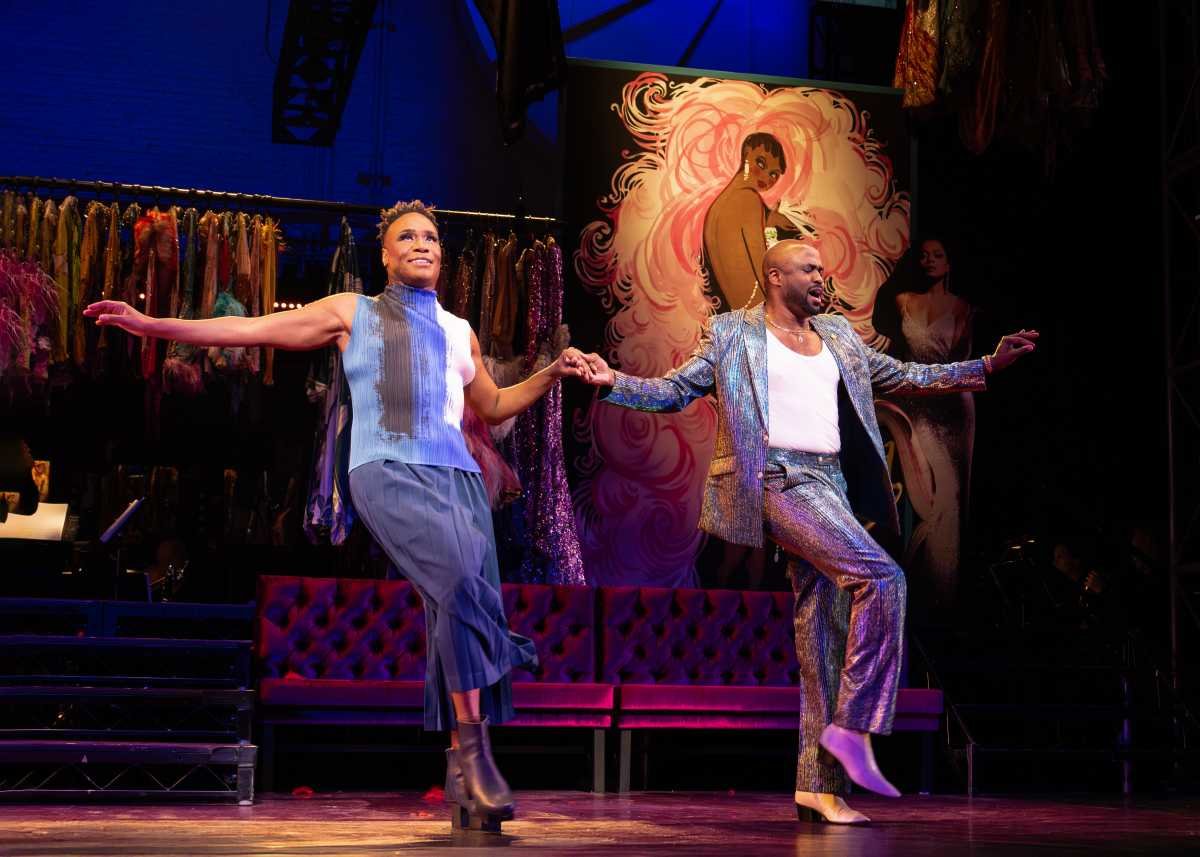
There were good reasons to welcome New York City Center Encores!’ revival of “La Cage aux Folles.”
It restores Jerry Herman’s 1983 score to a full orchestra — a welcome corrective after the 2010 Broadway revival downsized the sound. An all-Black company led by Billy Porter and Wayne Brady was an exciting prospect. And as drag entertainment is attacked in the supposed defense of “family values,” there is something especially apt about reviving a drag musical that defines those values through genuine love and loyalty.
But Robert O’Hara’s production is rough, underdeveloped and fundamentally out of step with the show it is trying to reinvent.
Based on Jean Poiret’s French farce, with a book by Harvey Fierstein, “La Cage aux Folles” still holds up as a musical comedy, with a wonderful, unabashedly old-fashioned score, colorful characters, laughs and a grounded emotional center. Beneath its feathers and sequins is the story of a long-married couple and the pain caused when a child asks one parent to hide.

Georges (Brady), the owner of a St. Tropez drag club, and Albin (Porter), its mercurial headliner, Zaza, have raised Georges’ son, Jean-Michel (Alaman Diadhiou). When Jean-Michel announces his engagement to Anne (Rachel Webb), the daughter of fiercely anti-gay politician Edouard Dindon (Peter Francis James), he asks Georges to pass as straight and Albin to disappear.
The setup is artificial, but it can be delicious when the farce is played with style, precision and speed. O’Hara, who directed Encores!’ “Jelly’s Last Jam” in 2024, is an unusual choice for this particular strain of old-school musical comedy. Setting “La Cage” in the present day makes its contrivances more conspicuous, without establishing a convincing relationship between its antique plot mechanics and contemporary queer politics.
The production’s treatment of Les Cagelles is similarly misguided. Instead of functioning as a unified drag chorus, the performers seem to have been broken up into individual nods to superstar divas and queer icons. The impulse to foreground individuality is understandable, but it leaves the club numbers scattered rather than exhilarating.
The orchestra sounds terrific, but it occupies so much of the stage that the design never establishes a coherent place for the action. The same cramped, makeshift space is asked to serve as the nightclub, its backstage area, Georges and Albin’s home and the outdoor locations. It succeeds as none of them.

The comedy never finds its footing. Fierstein’s book provides ample opportunities for disguise, panic and social collision, but the timing is loose and the farce rarely gathers momentum.
Porter is a persuasive Albin in conception. He understands the character’s theatricality, vanity, woundedness and flashes of rage. He and Brady have credible chemistry; they feel like a longtime couple with shared affection, irritation and desire.
Porter is heavily reliant on his script. That is not a problem in the Encores! context, but it made clear that he was still finding his way into the role and the production’s rhythms. His singing is uneven, with notes that can sound flat or strained. “I Am What I Am” has emotional urgency, but not the vocal command that Herman’s anthem demands.
Brady is a genial, appealing Georges, but his singing is too pop-inflected for Herman’s polished, old-school musical-theater style. Diadhiou is a winning dancer, but his singing also leans heavily toward pop and soul. James Jackson Jr. gets some of the evening’s cleanest laughs as Jacob, while Tonya Pinkins brings authority and glamour to Jacqueline, even if the role is underused.

The Encores! Orchestra is the evening’s triumph. The entr’acte (which serves as the overture on the original cast album) reveals the score’s sophistication, humor and warmth, and the curtain-call singalong of “The Best of Times” finally creates the elation the production has spent two acts chasing.
Comparison with “Cats: The Jellicle Ball” is unavoidable. That Black, queer-centered reimagining of another 1980s musical found a new theatrical language without losing the source material’s engine. It also had the benefit of a longer development process. O’Hara’s “La Cage” feels like an early pass at an idea that might work with more time, discipline and a clearer understanding of what should not be discarded.
For now, the best of times are mostly coming from the orchestra pit.
Through June 28 at New York City Center, 131 W. 55th St., nycitycenter.org.
