
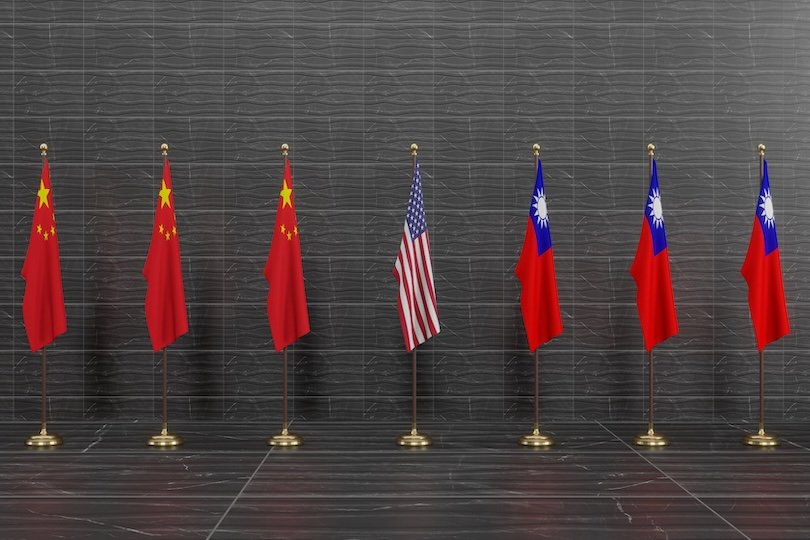
At the U.S.–China summit in May 2016, Xi Jinping stated that if the Taiwan issue was mishandled, China and the United States could fall into the Thucydides Trap. While some continue to use the original metaphor employed by the ancient Athenian historian to explain the current Taiwan issue, others point out that Xi’s underlying message was a warning to President Trump not to provoke war by interfering with China’s plan regarding Taiwan. It is critical to understand the real meaning of Taiwan’s Thucydides Trap in the context of Taiwan to avoid a possible war in the Taiwan Strait.
The original metaphor of the Thucydides Trap described the seemingly inevitable conflict between a rising Athens and a dominant Sparta, derived from the growth of Athens and Sparta’s fear. Taiwan’s Thucydides Trap involves three sides. The U.S. may block China from taking Taiwan. When Athens challenged Sparta, Sparta’s counterattack was certain; U.S. military involvement would be possible but not guaranteed. Moreover, China’s goal is not simply to replace the United States but to achieve unification with Taiwan, a process that involves a wide range of Asia-Pacific and global interests related to territorial sovereignty, global trade, and technology.
All the three sides—China, the United States, and Taiwan— are currently trapped in a vicious cycle: They seem to believe that military power can solve the ultimate conflict. China seeks unification through the enhancement of its military power; the United States relies on military power to maintain its deterrence strategy; and Taiwan emphasizes peace through strength as a core pillar of its national security strategy. However, if all three sides depend primarily on military buildups, they will escalate tensions instead of solving the potential Taiwan Strait crisis. The Thucydides Trap in this scenario is therefore not only a structural trap derived from conflicting interests, but also a trap of misperceptions and miscalculations among the three sides.
First of all, for decades, the United States has relied on strategic ambiguity and strategic deterrence to discourage both Taiwanese independence and Chinese military unification with Taiwan. The United States has believed that strategic ambiguity creates a balance: Beijing hesitates to attack Taiwan, and Taipei avoids provocation. However, ambiguity can also trigger miscalculation by leaving room for dangerous assumptions, because China might interpret the policy as a lack of U.S. resolve, believing Washington would not defend Taiwan. Taiwan could overestimate American support and neglect its own defense preparations. These misreadings could become a Thucydides trap, sowing confusion that sparks the very conflict they seek to prevent.
Strategic deterrence is based on the assumption that American comprehensive national power remains significantly stronger than China’s. However, if U.S. capabilities can no longer support credible deterrence and fail to prevent Chinese military action, it might be dragged into direct military confrontation with China. In that situation, the United States could find that its defense industry is not prepared for a long, high-intensity conflict between two global superpowers. At the same time, its domestic political polarization, high inflation, low public support, and insufficient cooperation from its traditional allies could weaken America’s ability to defend Taiwan effectively when a crisis occurs. Indeed, it is time for the United States to revisit its assumption of strategic deterrence and bridge the gap between its strategic goals and its actual capabilities, and to rebuild the credibility of its deterrence through concrete actions.
Another assumption of strategic deterrence is that China will not attempt to take over Taiwan by military force if it is convinced that the costs of a military campaign against Taiwan would far outweigh the potential gains. Essentially, from the CCP’s perspective, the political considerations of unifying Taiwan far outweigh the economic considerations. Since the founding of the People’s Republic of China, achieving national reunification has been a consistent political goal for successive top CCP leaders. The Taiwan issue has become increasingly urgent under the Xi Jinping administration. Xi has repeatedly stated that the Taiwan issue must not be handed down from one generation to another, as resolving the Taiwan issue would symbolize the formal end of the Chinese Civil War, complete China’s territorial claims, justify the CCP’s governing legitimacy, and eliminate the ripple effects of Taiwan’s democratic system.
Unlike China, the United States treats Taiwan as an international security issue. Although Washington does not formally recognize Taiwan as an independent state, it supports Taiwan’s right to self-govern, emphasizes the importance of peace and stability in the Taiwan Strait, and provides defensive arms to Taiwan as a democratic partner. However, China insists that Taiwan is an inseparable part of China’s territory, regarding reunification as a matter of national sovereignty, territorial integrity, and historical justice, and considers it the red line that the U.S. should not cross. This fundamental divergence in views of Taiwan has created a real Thucydides trap in U.S.–China relations.
Second, while many international observers believe Taiwan is already on the edge of war, more than half of Taiwan’s population does not see the situation as being so severe. Many hold the belief that war can be avoided as long as no accidental military clash occurs. According to recent polls, about 90% of Taiwanese people support maintaining the status quo. However, from Beijing’s perspective, an indefinite continuation of the status quo effectively resembles de facto independence. Although military unification remains China’s last resort, strategic miscalculation is often the most dangerous and most overlooked factor in the transition from a strategic frontline to actual war. In the past, China’s relative military weakness limited its options for unification. As China’s military advantage grows, the preferences of the country’s top leader become a decisive factor in determining whether military action is considered. China’s political power is becoming extremely centralized, and experienced military personnel have been ousted from the CCP’s Central Military Commission, which makes it easier for the top leader to make a decision on a military campaign.
Taiwanese politics are deeply divided, caught in a futile dilemma of either aligning with the United States to resist China or accommodating China to ensure coexistence. Such a debate is natural in a democratic society, but a highly divided Taiwan not only creates greater uncertainty for the future but also delays preparations for a possible war. In Taiwan today, the energy supply is fragile; basic infrastructure such as water, power, and finance lacks strong defenses against cyberattacks; natural gas reserves can sustain demand for only about 11 days; the communication system is vulnerable without a satellite backup system like Starlink; Taiwan’s asymmetric weapons rely heavily on imports and lack support from a strong domestic military industry; civilian defense awareness is extremely limited; although Taiwan has many reserve forces, their training is inadequate and unrealistic; and the mobilization speed of military and civilian defense forces in emergencies remains untested. These weaknesses could encourage China to attempt to seize Taiwan through military means.
Third, the Chinese political system has a persistent problem of bureaucratic filtering. Officials often report good news while hiding bad news, which can mislead the CCP’s top leadership regarding the strategic dynamics of the global context. If Beijing completely believes that “the East is rising while the West is declining” and ignores its own weaknesses, the top leader of the CCP could press the button for war under certain circumstances. To avoid the real Taiwan’s Thucydides Trap, it is wise for Beijing to make an objective assessment of both China’s comprehensive national power and the international opposition. If China ignores its weaknesses and miscalculates the response of the international community, a military campaign against Taiwan—expected to be a quick victory—could turn into a prolonged war of attrition or end in a stalemate. The consequences could threaten China’s social stability and even create risks of regime collapse. Any attempt at military unification would not simply involve military risks; it would amount to a gamble on China’s entire modernization project.
Finally, wars do not always result from miscalculations. In some cases, all sides might fully understand others’ intentions, capabilities, and the likely costs of conflict, yet the risk of war remains. On the Taiwan issue, China may clearly understand that a war could bring enormous economic, military, and political costs, but it may also conclude that the long-term strategic costs of inaction are even greater. Washington may also understand that confrontation with China is not in the best interest of the United States, while recognizing that choosing not to intervene could cause it to lose its global influence and ultimately its position as the world’s leading power. Therefore, Taiwan’s Thucydides represents not only a trap of misperception but also a trap of structural rivalry. Even if all three parties possess accurate strategic assessments, they can still fall into the Thucydides Trap, as each side is willing to pay substantial costs to achieve its goals. Given the history of the CCP’s development, the possibility that China may be willing to take extraordinary risks cannot be dismissed.
Further Reading on E-International Relations
