
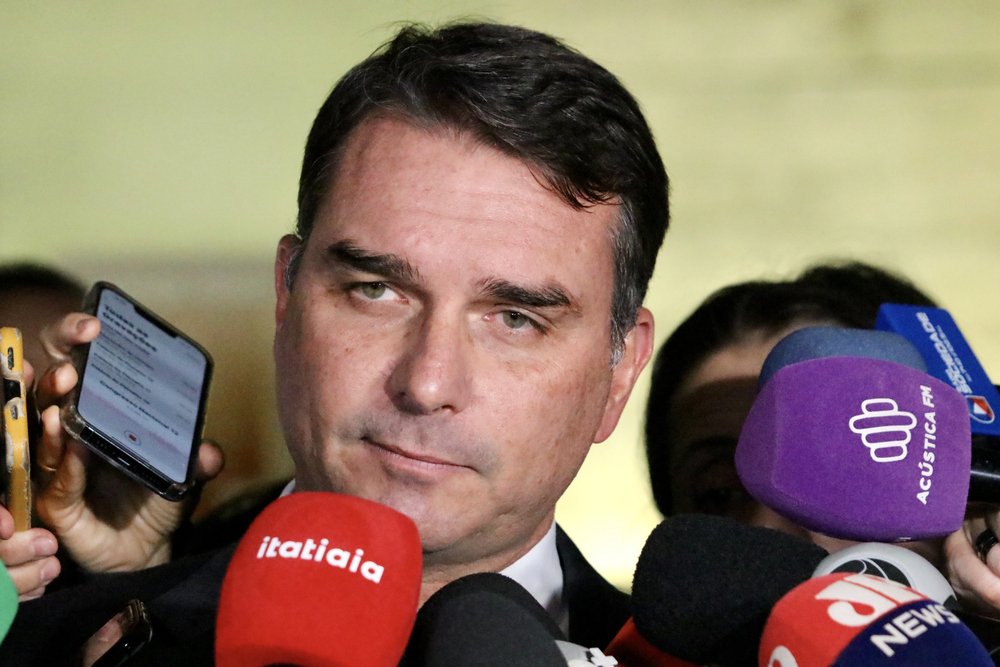
Six months before one of Brazil’s most consequential elections, current prospects suggest a landscape stalled in time. Though the country has a political system that is deeply fragmented into dozens of parties, polls have indicated that the presidential election of October 2026 is likely to be a two-man race reiterating the deep polarization that has been defining the last decade. Luiz Inacio Lula da Silva will run for a fourth presidential term, while most right-wing opposition parties will be represented by Flavio Bolsonaro, former president Jair Bolsonaro’s oldest son. One of the most surprising elements of this scenario is that despite the mismanagement of the Covid pandemic under his father’s presidential term (2019-2023), Flavio Bolsonaro, an unremarkable Senator from the state of Rio de Janeiro, is off to a good start. His numbers reflect the fact that Bolsonarism is the main platform for voicing positions held by the extreme right in the country. Bolsonaro’s supporters hold the largest base in Brazil’s both houses of parliament, with sustained influence and support across various segments of the country’s political, economic and ideological establishments. This includes broad sectors of the federal and state judiciaries and federal and state public ministries; especially state and local political bodies, such as state assemblies and city councils, as well as the most influential media conglomerates, and a vast array of professional and business associations.
Confirming the strength of the extreme-right across the Brazilian society, since his return to the presidency in January 2023, after a close race against Jair Bolsonaro – who likely only lost due to his consistently chaotic handling of the Covid crisis – Lula has not been able to obtain approval ratings above 50 percent. This measure provides an accurate snapshot of Brazil’s deeply divided electorate, which expresses profound societal divisions across the country. Trying to remain optimistic amidst growing concerning signs, Lula’s campaign believes that Flávio’s numbers will worsen once he becomes the main target of a campaign that will focus on bringing attention to his family’s multiple corruption cases. This seems optimistic, given that most of Flavio’s supporters are aware of such cases but state that they still prefer a Bolsonaro to having to continue to live under Lula. Flavio’s prospects may also derive from the fact that another of his purported shortcomings, his lack of charisma, could, in the end, prove to be an element of strength as voters might see him not as a replica of his father – but someone who could offer something different.
Adding to Lula’s challenges, a recent poll showed that should the election go to a second round, any anti-Lula candidate would likely manage to rally supporters of all other potential right-wing candidates against the sitting president. Further complicating things for Lula, the High Electoral Tribunal that oversees elections in Brazil is going to be led by two Supreme Court Justices appointed by Bolsonaro whose voting record display a clear willingness to act in support of his political agenda.
It is important to remember that the political history of Brazil has been defined more by conservative leaders and positions than progressive ones. In fact, though Lula managed to be elected three times, this only happened after three failed attempts and only in very special circumstances: in 2002, when the country faced a serious economic crisis, in his 2006’s reelection, when the country was conversely experiencing an economic boom, and in 2022, after the Covid crisis. What is more, it seems increasingly clear that today’s socio-ideological and religious composition of Brazilian society creates an ominous scenario for Lula’s reelection bid, as well as for more progressive politics in general.
The country has an older, more educated, while also more religious and conservative population that is more attached to the neoliberal narrative of entrepreneurialism and market-driven policies. All these factors will likely help the right wing, including its extreme version headed by the Bolsonaro clan. Moreover, the problem of violence, particularly in the country’s many big city centers, plays against the sitting government, and the appealing anti-corruption narrative tends to be especially problematic to the left, even though the Bolsonaro family and their associates have been involved in many corruption scandals over the years.
Thus, there is a possibility that next president of Brazil might again be a Bolsonaro. While this would represent a major redirection in what the country has been trying to achieve in the last three and a half years, the implications of this outcome clearly extend beyond national borders. The international dimension of the election is becoming evident not only due to its regional relevance, but also because of the potential global impact of its choices on strategic issues such as critical minerals, climate change, digital platform regulation, models of artificial intelligence development and infrastructure for global trade.
For Brazil–U.S. relations, the near-term outlook is one of greater uncertainty. Clearly depending on the outcome of the election, Brazil might indeed experience different types of interactions with US leaders, particularly Trump himself. And though Lula has managed to appease Trump’s initial aggressive measures, frictions are reemerging as the election gets closer. The promised meeting between Lula and Trump seems increasingly unlikely, while new sources of friction have emerged, including congressional scrutiny of the Brazilian payment platform Pix, which could result in the reimposition of tariffs on various of Brazil’s most important exports. Moreover, considering the close ideological ties between the Trump and Bolsonaro families, especially by means of the well-established connection between Jair’s third son Eduardo, who has been living in the US for the last 12 months, and one of Trump’s main ideological influences, Steve Bannon, many believe that having the Bolsonaro clan back in power would help relations with the US. Though this would require that Brazil offers concessions to the US, such as preferred access to its rare earth reserves and stopping regulatory legislation on big tech.
Repositioning Brazil towards a closer, more dependent relation with the US would also require that Brazil assumed a lower profile on the global arena, particularly as a representative of the Global South and, more important, a key player in the BRICS+. What is more, Brazil’s strong economic ties with China would need to be reframed to align the country towards Trump’s increasing aggressive opposition to that emerging superpower. This will not be easy for Brazil, but it seems certain that having a Bolsonaro back in power would be preferred by the Trump administration. All in all, Brazil is likely to experience an outcome that will help reshape the course of the country’s domestic and international policies in the upcoming years. Something that given the increasingly relevant role Brazil plays in the world, makes this one to watch globally.
Further Reading on E-International Relations
