
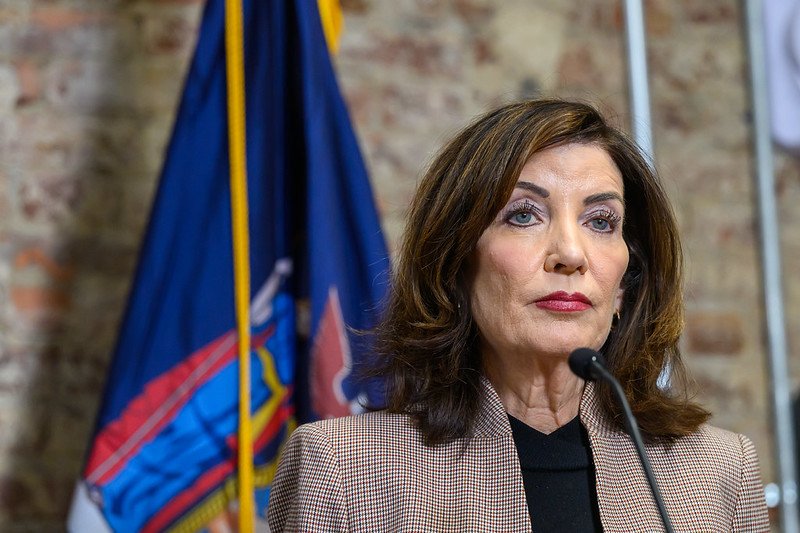

Gov. Kathy Hochul says President Trump is throwing a “temper tantrum” by refusing to release Gateway Tunnel project funds. Tuesday, Feb. 10, 2026.
(Susan Watts/Office of Governor Kathy Hochul)
Gov. Kathy Hochul has centered her affordability agenda on proposals she says will lower auto insurance premiums. But her plan amounts to a giveaway to Big Insurance and ride-hailing giants like Uber, at the expense of taxpayers and crash victims who will find the courthouse doors slammed shut when they seek justice.
At its core, this debate is not just about insurance premiums. It is about the Seventh Amendment. It is about whether people, not corporations, get to have their day in court when they are harmed.
We also know the system is already stacked against working families. Auto insurance pricing often functions like a form of modern redlining, where premiums are driven by ZIP code and credit score rather than driving record. The result is deeply inequitable: safe drivers in lower-income communities, often communities of color, can pay far more than riskier drivers in wealthier areas.
Weakening access to the courts only makes matters worse.
Civil justice has long been one of the most powerful tools for accountability in this country. It is how families seek answers and justice after preventable tragedies. It is how dangerous practices are exposed and changed. From police misconduct to unsafe products to corporate negligence, the right to a jury trial ensures that no one is above the law.
The cases I have been honored to work on — involving Trayvon Martin, Eric Garner, George Floyd, and Breonna Taylor — reflect that principle. But for every high-profile case, there are countless others that never make headlines: families devastated by crashes, workers injured on unsafe job sites, patients harmed by medical negligence. Their access to justice matters just as much.
That is precisely why powerful corporate interests are pushing to limit that access. Across the country, including in California, big insurers and ride-hailing corporations have backed efforts to restrict the civil justice system. Now, these forces are spending tens of millions in Albany to advance proposals that would weaken New Yorkers’ Seventh Amendment rights.
The jury system works. When cases are heard publicly, wrongdoing is exposed and behavior changes. Accountability makes our roads safer, our workplaces more secure, and our institutions more just. Taking that away does not lower costs. It simply shifts them onto victims, families, and taxpayers.
Hochul claims “the insurance companies didn’t create this system — it’s not on them — it’s a sympathetic jury not listening.” Insurers shaped this discriminatory system, and juries are not a flaw—they are the constitutional safeguard that ensures fairness and accountability.
And while some point to fraud as justification, that argument does not hold up. Fraud is already illegal and should be prosecuted. It should not be used as a pretext to take rights away from law-abiding New Yorkers.
The governor’s proposal, in effect, asks working families to give up a constitutional protection in exchange for promised savings that may never come. That is a trade no one should accept.
The question before New York is simple: Will we stand by the Seventh Amendment and the principle of equal justice under law, or will we allow access to justice to be restricted when it matters most?
We should be expanding fairness and transparency, not closing the courthouse doors.
Ben Crump is a civil rights attorney known for representing families in high-profile cases involving police misconduct.
