
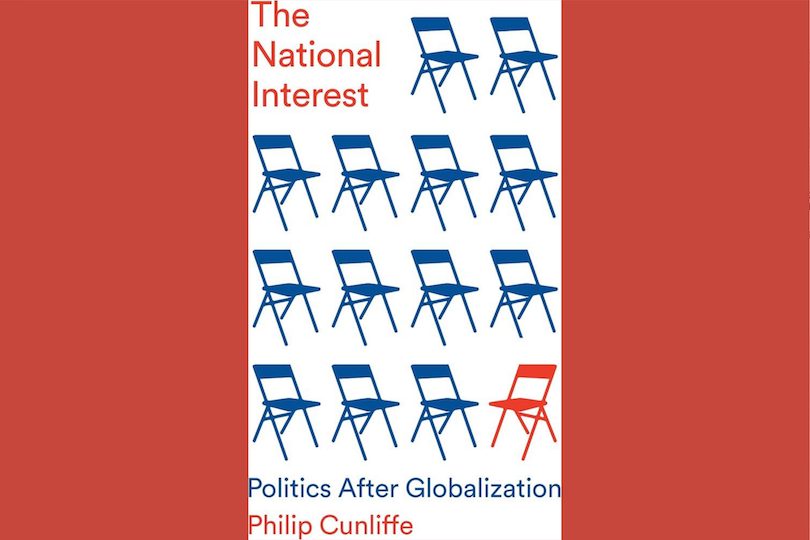
The National Interest: Politics After Globalization
By Philip Cunliffe
Polity, 2025
For the bulk of the post-Cold War period, centrist liberals had been associated with economic globalization, multilateral institutions and cosmopolitanism. Liberals may have been aligned with nationalists against the conservative empires of the 19th century and the communist ones of the 20th. But in the 21st century, mainstream Western politicians have insisted that nationalist demagogues pose a threat to liberal democracy. Then, something bizarre happened with Russia’s full-scale invasion of Ukraine in February 2022: nationalism made a comeback in the West, but only in a limited way. “Populist” political forces continued to be associated with chauvinism and xenophobia by the class of bien pensants. But at the same time, despite its historical association with a darker historical undercurrent of Ukrainian nationalism, it became perfectly acceptable for Western liberal politicians to chant “Slava Ukraini!” In other words, Western nationalism, bad; Ukrainian nationalism, good (pp.119-22).
This is just one example of several that Philip Cunliffe covers in his recent book The National Interest: Politics After Globalization, exhibiting Western countries’ ongoing inability to put their foreign policies on coherent conceptual footing. Cunliffe argues for a return to a politics based on the national interest after decades of growing postwar transnationalism – and that such a world has the potential to be more peaceful than a world of competing abstract principles (2025, p.54).
After the Cold War and the collapse of the Soviet Union, liberal principles emerged unchallenged in their ability to capture modernity – and hegemonic in their ability to shape it. Yet, liberalism has a long history of malleability, at times defending cultural pluralism and at others, uncompromisingly promoting liberal ideals. With the war in Ukraine, we have witnessed another transformation, away from the triumphalism of the “end of history” and back toward Wilsonian idealism and the defence of national self-determination. No longer praising interdependence as the foundation of perpetual peace, liberals now champion Ukraine’s “right to choose” and now warn of the risks of “weaponized interdependence.”
Yet, despite liberalism’s ability to defend opposing ideas at different historical junctures, one thing did not change: support for transnational institutions such as NATO. In recent years, the challenge to liberalism’s monopoly over international term setting has not led Western elites to question the foundations of the liberal order and rediscover the national interest. Rather, they have doubled down on the status quo.
Cunliffe traces transnationalism’s rise not to the birth of neoliberalism, but rather to the Second World War, when democratic enfranchisement was peaking. This aligns with Ian Clark’s assertion that the Cold War was a prerequisite for unleashing the forces of globalization, even prior to the neoliberal era (Clark, pp.199-201). In Cunliffe’s telling, political elites fled growing pressures for accountability at the national level by seeking refuge in a transnational hinterland, with “the West” and “the free world” superseding the national interest. This shift has proven remarkably durable, with NATO surviving long enough to defeat and then gradually reinvigorate the Russian threat. The endurance of rigid alliance systems has come at the expense of a more flexible foreign policy based on what Lord Palmerston called “permanent interests,” fostering the development of a national security state and eroding democratic discourse by placing certain topics outside the bounds of legitimate discussion.
After the Cold War, Western foreign policy has been conducted in recent decades on largely ideological grounds. The “liberal international order” envisioned a global transformation, with the West adopting “some sort of tutelary relationship” with the rest of the world (Sakwa, p.42). But the military campaigns waged in the liberal order’s name failed to achieve their desired results. As Cunliffe (p.30) notes, “the technocrats sagely discussing state capacity in Western states today are the heirs of the global technocrats who failed to build state capacity in countries such as Mali, Iraq, Congo and Afghanistan across the early 2000s.”
The abandonment of an interests-based foreign policy has produced policy disasters that have made it much harder to claim that the alternative to the West’s preferred outcome in Ukraine is the “law of the jungle.” The jungle, in reality, had never quite disappeared. Quite often, the West itself was the jungle’s principal progenitor, only in faraway lands where its impact could not be immediately felt. In fact, the pursuit of impossible-to-achieve ideological goals (such as ending tyranny) ensured that the decline of the national interest would be accompanied by endless war rather than utopia.
Cunliffe’s polemic in defence of the national interest therefore appears at an appropriate juncture. In the leadup to the war in Ukraine, transnational institutions were a significant part of the problem. All too often, the amount of energy expended in coordinating common positions among EU or NATO members left little space for substantive negotiations with Moscow. Statements of symbolic unity ended up replacing a more durable model for European security in which no leading stakeholder is excluded (Paikin, 2022). Self-congratulatory pats on the back that Europe was becoming a “geopolitical actor” have encouraged disparaging attacks against member states that have lent their voice to the cause of peace.
At the same time, transnational institutions have become entrenched to the point where they are also an unavoidable part of the solution. Persuading Kyiv that peace is preferable to war for “as long as it takes” will require the EU to promise it a credible path to economic reconstruction and eventual membership. Moreover, while the norms that international institutions codify should not be interpreted so inflexibly as to be cited at one another formulaically and accusatorily, they nonetheless offer a vocabulary for common aspirations and a sense of shared legitimacy that is foundational to any international order.
What Cunliffe calls transnational institutions are thought of in English School theory as “secondary” institutions, whose purpose is to provide a tangible manifestation of the deeper “primary” institutions of international society such as sovereignty, nationalism and the balance of power (Knudsen, 2022). In this sense, the national interest need not be posited against secondary institutions in zero-sum fashion. Rather, specific secondary institutions may have come to be in tension with those primary institutions whose guiding logic has not been entirely superseded by the advent of a so-called rules-based international order. The degree to which secondary institutions can be brought into “realignment” with international society’s shared goals – and, indeed, the extent to which such goals still exist – remain germane questions.
Still, Cunliffe’s call for a course correction is long overdue and captures an essential element of what is missing amid today’s growing global disorder. He not only diagnoses the problem but also offers a way forward. Recapturing the national interest may not, on its own, fill the gap of what plagues international society today. But given that Cunliffe (p.113) argues that Western populists have also failed to depart meaningfully from the transnational structures that have marked the past several decades, his book serves to reminds us that any transition toward a more stable and less contested international order is only just beginning.
References
Clark, I. (1997). Globalization and Fragmentation: International Relations in the Twentieth Century. Oxford: Oxford University Press.
Cunliffe, P. (2025). The National Interest: Politics After Globalization. Cambridge: Polity Press Ltd.
Knudsen, T.B. (2022). ‘The Relationship Between Primary and Secondary Institutions: Theorizing Institutional Change’, in Flockhart T. and Paikin Z. (eds.), Rebooting Global International Society: Change, Contestation and Resilience. Cham: Palgrave Macmillan, pp. 79-105.
Paikin, Z. (2022). ‘Europe’s “unity” for the sake of “unity” against Russia is misguided’, Responsible Statecraft. Available at: https://responsiblestatecraft.org/2022/02/24/europes-unity-for-the-sake-of-unity-against-russia-is-misguided/ (Accessed: 5/1/2026)
Sakwa, R. (2017). Russia Against the Rest: The Post-Cold War Crisis of World Order. Cambridge: Cambridge University Press.
Further Reading on E-International Relations
