
(RNS) — In a famous 1790 letter, President George Washington assured the Jewish community of Newport, Rhode Island, that in the United States, religious minorities would not merely be tolerated, but recognized as full and equal members of the political community.
“All possess alike liberty of conscience and immunities of citizenship,” he wrote. “It is now no more that toleration is spoken of, as if it was by the indulgence of one class of people, that another enjoyed the exercise of their inherent natural rights.”
But today, the growing influence of Christian nationalism is jeopardizing the pluralistic democracy Washington envisioned and shaping public policy in ways that could determine who is able to participate fully in that democracy.
Christian nationalism is a political ideology that seeks to preserve the supposed Anglo-Protestant heritage of our country and embed a particular form of conservative Christianity in American government. We are seeing it in efforts to introduce Bible study into public schools, in increasingly explicit religious language from government officials and in a broader insistence that American identity is rooted in Christianity.
Republican Sen. Josh Hawley of Missouri declared in 2024: “We are a nation forged from Augustine’s vision … a nation defined by the dignity of the common man, as given to us in the Christian religion. … Some will say I am calling America a Christian nation. And so I am.”
Hawley went on to claim that “Christian nationalism founded American democracy,” insisting that America protects religious liberty and welcomes people of many backgrounds because of that Christian heritage.

U.S. Sen. Josh Hawley, R-Mo., speaks at the National Conservatism Conference in Washington, D.C., July 8, 2024. (Video screen grab)
That may sound reassuring. But it isn’t.
Hawley’s comments suggest that Americans’ freedoms flow not from the “inherent natural rights” Washington described, but from the country’s Christian character. In that framework, rights are not simply guaranteed — they are conditioned by a particular understanding of national identity.
This is not only a matter of rhetoric. The idea that rights are conditional is increasingly shaping public policy, including proposals that would redefine access to the ballot.
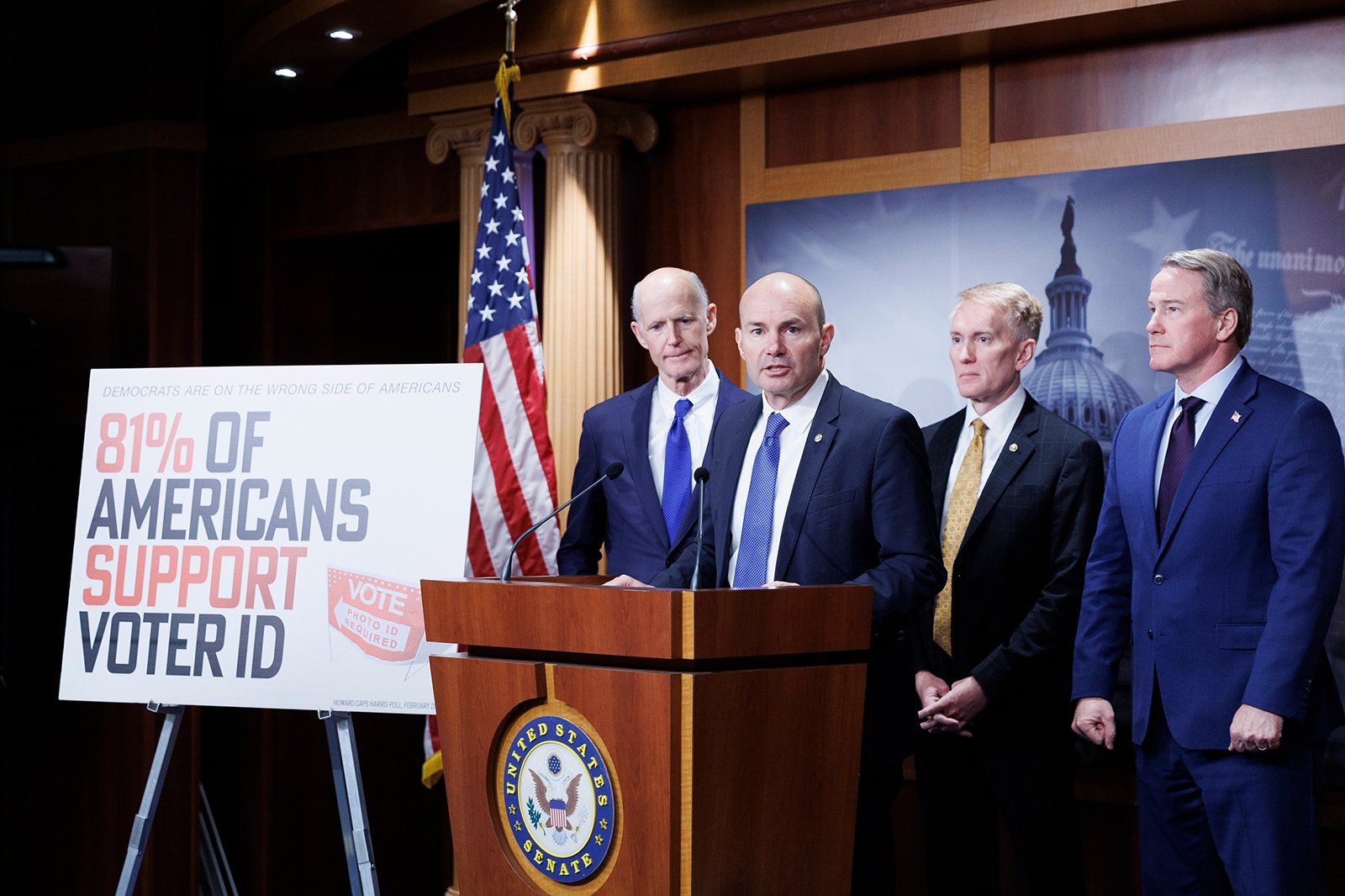
A bill moving through Congress, the SAVE America Act, would require voters to present proof of citizenship like a passport or birth certificate to register to vote.
At first glance, that might seem like a reasonable procedural change. But in practice, it would shift the burden from the government to the citizen. Instead of the government having to demonstrate that someone is not eligible to vote, individual Americans would have to prove that they are.
For many, that would not be simple. Millions of eligible voters do not have ready access to passports or birth certificates. Married women whose names have changed, elderly citizens without current documentation and lower-income Americans would face new hurdles in exercising a fundamental right.
Anyone who has dealt with government agencies knows how difficult it can be to obtain official records. Delays, misplaced files and bureaucratic errors are frustrating under any circumstances, but once our ability to vote depends on those documents, those frustrations become politically consequential.
And the risk does not end with inefficiency. The state can apply voter identification systems unevenly — whether through neglect, bias or deliberate action. When the burden falls on citizens to challenge those barriers, correcting injustices can take years.
Concentration of state power rarely happens all at once, but gradually and quietly. Then, one day a new ruler arises — a king who “knows not Joseph” — and suddenly everything changes.
The Jewish people’s experiences in countries like Spain and Germany show how fragile a minority group’s existence can be when it depends on the goodwill of the state. That is precisely the kind of society Washington was determined to prevent.

Rabbi A. Brian Stoller. (Courtesy photo)
The question now is whether we will preserve the pluralistic community Washington called into being — a nation where belonging is secure, where rights are inherent to all citizens and where no American lives here merely by the indulgence of someone else.
What we do now matters. And time may be running out.
(Rabbi A. Brian Stoller is senior rabbi of Temple Beth-El of Great Neck, New York. His book, “Politics & Pluralism: Essays on Democracy, Antisemitism, Power & Culture in an Age of Polarization,” was published earlier this year. This op-ed is adapted from a recent sermon. The views expressed in this commentary do not necessarily reflect those of Religion News Service.)
