

My primary goal for this site is to help you achieve financial freedom sooner rather than later. And if you’re still on your path to financial freedom, sending your children to private grade school often works against that objective.
I’ve experienced freedom from bosses, work travel, rush hour commutes, and client pressures since 2012. And I can unequivocally tell you the sacrifices you make to reach FIRE are well worth it. Your health improves. Your happiness increases. And you finally have the space to find something meaningful to do with your one and only life.
In this post, I want to highlight the latest private grade school tuition figures out of New York City and remind you to run the numbers before taking the plunge. The opportunity cost is not pretty.
The last thing you want is to sacrifice 10+ years of retirement just to send your child to private grade school, only for them to graduate, attend the same colleges, and pursue the same careers as everyone else who didn’t pay an arm and a leg for education.
The Private Grade School Debate Began Before Our Children Were Born
Paying for private grade school tuition is something I’ve debated since 2016, a year before my son was born. We visited a couple of private grade schools in Honolulu, and I wrote about whether paying for private school was worth it.
Like most parents, we initially paid for private preschool because cities don’t provide free childcare to families not in poverty. Then COVID hit, and my wife and I homeschooled our son for 18 months both because we could and to protect our daughter, who was born in December 2019.
It was refreshing to get a break from tuition. But as our investments grew and our desire for bilingualism increased, we decided to send our kids to a Mandarin immersion school.
Today, the cost is about $44,000 per child per year, or $88,000 in after-tax income for our two children. At a 30% effective tax rate, that requires roughly $125,000 in gross income just to cover tuition.
That’s a lot of money, taking up about 34% of our passive income. As a result, I’m still constantly reassessing each year whether it’s worth it.
The Value Of Mastering A Second Language Matters To Us
That said, our kids are happy, the school is excellent, and we highly value learning a second language. I’d personally pay $500,000 or more to be fluent in another language. When you can truly speak a second language, your world expands.
I loved living in Taiwan for four years as a kid and studying abroad in China for six months in 1997 during college. Learning to think and dream in another language is a gift. It’s almost like being FIRE, where you get to live two lives before and after retirement, but mentally.
Just imagine how much more you would’ve enjoyed the 2026 Super Bowl halftime show featuring Bad Bunny if you understood Spanish.
Debí tirar más fotos de cuando te tuve. Debí darte más beso’ y abrazo’ las vece’ que pude. As a FIRE practitioner who understands how fleeting life is – and how quickly our kids grow up – I feel these lyrics from the song, DtMF.
Too bad, after four years of studying Spanish in high school, and two years living in the Spanish House at William & Mary, my Spanish is terrible. I wish I started studying sooner.
Paying Private Grade School Tuition At The Expense Of Your Financial Health
Let’s be honest. Learning a second language is no longer necessary, especially if you don’t plan to live abroad. English dominates, and technology now translates languages instantly and for free.
Much like college, mastering a second language has become a growing luxury. There are also public schools that teach second languages for free, though very few start as early as preschool.
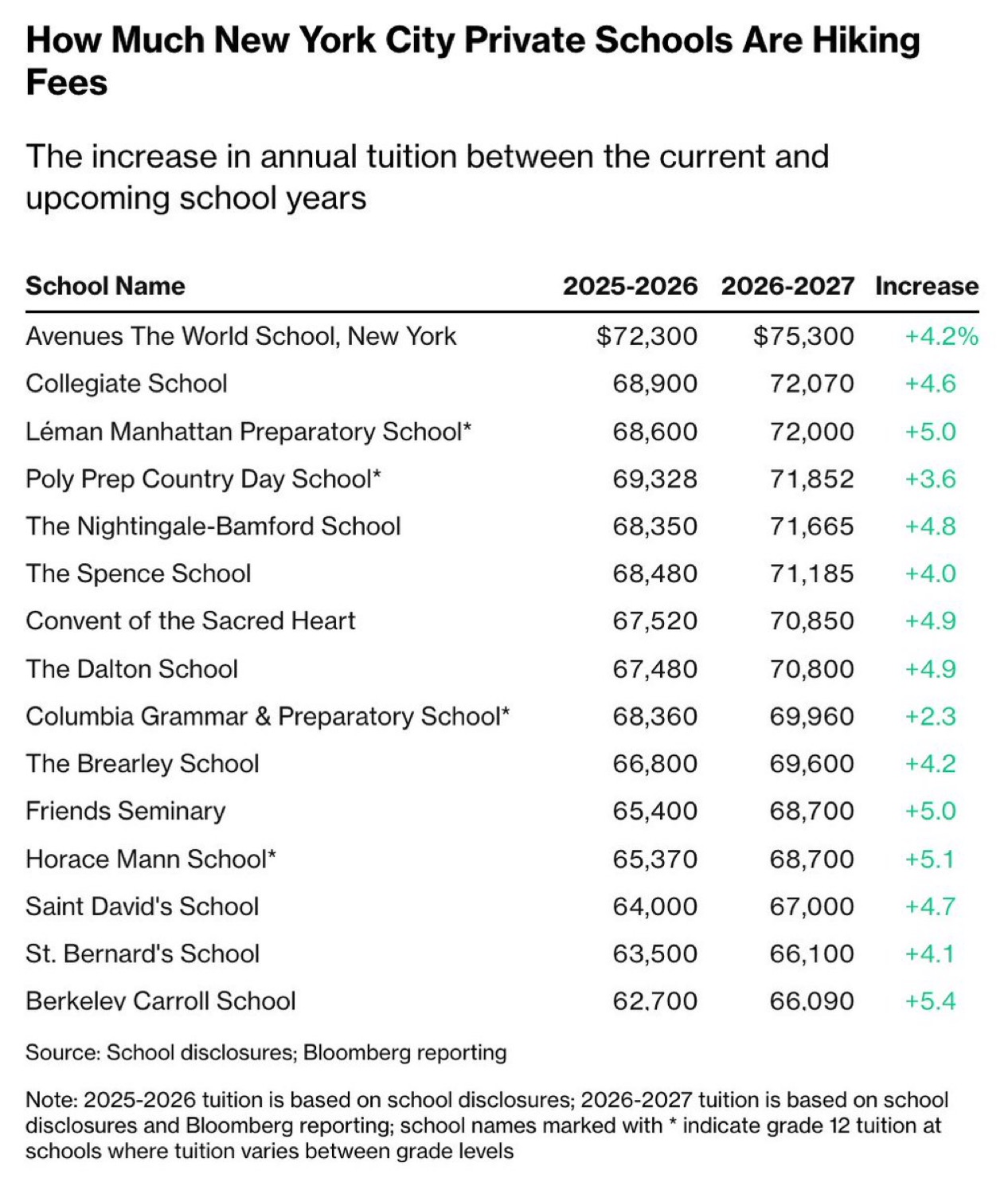
So when I saw the latest New York City private school tuition for 2026–2027, I was impressed. Even though some debate it, New York City is at least 20% more expensive than San Francisco. Seeing schools charge $70,800 to $75,300 per year is staggering.
At a 30% effective tax rate, a family needs to earn at least $100,000 in gross income just to pay annual tuition for one child.
Three Types Of Families Who Send Their Children To Private School
After four years of private schooling and speaking with hundreds of parents, there are three main groups who send their children to private school:
The ultra-wealthy, earning well over $1 million a year and/or with net worths well north of $20 million. To them, $70,000+ per child barely registers. They’re happy to spend freely on education. I estimate they make up about 20% of all private school families.
Lower-income families, typically earning under $200,000, who receive substantial financial aid. These families often make up about 20% of the student body. The $200,000 cutoff aligns with standards used by elite universities like Yale and Harvard. I estimate they also make up 20% of all private school families.
The mass affluent, or HENRYs, earning roughly $300,000–$600,000. They earn too much for meaningful aid but not enough to feel comfortable paying full tuition. This is the type of family who has a chance to FIRE, but ends up working 60 hours a week and grumbling about life, partially due to private grade school. I estimate these make up the bulk of private school families, about 60%.
If you’re ultra-wealthy or heavily subsidized, private school is manageable. It’s the mass affluent class that gets squeezed, paying 80%–100% of tuition while deciding whether private school is worth the tradeoff.
Run The Numbers On What Private School Tuition Really Costs
Let’s assume when your child turns five and enters kindergarten, you start investing $70,000 a year for 13 years instead of paying private school tuition. Your contributions increase by 5% annually, and you earn an 8% annual return. By the end of that period, you would accumulate roughly $2.1 million nominally. Adjusted for 3% annual inflation, that equates to about $1.43 million in today’s dollars.
Reduce the starting contribution to $50,000 under the same assumptions – 5% annual contribution growth, 8% annual returns, invested for 13 years beginning at age five – and the ending value comes out to roughly $1.5 million nominally, or about $1.02 million in today’s dollars after adjusting for 3% inflation.
That’s the real cost of private school, not just the tuition price. And I haven’t even included 1-3 years of preschool tuition, which can easily run $25,000 $60,000 a year.
If you’re middle class, sending your kids to public school and investing the difference is often the smarter move. Giving each child $1 – $1.4 million in today’s dollars when they turn 18 is hard to argue against.
Ask your kid if they’d rather have a million dollars at 18 and attend public school, or attend private school and receive nothing. The answer is obvious.

Years Taken Away From Retirement
Now let’s apply this to a real household.
Assume a $500,000 household income in New York City. Two children require roughly $200,000 in gross income annually for private grade school tuition alone. After taxes and living expenses, the household saves $50,000 a year, or 10 percent of gross income. Respectable, but not exactly aggressive if your goal is financial independence.
Let’s assume that $50,000 is invested annually at an 8 percent return.
To accumulate $1.02 million after tax (roughly the lower-end inflation-adjusted opportunity cost for one child), it would take about 12 to 13 years of consistent saving.
To accumulate $1.43 million after tax (the higher-end inflation-adjusted opportunity cost), it would take about 15 to 16 years.
That is per child.
If you have two children, you are looking at roughly 15 to 20 additional working years to replace the lost compounding, assuming markets cooperate and you stay disciplined.
Do you really want to work an extra decade or two so your child can attend private school from age five to eighteen?
If you already have the wealth or substantial free financial aid, the decision is easier. But if you are middle class and grinding toward freedom, you must be honest about the tradeoff.
You are not just buying education. You are potentially selling years of your life.
Now image how many more years the parents have to work if they only make $300,000 a year? A lifetime!
And remember, when you spend this much on private education, expectations rise. Parents naturally hope for elite colleges, exceptional careers, and financial outperformance. When outcomes end up similar to those of public-school peers, disappointment can creep in.
The Rich Are Really Rich
Now you see how wealthy families comfortably afford $70,000 per year for 13 years. To them, spending $1–$2 million per child doesn’t materially dent net worth.
A $20 million portfolio growing 10% produces $2 million in gains. That single year of returns can cover decades of tuition.
For these families, private school is the default choice. Even if there’s only one fewer student on average per class, it’s worth the tuition.
The top 20 percent of families are effectively expected to subsidize the bottom 20 percent through higher tuition. Meanwhile, the remaining 60 percent of families earning upper middle class incomes are the ones getting stretched the thinnest.
Income And Net Worth Guidelines
If you want the option to retire before 60, earn at least 7X net tuition per child. Paying $70,000 means earning roughly $490,000 with one child, or $980,000 with two. With a $20,000 discount, $350,000 for one or $700,000 for two, may suffice.
After 2020, I raised the guideline from 5X to 7X as education ROI declines due to technology. However, you can still use the 5X guideline if you wish.
For net worth, aim for 25X net tuition, excluding your primary residence. In other words, Paying $71,000 requires at least $1.78 million in investable assets per child.
While 25X is a bare minimum for FIRE, tuition is temporary, and assets usually compound faster than tuition inflation. Further, I assume you’re still working and adding to your retirement portfolio.
If these guidelines sound harsh, don’t worry. They are guidelines, not rules of law. If you choose not to follow them, just be honest about the tradeoff and model more years of work and fewer years of retirement. That approach works well if you truly love what you do.
Why I’m Still Uncomfortable Paying So Much
As FIRE parents in San Francisco, we’re considered middle-to-low income but have high net worths after decades of compounding. We pay full tuition, donate what we can, and feel the squeeze. Nearly all of our passive income now goes toward living expenses.
That’s normal post-FIRE. Kids are excellent decumulators of wealth. Still, spending this much after 20+ years of aggressive saving is uncomfortable. I’m making progress, but probably still need a few more years to be fully comfortable.
Long term, I’d rather relocate to Honolulu before high school, where tuition in San Francisco is currently around $60,000 a year. Private tuition there is closer to $36,000 per year through high school, saving between $8,000 – $24,000 a year after tax per kid.
That tradeoff alone could let me fix my 11-year-old car stress free and buy endless amounts of the best Hawaiian poké and mangos. I gotta say, that sounds pretty amazing to me!
Are you a mass affluent parent paying private grade school tuition? If so, how do you justify the cost, and are you prepared for you or your spouse to work many more years than necessary? And have you ever asked your child whether they would rather attend public school and receive over a million dollars at 18, or attend private school and receive nothing?
Suggestions For A Better Life
If you have debt and children, protect your family with an affordable life insurance policy through Policygenius. My wife and I both secured matching 20 year term life insurance policies during the pandemic to protect our two young children, and once we did, a tremendous amount of financial worry disappeared.
If you want to hedge against AI disrupting your children’s livelihoods once they graduate, check out Fundrise Venture. It invests in some of the top private AI companies, including OpenAI, Anthropic, and Databricks. Investing in AI has made me feel much better about all the disruption ahead. The minimum investment is just $10.
To expedite your journey to financial freedom, join over 60,000 others and subscribe to the free Financial Samurai newsletter. You can also get my posts in your e-mail inbox as soon as they come out by signing up here. Financial Samurai is among the largest independently-owned personal finance websites, established in 2009. Both Policygenius and Fundrise are affiliate partners of FS.
