
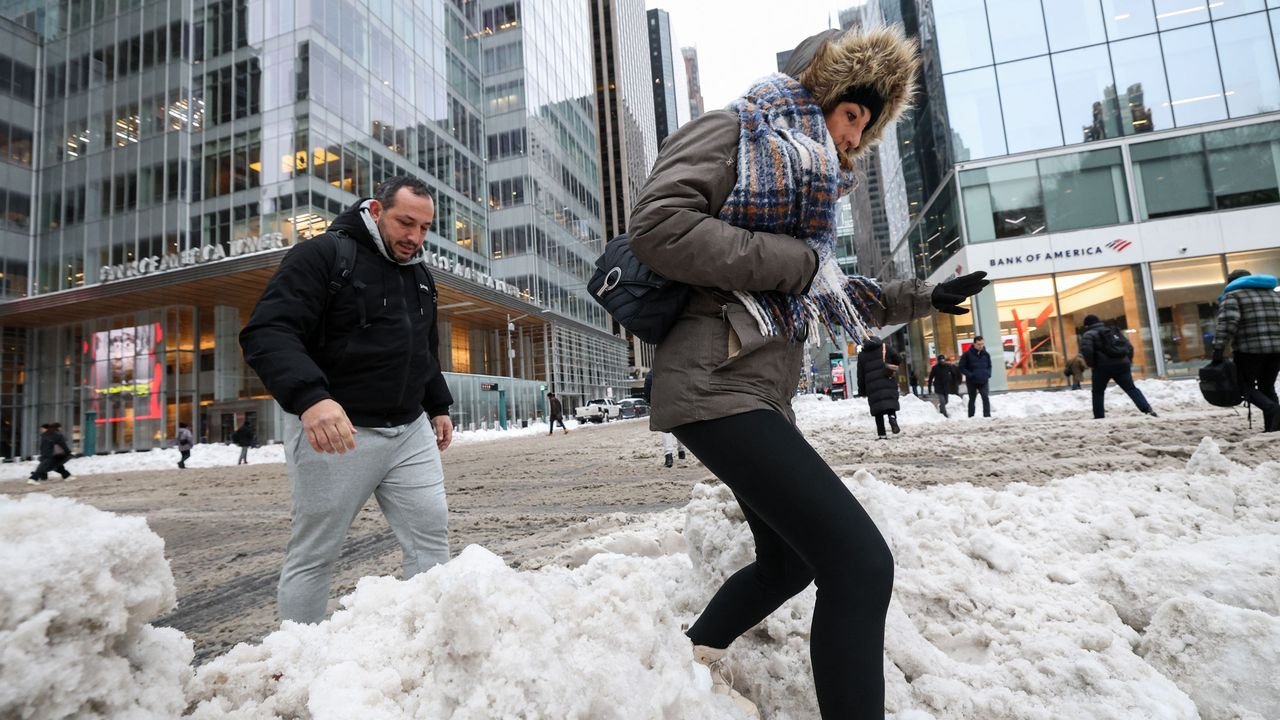
The other day, at the intersection of 174th Street and Broadway, in Washington Heights, I met Joshua Goodman, a deputy commissioner at the Department of Sanitation, to watch the destruction of a few sneckdowns. It was the sixth day in a row below freezing, and Goodman wore a green D.S.N.Y. jacket, a gray beanie, and duck boots. Together, we watched a skid steer, a maneuverable miniature excavator, attack a sneckdown that had built up on a street corner, near a gas station. Conditions were tough. Handheld tools sometimes broke. “These are one of the only things that can break an ice boulder,” Goodman told me.
Not every pile of ice is a sneckdown. There is a complex taxonomy. (It helps to know your enemy.) Sanitation workers call sneckdowns corner caps. The narrow path through a sneckdown that lets people cross the street is known as a “curb cut.” A blocked-off bus stop is not a sneckdown. “I’ve seen people post their own photos and I’ll be, like, ‘Well that’s not a sneckdown,’ ” Eckerson told me. One helpful heuristic: if you can see tire tracks, it’s not a sneckdown—the cars have been using it. Whether the furrow of snow in a lane of parked cars is a sneckdown depends on your philosophical opinion of what the street is for.
Most of the time, when people complain about lingering, no-man’s-land snow, they are complaining about something called the curbline. This is the snow that piles up between the cleared path of the sidewalk and the street, often against parked cars, maybe crowned with trash. Property owners don’t have to clear more than a four-foot-wide path, enough for a stroller or a wheelchair; the city doesn’t have to, either.
Goodman told me it’s simple: if snow is on the street, it’s the city’s responsibility. If it’s on the sidewalk, it’s the property owner’s. But there are complications; the snow around a parked car is the responsibility of the driver—even though it’s on the street. If a bus stop is sheltered, the Department of Transportation is on the hook. A regular bus stop is the responsibility of the property owner whose place abuts the stop, but the city must insure that the bus can pull up to the curb. Previous mayors, Goodman told me, thought it was fine as long as the bus door could open. This year, Mamdani insisted to Sanitation that there be pedestrian access at every stop.
On Broadway, a crew of emergency shovellers, whom the city pays a starting rate of $19.14 an hour, were deployed to another corner, outside a radiologist’s office. One shoveller, Anthony Gutierrez, who is normally a truck driver, was hacking away at a sneckdown with an ice scraper. Next to him, Daniel Johannes wore a bright orange vest that said “laborer” and an ushanka hat. “I have shovelling experience—I once excavated a big hole,” he told me. Johannes lives locally and usually works in construction. This was his third twelve-hour shift. “Our neighbors need to pass these streets,” he said, undeterred.
Before the recent snowstorm, the city activated PlowNYC, a real-time map showing when every street in the city was last plowed. The computer program that tracks the snowplows is called Blade Runner. When it isn’t snowing, Sanitation uses it to track trash collection. This is because the vast majority of New York City’s snowplows are regular garbage trucks with a plow attached.
The snowstorm presented an outlet for Mamdani’s embrace of “sewer socialism,” which focusses on everyday municipal problems. (It could also be a trip wire: the former mayor John Lindsay was pelted for poorly handling a blizzard in the sixties.) During the storm, Mamdani was shovelling out a car trapped near public housing in Bed-Stuy. The Governor, Kathy Hochul, told him to put on a hat. Javier Lojan, the acting commissioner of sanitation, told me that Mamdani was at morning roll call with the workers on the first day of the storm. (He said, of the mayor’s shovelling form, “He’s got to bend his knees a little more, maybe.”)
