
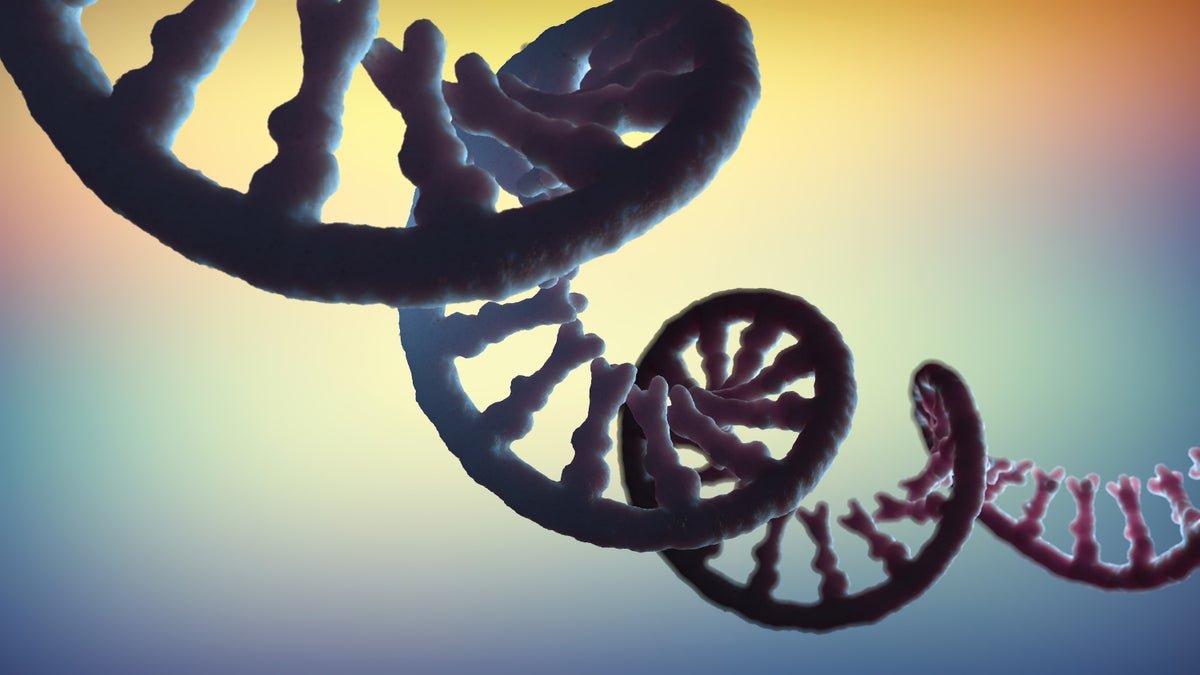
How life begins remains an unsolved question. One key component might be RNA, a molecular cousin of DNA found in every form of life on Earth, and now scientists say they have shown how it could have formed on our planet eons ago. But not everyone is convinced, and RNA is possibly just one of many molecules that could give rise to life on different worlds.
In a paper published today in the Proceedings of the National Academy of Sciences USA, astrobiologist Yuta Hirakawa and his colleagues describe how the conditions on Earth about 4.3 billion years ago might have been perfect for life to arise. In their experiment, they showed that, following a large impact on Earth, RNA and subsequently life could have formed.
The steps the team has outlined suggest “that RNA is an intrinsic outcome of planets everywhere,” says Steven Benner of the Foundation for Applied Molecular Evolution (FfAME) in Florida, a co-author of the paper. And that, in turn, “would imply that there’s life everywhere.” Unlike proteins, which carry out most chemistry in modern cells, and DNA, which stores genetic information, RNA can do a bit of both—one reason it has long been considered a promising candidate for life’s first molecule.
On supporting science journalism
If you’re enjoying this article, consider supporting our award-winning journalism by subscribing. By purchasing a subscription you are helping to ensure the future of impactful stories about the discoveries and ideas shaping our world today.
Led by Hirakawa, the research team prepared test tubes containing an aqueous mix of materials similar to those thought to have been common on early Earth, then heated them and allowed them to dry. The mixtures included a chemical soup of ribose sugar, nucleobases, a reactive source of phosphorus and minerals of a compound called borate.
The heating and drying process would have been “ubiquitous on early Earth,” Hirakawa says. “So this reaction must have occurred.” The outcome of the experiment was the formation of RNA-like molecules, which, with minimal further chemical reactions, could become RNA proper. The team says this shows RNA could form naturally near the dawn of our planet.
Lee Cronin, an expert in prebiotic chemistry at the University of Glasgow, who was not involved in the paper, says he is uncertain about its findings because human input was required to acquire and mix the various components. “The fact they have reverse engineered the synthesis of RNA under the right conditions doesn’t say anything,” he says. “The justification of plausibility is false.”
One of the key findings in the paper is that the compound borate doesn’t inhibit the formation of life’s precursor materials, as previously thought, but actually aids the production of RNA. “Borate is very important to stabilize the sugars, which are unstable molecules,” Hirakawa says, noting as well that borate reactions can form ribose phosphate and dehydrated phosphate, two key molecules for RNA’s subsequent synthesis. “The biggest finding of my research is that borate facilitates these reactions.”
Researchers have also detected borate on Mars, raising the possibility that life could have arisen independently on the Red Planet, Benner says. “The early Earth atmosphere was not all that different from what Mars is now,” he says.
That said, the research team’s hypothesis still requires some heavy-handed external influence. Namely, a large object slamming into Earth would be the most obvious way to deliver RNA’s precursors. They calculate that something about the size of the asteroid Vesta, which is located in the asteroid belt, should have sufficed. This impactor would have been separate from and much smaller than the Mars-sized object that is thought to have caused the formation of the moon by impacting Earth. The known physics of planet formation strongly suggest that midsize impacts like the one proposed in the new study were relatively common in Earth’s early epochs.
This means, Benner says, that it’s likely that other rocky planets also had impact events that could have led to similar conditions. “The argument is: the impact history is universal,” he says. “As a planet is accreting a little part of its orbit around a star, it’s going to clean up its area,” acquire RNA’s precursors and presumably cook up RNA. And if that scenario is true, he says, it “means life is everywhere, including in billions of other stars like the sun [in the Milky Way that] almost certainly have rocky planets.”
The most notable input from the putative large impact, the team says, would’ve been molecules necessary for converting ribose, a sugar, into ribose phosphate.
A recent analysis of samples of the asteroid Bennu, scooped up by NASA’s OSIRIS-REx spacecraft in 2020 and returned to Earth in 2023, also revealed the presence of ribose on that asteroid. The finding further suggests that ribose was present on the early Earth, says Yoshihiro Furukawa of Tohoku University, who led the ribose finding and was also a co-author of the new paper, because Bennu is indicative of the same sort of primordial material that would have initially formed our planet. “So Bennu-like meteorites should have provided building blocks of life to prebiotic Earth,” he says.
Cronin, however, says that Benner and the new study still relies on human input to produce RNA, even if it seems like it has been the result of a natural process. And even with all the right ingredients, the chances of actually producing RNA are exceedingly low without human input, he says, akin to drawing a royal flush in a poker game. “The mathematical likelihood of finding RNA elsewhere in the universe is basically zero,” Cronin concludes.
Instead, he says, many other molecules besides RNA could be ingredients of life on other worlds. “RNA is a super boring molecule,” he says. “There’s nothing special about it, and there are loads of alternatives that could do its job.”
The role of borate in the process, though, is “super interesting,” Cronin adds. The researchers’ “borate work is tremendous,” he says. “It shows how odd things can create molecules we didn’t think of.”
