

Brand Strategy For Growth: Turning Branding Into Market Share
In the current state of the market, many companies invest heavily in brand building, yet struggle to connect those investments to measurable business growth.
Nowadays, a brand is still often treated as a top-of-funnel marketing function focused on awareness, aesthetics, or recognition. Leadership teams may approve redesigns, messaging updates, or campaigns, but still ask the same question months later: “How is this driving revenue?”
That disconnect is where most brand strategies fail. Here, the reality is that brand strategy directly influences growth.
Brand strategy shapes how buyers perceive your company, whether they trust your expertise, how quickly they remember your name, and ultimately whether they choose you over competitors.
Especially in competitive markets, especially in B2B and SaaS categories, brand is often the deciding factor before a product comparison even happens.
Companies with strong market positioning:
- Generate higher buyer trust
- Create stronger category association
- Reduce friction in the buying process
- Increase conversion efficiency
- Expand market share over time
This is why the highest-growth companies do not separate brand from business strategy.
Instead, they use branding strategically to influence demand, strengthen positioning, accelerate pipeline growth, and create long-term competitive advantage.
In this article, we explain how brand strategy becomes a growth engine, how market positioning impacts revenue, and what companies must do to turn branding into market share.
Brand strategy drives growth by shaping perception, building trust, and positioning companies as the preferred choice in competitive markets.
Struggling with your brand strategy?
Make your brand known and stand out with these marketing solutions.
TL;DR
- Brand strategy is a growth lever, not just a marketing function.
- Strong positioning influences buyer decisions and market share.
- Brand impacts visibility, trust, and conversion.
- Companies that align brand with business strategy outperform competitors.
- Thought leadership and strategic distribution amplify brand authority.
- Market leaders are rarely the loudest companies, but often the clearest and most trusted.
In This Guide, You Will Find…
Why Brand Strategy Is A Growth Lever (Not Just Awareness)
Unfortunately, most companies think about brand too narrowly.
That is because they associate branding with logos, visual identity, campaigns, or social engagement. While those elements matter, they are only surface-level expressions of something much more important: perception. That is an element that directly impacts growth.
Overall, the relationship works like this:
- Brand influences perception
- Perception influences decisions
- Decisions drive revenue
The truth is that buyers rarely make decisions based on features alone.
Especially in crowded markets, competitors often offer similar products, pricing structures, and capabilities. In this case, the companies that win are usually the ones buyers trust first, remember first, and understand fastest.
That is the role of strategic branding. A strong brand reduces uncertainty.
This brand strategy communicates:
- Who you serve
- What you solve
- Why you are different
- Why buyers should trust you
The result of a solid brand strategy is shorter evaluation cycles, stronger consideration rates, and higher conversion efficiency. This is especially true in B2B markets where purchasing decisions involve risk and where executives don’t simply buy software, platforms, or services. Rather, they buy confidence. That confidence is heavily influenced by brand positioning.
A well-executed brand strategy for growth creates familiarity before sales conversations begin. Buyers enter the funnel already believing your company is credible, relevant, and category-worthy.
That changes everything in this area because when buyers already trust your brand, competitors must work harder to replace you in their minds.
And that is exactly how a brand becomes a market share lever.
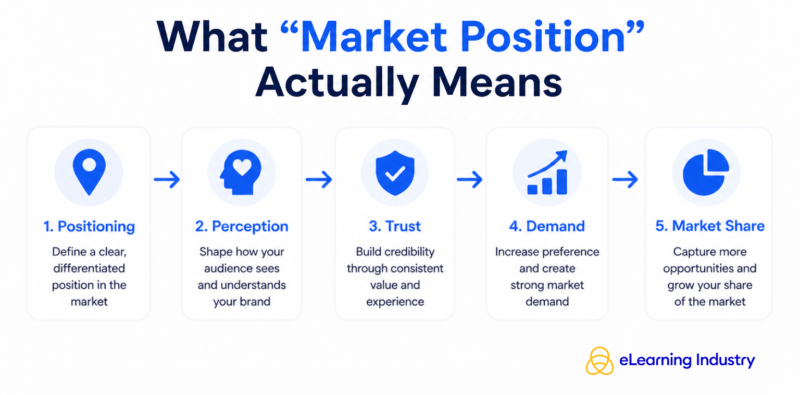
What “Market Position” Actually Means
In the market, we see many organizations talk about positioning without clearly defining it.
However, market position is one of the most important growth variables in modern business. It refers to how your company is perceived relative to competitors.
Market position determines:
- What your company is known for
- Which category buyers associate you with
- How buyers compare you to alternatives
- Whether your brand is seen as premium, innovative, trustworthy, or interchangeable
Overall, strong market positioning creates mental clarity. On the other hand, weak positioning creates confusion, and confused buyers rarely convert.
A strong brand positioning strategy usually includes three core components, as we present below.
Category Positioning
The first one is category positioning that defines where your company fits in the market. For instance, are you:
- A premium provider?
- A category disruptor?
- A specialized solution?
- An enterprise platform?
- A niche expert?
The clearer your category position, the easier it becomes for buyers to understand your value.
Messaging
Positioning must be translated into messaging buyers immediately understand. This messaging includes:
- Value propositions
- Website copy
- Product messaging
- Campaign language
- Executive communication
- Sales enablement materials
Consistency in messaging matters. That means, if every channel communicates something different, perception weakens.
Differentiation
You need to explain why your company matters in a crowded market. It is not about claiming to be “better.” Instead, it is about owning a specific space in the buyer’s mind.
Companies that fail to differentiate become commoditized. And commoditized companies compete on price. That is not sustainable growth for a B2B company.
The Link Between Brand And Market Share
Truth is, the connection between brand and market share is far more direct than many executives realize.
Strong brands create stronger recall, while stronger recall increases buyer consideration. Higher consideration improves conversion probability, and that creates a larger market share over time. The mechanism in this scenario is simple.
When buyers repeatedly encounter a company with:
- Clear positioning
- Consistent messaging
- Visible expertise
- Trusted authority
The potential buyer begins associating that company with category leadership. Meanwhile, that association influences purchasing decisions long before buyers request demos or speak with sales.
This matters because most buying decisions are not fully rational. Moreover, buyers tend to use shortcuts to reach their decisions.
In detail, they gravitate toward brands that they:
- Recognize
- Trust
- Remember
- See frequently
- Associate with expertise
This is why market leaders often appear to grow faster even when competitors offer similar products. It is because a brand reduces friction, and a trusted brand requires less explanation.
In short, less explanation means:
- Faster decision-making
- Lower resistance
- Higher confidence
- Stronger conversion efficiency
Especially in B2B environments, this can dramatically influence pipeline performance. For example, companies with strong strategic branding often experience the following:
- Higher inbound lead quality
- Increased organic traffic
- Better close rates
- Lower customer acquisition costs
- Higher enterprise trust
The result is cumulative growth because brand compounds. Every piece of visibility, authority, and positioning reinforces future demand. As a result, companies that invest in long-term brand growth strategies often dominate categories over time.
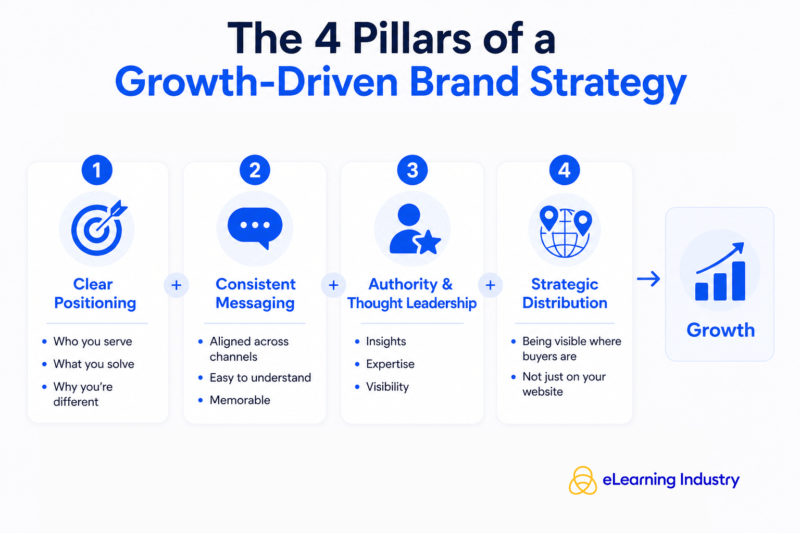
The 4 Pillars Of A Growth-Driven Brand Strategy
High-growth brands rarely succeed by accident. Behind most category leaders is a deliberate system designed to influence perception, trust, and demand.
That system is usually built on four foundational pillars.
1. Clear Positioning
Clear positioning is the foundation of every effective brand strategy.
If buyers cannot immediately understand:
- Who you serve
- What you solve
- Why you are different
Growth becomes harder, but clear positioning creates clarity in crowded markets.
Hence, it allows companies to own specific buyer problems instead of competing broadly. This is especially important in SaaS and B2B categories where feature parity is common.
The strongest brands are rarely the most generic; they are usually the most specific.
For example:
- A learning platform for enterprise workforce enablement
- A compliance-first HR technology provider
- A data analytics solution built for healthcare organizations
In short, specific positioning creates stronger relevance, and relevance drives demand.
2. Consistent Messaging
Even strong positioning fails without consistent communication. Many companies unintentionally weaken their brand because every channel says something different.
In practice, the website emphasizes innovation, sales emphasizes pricing, and social content emphasizes culture. However, it is product messaging that emphasizes features. As a result, you have a fragmented perception, while strong brand marketing strategy requires alignment.
Modern buyers should consistently hear:
- The same value proposition
- The same differentiators
- The same category narrative
- The same strategic message
Consistency increases memorability, and memorability influences market share.
3. Authority And Thought Leadership
Needless to say, visibility alone is not enough. Companies must also establish expertise. This is exactly where thought leadership becomes critical.
Authority-building content shapes how buyers perceive your company before making purchasing decisions.
It signals:
- Market understanding
- Strategic insight
- Industry expertise
- Category leadership
The companies that dominate attention often dominate trust, and trust strongly influences growth.
Effective thought leadership includes:
- Executive articles
- Industry analysis
- Research reports
- Podcasts
- Webinars
- Case studies
- LinkedIn content
- Educational media
It is B2B thought leadership that transforms a brand from recognition into influence.
4. Strategic Distribution
Great positioning is useless if buyers never see it. That is why distribution is one of the most overlooked components of brand growth strategy.
Many companies create valuable content but rely entirely on their website for visibility. That approach limits reach.
Growth-oriented brands distribute strategically across:
- Industry publications
- Search engines
- Podcasts
- Communities
- Partnerships
- Events
- Email ecosystems
- Earned media
The goal is simple: be visible where buyers already spend attention because market share follows attention.
Why Most Brand Strategies Fail To Drive Growth
Unfortunately, many brand strategies fail because they focus on appearance instead of strategic differentiation.
A polished website does not automatically create growth, and neither does a visual refresh. In fact, a brand only becomes valuable when it changes buyer behavior.
Most underperforming brand strategies share similar problems. Here are some issues brands face.
They Are Too Generic
We talked before about the importance of specific positioning. On the other side, generic positioning creates weak perception.
If every competitor claims:
- Innovation
- Customer-centricity
- Scalability
- Transformation
Then nobody stands out. Meanwhile, their generic messaging blends into the market, and invisible brands struggle to grow.
They Lack Clear Differentiation
Differentiation is not optional; it is optimal. Without it, buyers compare vendors primarily on price and features. Eventually, that creates commoditization.
Strong brands define a unique strategic position that buyers can remember. Weak brands sound interchangeable.
Messaging Is Inconsistent
Inconsistent messaging weakens trust.
When buyers encounter conflicting narratives across channels, they lose confidence in what the company actually represents.
Consistency creates credibility, and credibility drives growth.
Distribution Is Weak
Organizations often underestimate the role visibility plays in brand growth.
A company cannot influence markets if buyers rarely encounter its expertise. Even exceptional positioning fails without distribution.
Overall, a brand that is not visible or distinct cannot drive growth.
This is why strategic branding must combine:
- Positioning
- Messaging
- Authority
- Visibility
At the end of the day, growth happens when all four operate together.
How Thought Leadership Strengthens Brand Position
Thought leadership is one of the most effective ways to strengthen market position. It allows companies to shape industry conversations instead of simply participating in them. More importantly, it changes how buyers perceive expertise.
Companies that consistently publish valuable insights become associated with:
- Strategic intelligence
- Market understanding
- Innovation
- Trustworthiness
That perception influences purchasing behavior, especially in complex B2B buying environments.
Thought leadership is not about publishing branded content for volume; it is about influencing how decision-makers think.
High-performing thought leadership usually focuses on:
- Industry shifts
- Strategic insights
- Operational challenges
- Market analysis
- Buyer education
- Category trends
Effective formats include:
- Articles
- Research reports
- Case studies
- Executive interviews
- Podcasts
- Webinars
- LinkedIn content
- Conference speaking
The goal is not simply visibility, but authority. That is because authority accelerates trust and trust accelerates growth.
Especially for SaaS companies, HR technology providers, and LMS vendors, thought leadership can significantly strengthen competitive positioning. It demonstrates category expertise before buyers enter active evaluation, and this creates an important advantage.
By the time competitors begin pitching features, the market may already perceive your company as the category authority.
That changes conversion dynamics dramatically. Thought leadership turns brand into influence, and influence drives market share.
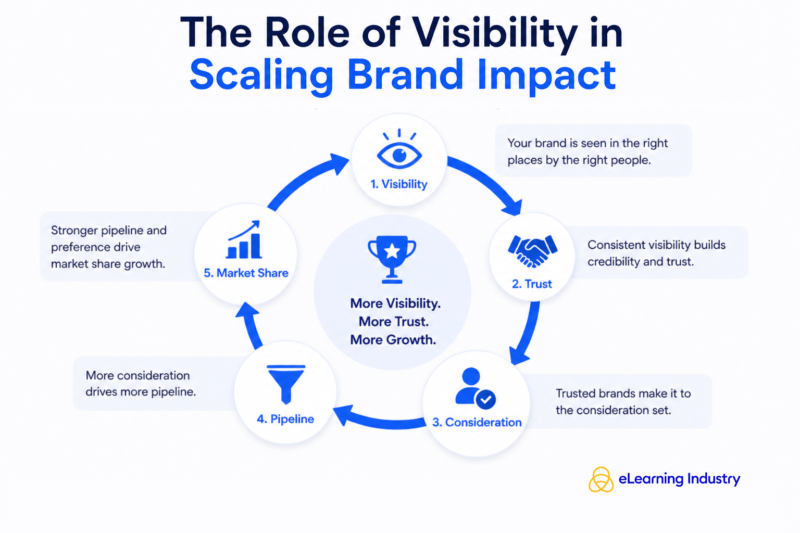
The Role Of Visibility In Scaling Brand Impact
Even the strongest positioning strategy fails without visibility. That is because modern buyers discover brands long before they visit websites or speak with sales teams.
They encounter companies through:
- Search results
- LinkedIn posts
- Industry media
- Podcasts
- Peer recommendations
- Webinars
- Communities
- Conferences
- AI-generated summaries
This means visibility now shapes perception at scale. Companies that appear consistently in trusted environments gain an advantage in buyer consideration.
Presence creates familiarity, and familiarity creates trust. At the end, trust increases conversion likelihood. This is why distribution strategy matters so much.
A strong market positioning strategy requires companies to actively place expertise where buyers already consume information. Otherwise, competitors own the conversation.
Moreover, visibility influences shortlists. When buyers begin evaluating solutions, they rarely start from zero. They usually already recognize several brands.
Those brands enter consideration faster, and that is the hidden growth advantage of strategic branding.
Companies with strong visibility:
- Generate more inbound demand
- Increase branded search volume
- Improve recall during evaluations
- Expand organic market reach
- Strengthen category authority
Over time, visibility compounds. The more buyers encounter a brand associated with expertise and consistency, the more dominant that brand becomes in market perception.
From Brand Awareness To Demand Generation
Of course, awareness on its own is not enough. A company can be visible without generating meaningful growth.
The goal of modern brand strategy is not simply recognition; it is demand creation.
Growth-oriented brands connect awareness directly to pipeline outcomes. That means brand efforts should support:
- Inbound traffic
- Lead generation
- Sales enablement
- Conversion efficiency
- Revenue growth
The strongest brands create demand because buyers already trust them before entering the funnel, dramatically changing acquisition performance.
For example:
- Buyers spend less time evaluating alternatives
- Sales conversations become more strategic
- Objections decrease
- Conversion rates improve
- Enterprise trust increases
Brand also amplifies performance marketing, in which paid campaigns perform better when audiences already recognize the company behind the message.
Content converts better when the source is trusted. Meanwhile, sales outreach performs better when buyers know the brand. This is why brand awareness vs growth is the wrong comparison.
Brand should support growth.
The companies that scale effectively understand this relationship, and they do not isolate brand from demand generation.
Instead, they integrate:
- Brand strategy
- Content strategy
- Thought leadership
- SEO
- Paid media
- Distribution
- Sales enablement
Into one unified growth system.
That alignment creates sustainable competitive advantage.
How High-Growth Companies Use Brand Strategically
High-growth companies approach brand differently from average competitors. They treat brand as infrastructure, not decoration. Instead of relying on campaigns alone, they build systems that consistently strengthen market perception.
Several patterns appear repeatedly among category leaders.
Clear Niche Positioning
Fast-growing companies often dominate specific niches before expanding broadly.
They position themselves around:
- Specific industries
- Buyer problems
- Operational outcomes
- Market categories
That specificity creates stronger relevance, and relevance improves conversion.
Strong Thought Leadership
Additionally, market leaders invest heavily in educational content and expertise-driven visibility.
They publish consistently, shape conversations, and become recognizable voices within their industries.
In the end, this strengthens trust long before sales engagement begins.
Consistent Messaging
Successful brands communicate clearly across every channel.
Their:
- Website
- LinkedIn presence
- Sales materials
- Executive communication
- Product positioning
All reinforce the same strategic narrative.
That is the consistency that strengthens memory and authority.
Multi-Channel Visibility
High-growth brands do not rely on a single acquisition channel.
Instead, they distribute strategically across:
- Search
- Social
- Media
- Partnerships
- Events
- Communities
- Podcasts
- Video
- Industry ecosystems
This multiplies exposure and increases buyer familiarity. The result is stronger market presence, and stronger market presence usually leads to stronger market share.
How To Turn Your Brand Into A Growth Engine
Companies that want to transform brand into measurable business growth should focus on five strategic priorities.
1. Define Clear Positioning
Clarify:
- Who you serve
- What problem you solve
- Why your approach is different
- What category you want to own
Strong positioning simplifies decision-making for buyers.
2. Align Messaging Across Channels
As we have previously stated, consistency matters.
Your:
- Website
- Sales materials
- Executive communication
- Social content
- Advertising
- Product messaging
Should reinforce the same core narrative.
Repetition in this scenario is positive and strengthens perception.
3. Invest In Authority
Start building expertise-driven visibility. You should publish:
- Articles
- Research
- Industry analysis
- Case studies
- Educational content
Thought leadership increases trust and strengthens market positioning.
4. Distribute Strategically
Do not rely solely on owned channels. Instead, place your expertise where buyers already spend attention.
This includes:
- Search visibility
- LinkedIn distribution
- Media partnerships
- Podcasts
- Industry communities
- Webinars
- Conferences
Overall, visibility accelerates market influence.
5. Measure Brand Impact
Brand strategy should connect to business outcomes.
Therefore, track metrics such as:
- Branded search growth
- Organic traffic quality
- Share of voice
- Pipeline influence
- Lead conversion rates
- Market perception
- Customer acquisition efficiency
Brand becomes significantly more valuable when leadership can connect perception to revenue outcomes. That is when strategic branding evolves from marketing support into a core growth function.
Conclusion
Brand is not just about awareness; it is about growth.
In modern markets, positioning influences perception, and perception influences trust. In the end, it is trust that influences buying decisions, and buying decisions determine market share.
Companies that understand this relationship treat brand strategically. This means that they align positioning with business objectives, invest in authority, distribute expertise consistently, and build visibility in the places where buyers already spend attention.
The result is stronger demand generation, higher conversion efficiency, and long-term competitive advantage.
The future of growth belongs to brands that combine:
- Visibility
- Authority
- Clarity
- Strategic positioning
Because in crowded markets, the companies that win are not always the ones with the most features but the ones buyers trust first. Ultimately, trust is one of the most powerful growth assets a company can build.
FAQ
Brand strategy for growth is the process of using positioning, messaging, visibility, and differentiation to increase demand, customer trust, and market share. Instead of focusing only on awareness, growth-focused branding aligns brand perception with business and revenue objectives.
Brand strategy drives growth by influencing how buyers perceive a company. Strong positioning improves trust, increases buyer consideration, reduces friction in the purchasing process, and strengthens conversion rates. Over time, this contributes to higher revenue and larger market share.
Brand awareness measures how many people recognize your company. Brand growth focuses on how branding contributes to demand generation, customer acquisition, pipeline growth, and revenue performance. Awareness alone does not guarantee business growth.
Brand positioning determines how a company is perceived compared to competitors. Clear positioning helps buyers understand what a company does, who it serves, and why it is different. Strong positioning increases trust and improves the likelihood of being selected during purchasing decisions.
A successful brand strategy typically includes:
- Clear positioning
- Consistent messaging
- Strong differentiation
- Thought leadership
- Strategic distribution
- Visibility in relevant channels
Together, these elements strengthen market perception and support long-term growth.
Thought leadership strengthens brand authority by positioning a company as a trusted industry expert. Articles, webinars, research reports, podcasts, and educational content help shape buyer perception and influence decisions before sales conversations begin.
Many brand strategies fail because they are too generic, lack differentiation, or are inconsistently communicated across channels. Others fail because companies invest in branding without building visibility or authority in the market.
SaaS companies can use brand strategy by focusing on niche positioning, category expertise, thought leadership, and multi-channel visibility. Strong strategic branding helps SaaS businesses improve buyer trust, increase inbound demand, and shorten sales cycles.
Visibility helps buyers repeatedly encounter a brand across trusted environments such as search engines, industry media, LinkedIn, podcasts, and events. Consistent visibility increases familiarity, trust, and buyer consideration, which can directly influence pipeline and market share.
To turn a brand into a growth engine, companies should:
- Define clear positioning
- Align messaging across channels
- Invest in thought leadership
- Distribute content strategically
- Build visibility in buyer ecosystems
- Measure brand impact against pipeline and revenue metrics
When branding is aligned with business strategy, it becomes a measurable driver of long-term growth.
