
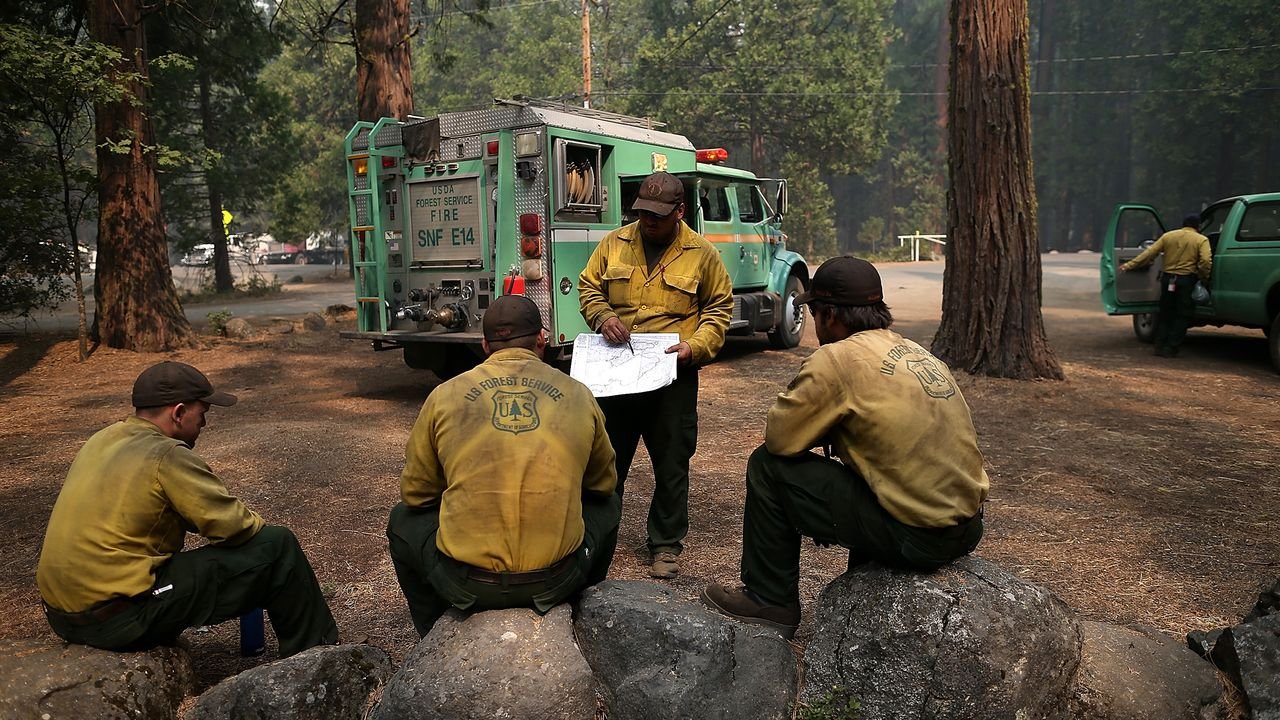
Aldo Leopold, for instance, essentially invented the field of conservation biology while working on game management in the national forests of the Southwest; the U.S.D.A. website, as of this writing, still pays tribute to his un-Trumpian ideas about “the benefit that comes from slowing down and taking the time to listen to nature. In today’s world, being quiet is a valuable commodity; taking time to stop and listen for those minute details outdoors that weave a tapestry of stories all around us is a rewarding experience if we but stop and pay attention.”
The Service maintains many experimental forests, which have produced new understandings of woodland ecology, making it clear that the trees that cover about a third of the country are far more than machines for producing lumber or fibre. I was once told, over a beer with one of the heads of the Clinton-era Forest Service, that its research showed unequivocally that the greatest value of those millions of acres was not timber or even recreation but the way that intact forests absorb and filter water, which reduces both flooding and the need for expensive artificial filtration.
Sound science, we have learned, is anathema to the Trump Administration, which moved within weeks of taking office this term to demand more timber production from America’s forests. So it was no surprise that part of the “reorganization” announced last week involved the ceasing of most of the experimental-forest research and closure of the research stations in the U.S.F.S. network. These are the sites of experiments that can reach back for decades; since trees, by definition, take a fairly long time to grow, that span allows scientists to understand how forests develop and to look for the changes that a warming climate is producing.
But there’s a deeper message in the reorganization, too, which shuts down the Service’s nine regional offices and relocates its headquarters from Washington, D.C., to Salt Lake City. Utah is at the heart of what’s been called the Sagebrush Rebellion, which rose during the Reagan era to challenge the prevailing management of federal lands, and, indeed, the entire idea of federal lands. In recent years, Utah’s senator Mike Lee has led efforts to sell off huge tracts of those lands across the West to developers. The Senate refused to act on those plans last year, one of the few defeats suffered by the MAGA right. That was largely because of a huge swell of protests from hunters, fishermen, hikers, mountain bikers, and other recreational users of these lands—and from the businesses that cater to them. The Forest Service reorganization is a backdoor way to achieve some of the same goals: during Trump’s first term, his Administration moved the B.L.M. headquarters from Washington to Colorado, which led many of its key employees to quit. (The Biden Administration moved it back.) It is likely that the same will happen with Forest Service workers (thousands of them have already been DOGE-d). The Service will now have, instead of a regional headquarters, a “state coördinator” in the capitals of states where it has large holdings, and I think it’s safe to predict that these people will service connections to the interests that value timber more highly than those that value, say, water filtration, much less backpacking.
The U.S.D.A. last month announced big loans and grants to companies revitalizing sawmills and wood-processing infrastructure. The current chief of the Forest Service, Tom Schultz, as the Sierra Club explained, served as the vice-president of resources and government affairs with a company called Idaho Forest Group, one of America’s largest lumber producers, “where he led timber procurement operations and managed relationships with government officials.” As Schultz put it recently, “The value of National Forest Systems lands is demonstrated by providing various forest products, such as timber, lumber, paper, bioenergy, and other wood products.”
It is perhaps beyond obvious that the Trump Administration would look at a forest and see board feet of timber. But the gutting of the Forest Service couldn’t come at a more inopportune moment. This winter was by far the hottest ever recorded across the Western U.S., and that has left the mountains of the West, where Forest Service lands are primarily concentrated, with the smallest snowpacks in recorded history, which, a new study from Western Colorado University found last month, is intimately linked to wildfire danger. The possibility—the probability—of conflagration is on every Western mind. It turns out that conservation really does matter: when you burn too much oil, draw too much water, cut too many trees, you eventually end up in enormous trouble. The Trump Administration seems to have decided that, if we’re in this bad a fix, we might as well make the last few dollars out of it, on every possible front. To borrow, out of context, a Trump quote from last weekend, “All Hell will reign down.” ♦
