
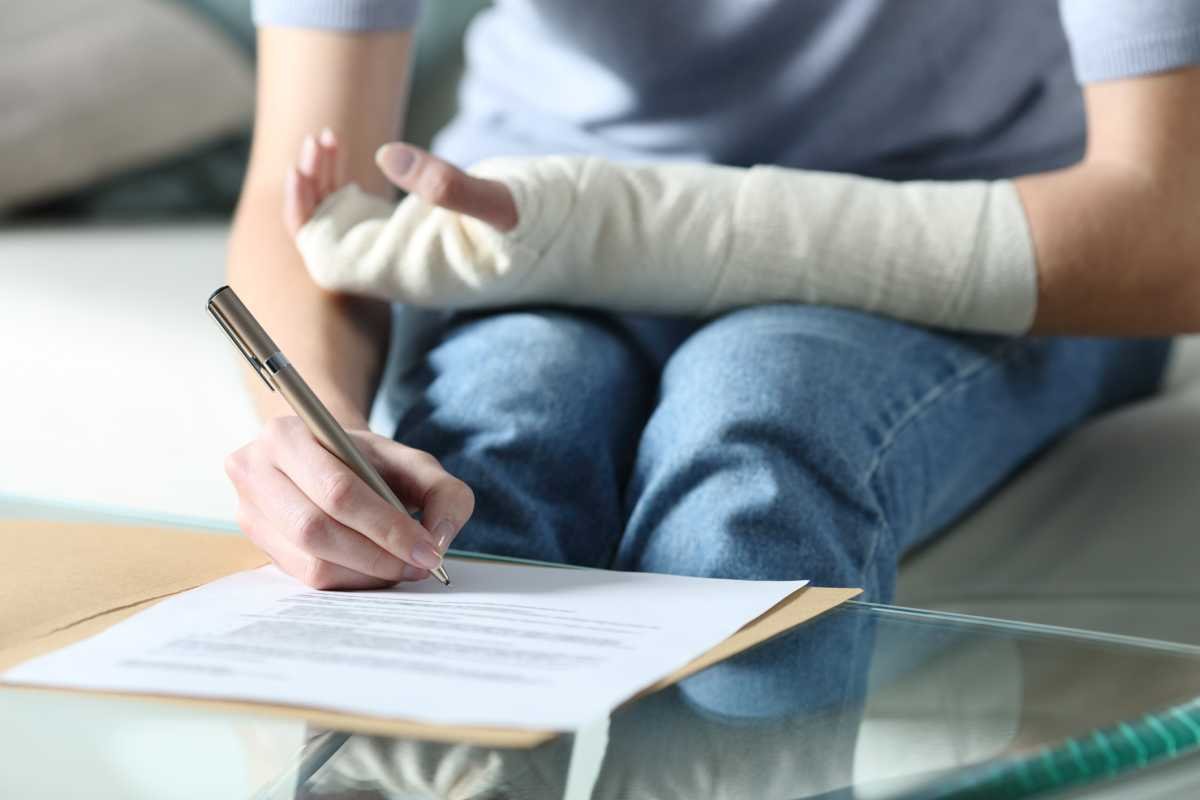

Disabled woman with bandaged arm signing document
If you lose your job in New York, you can receive unemployment insurance payments of up to $869 per week. If a family member needs care, Paid Family Leave can provide up to $1,230 per week. But if you are injured outside of work — hit by a car, struck down by illness, suddenly unable to work through no fault of your own — the maximum benefit is just $170 a week. That figure has not been updated since 1989.
Small businesses know what it looks like when that inadequacy becomes someone’s reality. Uncommon Goods is based in Brooklyn, employing about 140 year-round workers and around 1,000 during the peak holiday season. On Christmas Eve 2025, one Uncommon Goods warehouse team member was hit by a car on his way to work. He is lucky to be alive. He sustained a shattered pelvis, has undergone multiple surgeries, and remains hospitalized. Since his injury, Uncommon Goods has done what we can to support him financially — because $170 a week is not support. It is an insult to someone who has given years of honest work.
His situation made something abstract suddenly concrete: New York’s Temporary Disability Insurance program is broken, and the people it fails most are the ones who can least afford it.
The fix is straightforward. Workers who need time off to recover from their own illness or injury should receive the same wage replacement as those who take Paid Family Leave to care for a loved one – it is only fair. It is not a windfall. It is the bare minimum for a worker who cannot earn a paycheck through no fault of their own. And the cost to small businesses would be minimal — fully funded by small contributions from employers and employees.
Small businesses support this update because it is the right thing to do. It would also be good for business. Research consistently shows that robust paid leave programs improve employee engagement, morale, and loyalty. And when workers feel financially pressured to return before they are ready — or to work through illness they cannot afford to acknowledge — it costs companies, and society, more in the long run than any benefit contribution ever would.
New York considered legislation in 2025 that would make exactly this update. It did not pass. In 2026, the Governor and the legislature have another chance to make this change. The math is not complicated. The need is not abstract. The cost is manageable. What is missing is simply the will to act.
Uncommon Goods’ team member is still in the hospital. He is not thinking about legislation or benefit formulas. He is thinking about his recovery, his future and whether he will be okay. The least New York can do is to make sure that when the next person finds themselves in this position, the state’s answer is something better than $170 a week.
Dave Bolotsky is the founder of Uncommon Goods in Brooklyn and one of the 85,000 small business owners in Small Business Majority’s network. Randy Peers is President & CEO of the Brooklyn Chamber of Commerce.
