
His curiosity extended to the universe. One night, at a house party, John and I ended up in the back yard, drinking beer. Suddenly he stood up and gazed at the night sky. “Hey,” he said, “you take a lot of reli-stu, right? Can I ask you something? Do you think there’s a God?”
I said I thought it was highly likely.
“My family’s Catholic,” John said. (And that was endearing, too. That he didn’t presume I knew that.) “It just seems to me that there has to be a God. Like, how did we get here? You know what I mean?”
There’s a long monologue in “Short Eyes,” where the character of Ice describes his masturbatory fantasies about the actress Jane Fonda. At its climax, he cries out again and again, “Janey baby! Oh, Janey baby!” The soliloquy was something of a showstopper at every performance. On the night Jacqueline Kennedy Onassis came to see our play, the actor playing Ice had an idea. We were crowded together in the dressing room, getting ready to go on, when he said, “Hey, John, your mom’s here tonight, right? I was thinking. You know my monologue, where I go ‘Janey! Janey!’ while I’m talking about jerking off? Maybe I could switch ‘Janey’ out for another name tonight.”
It took a moment to sink in. Then John began shaking his head. “No, no, no, no, no,” he said, to general amusement.
You couldn’t be around him without thinking about who he was. Even if you succeeded for a moment, you would soon get a reminder. I remember being at a loud party, with loud music, and sweaty bodies packed together on the dance floor. At some point, I began to sense, from the flutter of activity across the room, that John was present. (And that was another thing, the way people said, “John”—“I just saw John,” “Is John here?” “I was talking to John and . . .”—never specifying which “John” they meant and never needing to.) Turning my head, I saw John’s silhouette against the far wall. He was dancing, too, though it wasn’t easy for him. No one would let him alone. People kept coming up, girls especially, and he would lower his head so they could shout in his ear. (The same ear that Jackie Kennedy had whispered in, all those years ago.) As I watched, I realized the song that was playing was none other than “Sympathy for the Devil,” by the Rolling Stones. Uh, oh. Here it came. The famous lyric. Nothing could stop it now. I watched John as, from the stereo speakers, Mick Jagger’s voice, in the role of Lucifer, sang, “I shouted out / ‘Who killed the Kennedys’ / When after all / it was you and me.” Did John hear that? Did he hear it and block it out? Or had he stopped noticing things like that because they were everywhere? The lyric came and went, John showed no reaction, and we all danced on.
My most intimate encounter with John happened a few months after the run of “Short Eyes.” It was the middle of the night. I was making a postcoital trip to the bathroom in an off-campus apartment that wasn’t mine. As I inched along the hall, in boxer shorts, a door opened and John stepped out. He was also in boxers. It wasn’t his apartment, either. We faced each other in the darkness. And then, sizing up the situation, John grinned and said, “You dog!”
Me? A dog? And so designated not just by anyone but by a Kennedy.
Magnanimously, like Henry V, he had included me in his band of brothers. A little touch of John-John in the night.
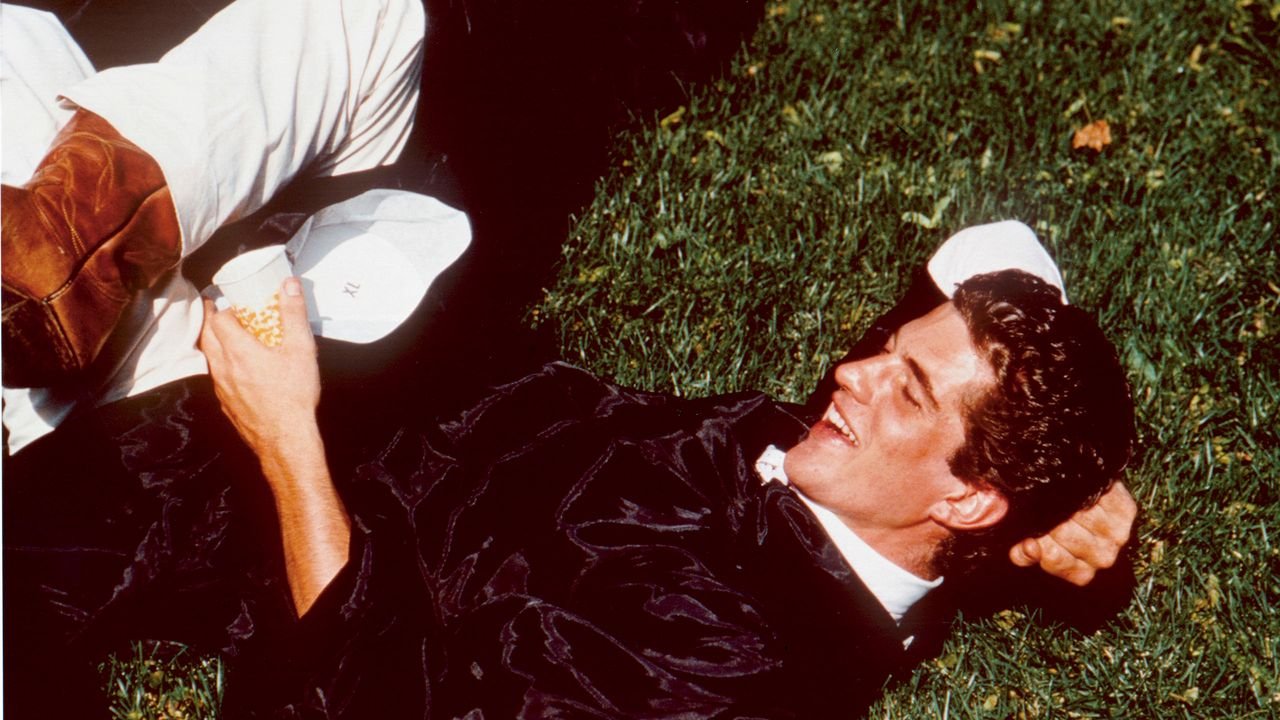
He inspired fealty. You have to reach back for a feudal term like that to describe the effect he had on people, and especially men. On the morning of graduation, I was standing with John and a group of guys as we waited, in our caps and gowns, for the signal to start marching. Someone passed a joint. At that moment, from every direction, photographers appeared. They’d left John alone during his time at Brown for the most part. But they weren’t about to forgo getting a picture of him on graduation day. As they streamed toward him with cameras raised, John did something I’d never seen before. He looked embarrassed. He hung his big handsome head, defenseless against the approach of the paparazzi. All at once, as if by instinct, the rest of us clustered around him. Turning our backs to the photographers, we spread our gowns and tilted our mortarboards to shield our prince from view. I’d never felt anything like it. The sense of duty. Of fidelity. I might’ve been kneeling before John and calling out, “My liege!”
