
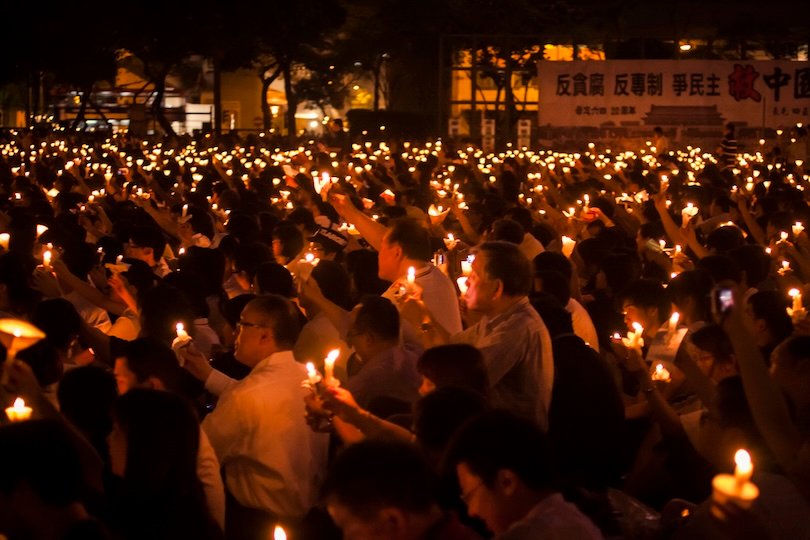
In March 2026, the trial of former leaders of the Hong Kong Alliance in Support of Patriotic Democratic Movements of China—the group long responsible for commemorating the 1989 Tiananmen Square crackdown—reopened a fraught debate over history, memory, and law. Under the city’s National Security Law, the Alliance’s decades-long advocacy is now deemed subversive, and in court, the judge controversially claimed that the events of June 4, 1989, do not constitute a “massacre.” This legal framing exemplifies how judicial discourse is employed to reshape collective remembrance, rendering politically sensitive commemoration a potential threat to the authoritarian control of the Chinese state.
The Tiananmen Square Massacre cannot be understood without revisiting the events that precipitated it. In April 1989, the sudden death of Hu Yaobang, a reform-minded General Secretary of the Chinese Communist Party (CCP), ignited widespread mourning among students and intellectuals, who saw his passing as a symbol of lost political openness. Mass demonstrations quickly followed, calling for political reform, transparency, and accountability. The movement escalated after the April 26 Editorial in the People’s Daily denounced the protests as “turmoil,” alleging they were instigated by a small group with ulterior motives attempting to destabilise the Party. It framed them as threats to the Party and state, signalling that continued protest would be treated as subversive.
By May 1989, Beijing declared martial law after the demonstrators refused to disperse. Zhao Ziyang, the reformist General Secretary, was in Pyongyang during the critical period when the Politburo Standing Committee deliberated on the city’s response. Zhao, alarmed by the growing likelihood of military action, sought to advocate de-escalation. He attempted to press Deng Xiaoping for restraint, but the meeting took place within the broader Politburo framework, where Deng, together with hardliners such as Li Peng and Yao Yilin, decisively supported the imposition of martial law. Zhao’s conciliatory position was overruled, marking the political marginalisation of reformist voices and clearing the path for armed suppression.
In the early hours of May 19, shortly after this decision, Zhao made his final public appearance in Tiananmen Square. Addressing hunger-striking students through a megaphone, he urged them to preserve their lives, telling them: “You are still young… you must live to see the future,” before adding the now-famous words, “We are already old, it doesn’t matter to us anymore.” These remarks have been widely interpreted in different ways. Some scholars argue that Zhao was attempting a last conciliatory gesture, hoping to regain political leverage against hardliners. Others suggest that he was motivated by genuine concern for the students’ lives, recognising that the situation was spiralling toward violence and that they would bear the consequences. At a deeper level, however, the statement reflects a stark moral asymmetry: Zhao, as part of an older revolutionary generation, acknowledged his own expendability, while emphasising that the students—young, educated, and representing China’s future—should not sacrifice themselves in a political struggle they could not win. His words were both a warning and a quiet act of dissent, signalling his refusal to legitimise the impending crackdown.
Zhao’s visit to the Square thus functioned as a final break with the Party leadership. Within days, he was removed from power and subsequently placed under house arrest for the remainder of his life. His attempt to preserve dialogue, his refusal to endorse violence, and his final appeal to the students together reveal a rare moment in which political authority confronted moral responsibility, and chose, in Zhao’s case, not to act in service of coercion. The tragedy of June 4 therefore lies not only in the violence itself, but in the silencing of an alternative path that was briefly, but definitively, rejected.
On June 3–4, the People’s Liberation Army entered Beijing with tanks and troops, forcibly dispersing students and demonstrators from Tiananmen Square and surrounding streets. The crackdown resulted in thousands of deaths and injuries, with some estimates reaching up to 10,000 civilians. In the immediate aftermath of the crackdown, the CCP moved swiftly to impose an official interpretation of events. In his June 9 speech, Deng Xiaoping characterised the protests as a “counter-revolutionary rebellion” orchestrated by hostile forces, and unequivocally justified the use of military force. This statement functioned as a definitive political verdict, transforming a complex and contested movement into a narrative of subversion and restoring ideological coherence within the Party. By reaffirming the April 26 Editorial’s framing and praising the People’s Liberation Army, the leadership closed off alternative interpretations of the crisis, recasting violence as necessity and dissent as threat.
Against the Party’s official narrative, Zhao Ziyang’s legacy has endured as a suppressed political alternative. Remembered as a reformist who refused to become the General Secretary who authorised the use of force, Zhao came to symbolise a path not taken—one grounded in dialogue, restraint, and political accountability. His final appearance in Tiananmen Square, where he appealed to students to preserve their lives, stands in stark contrast to the leadership’s subsequent justification of violence. Following his removal from power, Zhao was placed under house arrest for the remainder of his life, and his efforts to challenge the “counter-revolutionary” characterisation of the protests were systematically silenced.
The treatment of his memory after death further reveals the extent of this suppression. In Hong Kong, Zhao was publicly mourned following his death in 2005, with vigils and commemorations reflecting a civic space in which alternative interpretations of 1989 could still be expressed. On the mainland, however, his name was largely erased from public discourse, with strict controls over media coverage and historical discussion. This divergence is telling: Zhao’s legacy embodies a form of political legitimacy that directly challenges the Party’s authorised account of June 4. The marginalisation of his memory therefore reflects not only an effort to control the past, but an ongoing struggle to contain meanings that continue to resonate beyond the state’s control.
The significance of Zhao Ziyang’s position also invites consideration of an alternative trajectory that was foreclosed in 1989. Had Deng Xiaoping accepted Zhao’s proposal for dialogue and restraint, the immediate tragedy of June 4 might have been avoided, and the Party could have pursued a more gradual path of political reform alongside economic liberalisation. While it would be speculative to suggest that China would have become a liberal democracy, Zhao’s later reflections, particularly those recorded during his house arrest, indicate a reform vision that extended beyond the Party’s orthodoxy, including support for greater transparency, institutional accountability, and elements of press freedom. In this sense, Zhao’s ideas have, over time, come to appear more radical than they did in 1989, highlighting how the suppression of reform did not resolve underlying tensions, but deferred them. The silencing of this alternative trajectory underscores the broader stakes of historical control: not only what is remembered, but what futures are rendered impossible.
The British Response and Trajectory to the National Security Law
The international response to June 4 extended beyond condemnation and into policy, most notably in the United Kingdom’s introduction of the British Nationality Selection Scheme in 1990. Presented as a stabilising measure, the scheme granted full British citizenship to 50,000 selected households—primarily drawn from the civil service, professional classes, and key institutional sectors—amounting to approximately 225,000 individuals including dependents. Yet this was not a universal offer. The vast majority of Hong Kong’s population were instead designated as British National (Overseas), a status that conferred a form of travel documentation without the right of abode in the United Kingdom. In effect, Britain institutionalised a hierarchy of belonging, distinguishing between those deemed essential to Hong Kong’s continuity and those left outside the scope of full political inclusion.
This stratification produced enduring political consequences. While intended to stabilise confidence before 1997, the nationality scheme consolidated an elite administrative class whose institutional role persisted beyond the transfer of sovereignty. The career trajectory of Carrie Lam—a career civil servant shaped within the late colonial system and later the Chief Executive who oversaw the implementation of the National Security Law—illustrates this continuity. Her transition from a British-administered governance structure to alignment with Beijing’s post-2019 political order reflects not a rupture, but a reorientation of elite function under changing sovereign authority. The same governing class once tasked with maintaining stability became instrumental in enforcing a legal regime that now criminalises forms of civic expression previously embedded in Hong Kong’s public life.
The limitations of this earlier British approach have since become more apparent. By selectively extending full citizenship while withholding it from the majority, the policy did not establish a broadly grounded framework capable of sustaining civic freedoms after 1997. The contemporary BN(O) citizenship pathway can therefore be understood as a partial corrective, expanding meaningful rights to those previously excluded and acknowledging, albeit implicitly, that earlier measures failed to secure long-term protections for Hong Kong’s civic and political autonomy.
At the same time, the United Kingdom’s response to Hong Kong’s transformation reflects a broader pattern that extends beyond policy design to questions of values. While the People’s Republic of China asserts that Hong Kong is an “inalienable part” of its territory, this claim sits uneasily alongside the city’s historical development under British rule, where institutions of common law, civil liberties, and open civic expression shaped a distinct political culture. Britain’s responses at key moments—following June 4 and again after the imposition of the National Security Law—suggest a recurring dynamic: when these underlying civic principles are threatened, the UK re-engages, not as a sovereign power reclaiming territory, but as a state responding to the erosion of a shared legal and political inheritance.
Had the British government offered full citizenship to all Hongkongers in 1990, rather than a selected elite, the trajectory of Hong Kong’s governance might have been profoundly different. With widespread access to full British passports, civil servants, professionals, and ordinary citizens alike could have exercised real mobility, creating a population capable of exit if political or legal conditions deteriorated. In this scenario, the universal option would have shifted the balance of leverage. Hong Kong officials, faced with a population with legitimate avenues to relocate and assert their rights abroad, might have found it politically and socially riskier to fully align with Beijing’s post-2019 control over memory and civic life.
Broad citizenship could have created a structural deterrent to authoritarian consolidation, making the National Security Law, and by extension the prosecution of the Alliance, more difficult to enforce. In other words, a truly inclusive British Nationality Act at the time could have been a bulwark for civic autonomy and historical memory, constraining both the central state’s and local elite’s ability to monopolise political identity. The current BN(O) citizenship pathway and diasporic commemorations in the UK illustrate this point: with British citizenship, those determined to preserve civic memory could have relocated en masse, ensuring that the vigils and the remembrance of Hong Kong’s protests would have continued on British soil rather than being curtailed at home.
The Alliance trial thus represents the culmination of this trajectory. It demonstrates how law has become the primary instrument through which memory and political identity are redefined in Hong Kong. The prosecution of those who commemorate June 4 is not merely an act of suppression, but a transformation of the boundaries of permissible history and expression. Practices once central to the city’s civic life are recast as threats to state authority. This shift underscores a deeper contradiction: although sovereignty has changed, the values that shaped Hong Kong’s public culture remain contested. Their suppression, and the international responses it continues to provoke, reveals that the struggle over Hong Kong now extends beyond governance into the preservation of historical truth and political meaning.
Massacre Denied, Memory Punished
For decades, the memory of the Tiananmen crackdown persisted in Hong Kong through the annual Alliance vigil, a civic ritual that allowed society to honour victims and reflect on the legacy of totalitarian violence across the border. The enactment and enforcement of the National Security Law, however, criminalised these acts of commemoration, treating them as subversive. In effect, Hong Kong is being drawn into alignment with mainland China, where public acknowledgement of June 4 is strictly prohibited. This legal suppression directly contravenes the spirit of the Sino-British Joint Declaration, which guaranteed the territory a high degree of autonomy, including freedoms of expression and assembly. By targeting civil society actors, restricting commemoration, and shaping judicial discourse, the state consolidates authority while signalling to domestic and international audiences that memory and truth are instruments of governance, not merely reflection.
The Alliance trial exemplifies a broader pattern: the CCP exhibits zero tolerance for dissent or alternative political identities. In IR terms, the Chinese state is strong in coercive capacity, yet fragile in the face of competing historical narratives. Any deviation from the Party line threatens its monopoly on legitimacy. This perspective is reinforced by the Party’s historical narrative of the “Century of Humiliation,” which frames external influence as a persistent danger; in the Party’s view, the 1989 student protests, like the 2019 demonstrations, were not purely domestic unrest but shaped or exploited by foreign actors. Through legal instruments, discursive framing, and political repression, the regime consolidates power while ensuring that both collective memory and civic critique are treated as threats.
The CCP’s influence over Hong Kong’s historical narrative is not without precedent. During the 1980s, Deng Xiaoping framed the 1997 handover as a “resumption of sovereignty,” implying that Hong Kong’s legitimacy had always resided with China and that British administration was temporary. This discursive construction created a historical fiction: Hong Kong was never a British colony. The 2021 overhaul of Hong Kong’s curriculum extends this logic, embedding the message that the territory was only “temporarily administered” by Britain into the education of a new generation. By shaping historical understanding through civic rituals and schools, the Party ensures that memory, identity, and political interpretation remain tightly controlled, marginalising pluralism and erasing recognition of civic autonomy.
Ironically, the Alliance is prosecuted not for violence, but for exposing these mechanisms of control—a paradox in which truth-telling and civic remembrance are framed as subversive. The National Security Law, rather than addressing genuine threats, functions primarily to restrict speech and regulate historical understanding, illustrating the consolidation of authoritarian power in Hong Kong. Comparative experience shows that pluralistic societies are better able to protect civic memory, autonomy, and freedom of expression. This case underscores the importance of safeguarding civic space, institutional checks, and the public’s capacity to reflect critically on history.
Remembering Tiananmen’s Young Lives Lost
Beyond the territory, the struggle over historical memory has extended to the Hong Kong diaspora, which commemorates the Tiananmen crackdown worldwide. These communities serve as custodians of a narrative the CCP seeks to erase, keeping the memory of June 4 alive despite distance. Yet diasporic commemorations often exist in stateless spaces, lacking institutional support or formal recognition. The dispersal of Hongkongers after the National Security Law highlights the fragility of memory when untethered from legal and civic structures capable of safeguarding it.
This presents both a challenge and an opportunity. The Sino-British Joint Declaration, which guaranteed Hong Kong’s autonomy and freedoms, implies a continuing moral responsibility for the preservation of civic and historical rights. In this context, creating recognised civic spaces abroad—supporting memory, civic participation, and historical preservation—offers a mechanism to counterbalance the CCP’s monopolisation of identity and truth. Diasporic communities can thus maintain historical continuity, ensuring narratives erased within Hong Kong remain visible and politically meaningful.
The concept of a new Hong Kong space, potentially as a Crown Dependency or other semi-autonomous entity under British auspices, is not merely symbolic. It illustrates how sovereignty, memory, and legitimacy intertwine, and how states and transnational communities can construct alternative arenas of civic and political life when domestic spaces are restricted. Supporting these diasporic structures could provide a legally and politically recognised framework to safeguard historical memory, reinforcing transparency, pluralism, and civic autonomy, values increasingly imperilled in Hong Kong itself.
Such developments highlight a broader lesson: authoritarian regimes consolidate power not only through coercion, but by monopolising narrative and memory. Transnational and institutional mechanisms that preserve historical knowledge, protect civic ritual, and sustain political pluralism represent both cultural preservation and strategic resilience. Supporting diaspora initiatives, legal recognition, and civic infrastructure abroad can act as a counterweight to the CCP’s efforts to suppress historical and political plurality.
Further Reading on E-International Relations
