
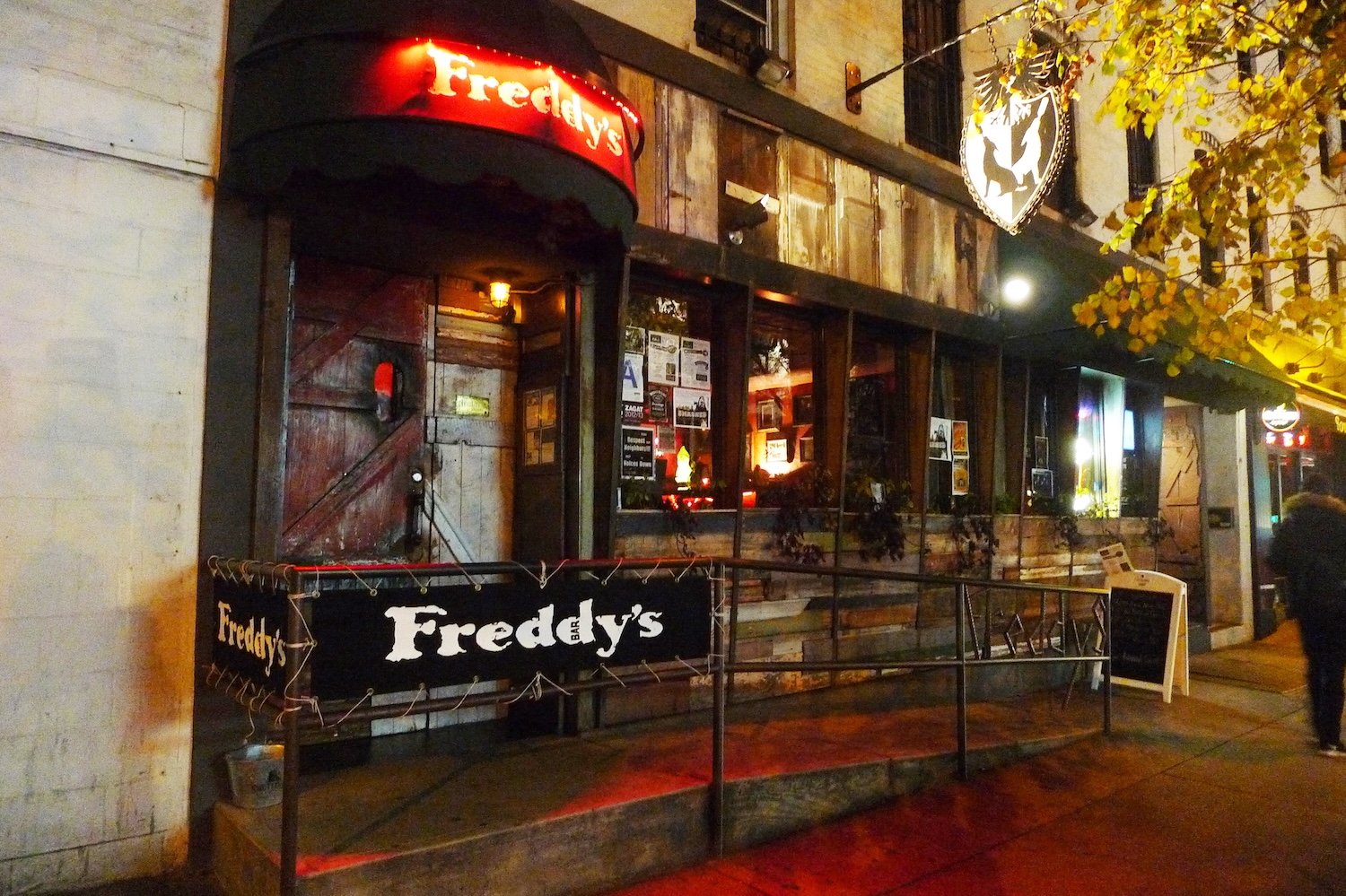
A gigantic, heavy link chain rings the sixty-something-year-old red mahogany bar at Freddy’s, a humble neighborhood pub at the southern edge of South Slope on 5th Avenue. It’s a length of construction material that feels slightly out of place indoors. You can better picture it wrapped around a piling on a dock. But like all the random bric-a-brac crowding the shelves, and seemingly every square inch of wall space in Freddy’s Bar, it’s an artifact, a keepsake, a remnant of another time and place.
It is referred to affectionately by the regulars, the long-tenured employees, and the owners as “The Chain of Justice.” Like the weathered, gorgeous old bar, that chain made the trek from Freddy’s Bar and Backroom, the first iteration of the business located at the intersection of 6th Avenue and Dean Street, where the bar began its life as a speakeasy for the local factory workers during prohibition. The chain was installed after the establishment lost its seven-year appeal to stay on its ancestral ground on the border of Park Slope and Prospect Heights in 2010. As a symbolic protest following the final appeal, patrons and staff handcuffed themselves to the chain for several hours to stave off the wrecking ball, downing beers and cherishing their final few hours in the bar that was their home for the news cameras, and for themselves.
Courtesy of Freddy’s Bar
The postmodern era of Freddy’s began with the arrival of Donald O’Finn, a refugee bartender from another extinct Park Slope warhorse called O’Connor’s. “I am by nature not a great bartender or bar owner, but I’m a very serious and obsessive artist. I love people that are really smart and talk about philosophy, so I weeded out the assholes, and we ended up with a great core of regulars, most of whom were writers and poets,” O’Finn told me recently. When he walked into Freddy’s in the late 90s, it had become a cop bar servicing the 78th precinct, which was practically next door. Donald changed the vibe at Freddy’s with music and decor and events, and in doing so curated a crowd that articulated the early years of Brooklyn’s shift from a residential commuter borough to a crunchy cultural hub.
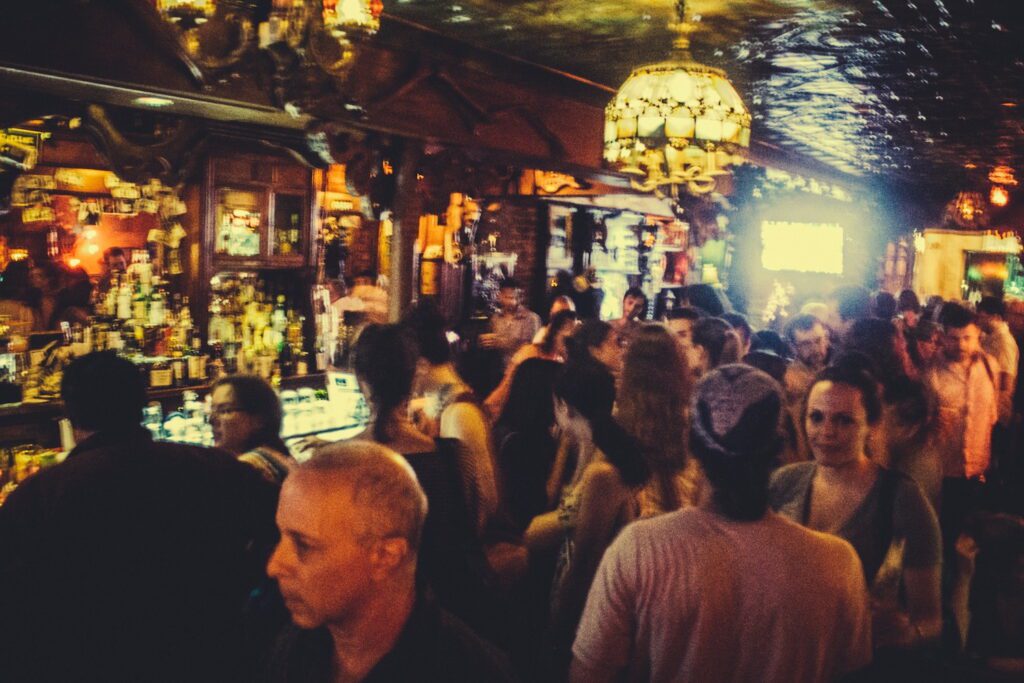
Freddy’s had a massive back area that was once a bowling alley, and became a performance space for open mics, bands, comedians, dramatists, and filmmakers. Odd taxidermy and bar napkin Bic inked masterpieces and street signs and vintage ephemera foraged from flea markets at exotic locales by staff or guests who brought back artifacts from vacation hung on the walls. Donald is a visual artist—he made a library of spliced VHS tapes, montages composed of random moments from obscure old films that played on a loop on the fucked up televisions mounted above the bar. “I like to think of them as an old TV that has somehow become sentient, and it’s slowly dying and in its dying throws it’s remembering everything that ever passed through it,” O’Finn says of his art. I can neither confirm nor deny this, but I am told, at least in the aughts, the original Freddy’s was a place where, say, a young shithead line cook could go with his co-workers after a long, busy shift, be pleasantly exhausted, and make friends and family and feel less alone for an evening in a newly adopted home until 4 a.m., at which point the bar “closed”, the door was locked, and you could smoke whatever you had on you past sunrise.
Courtesy of Freddy’s Bar
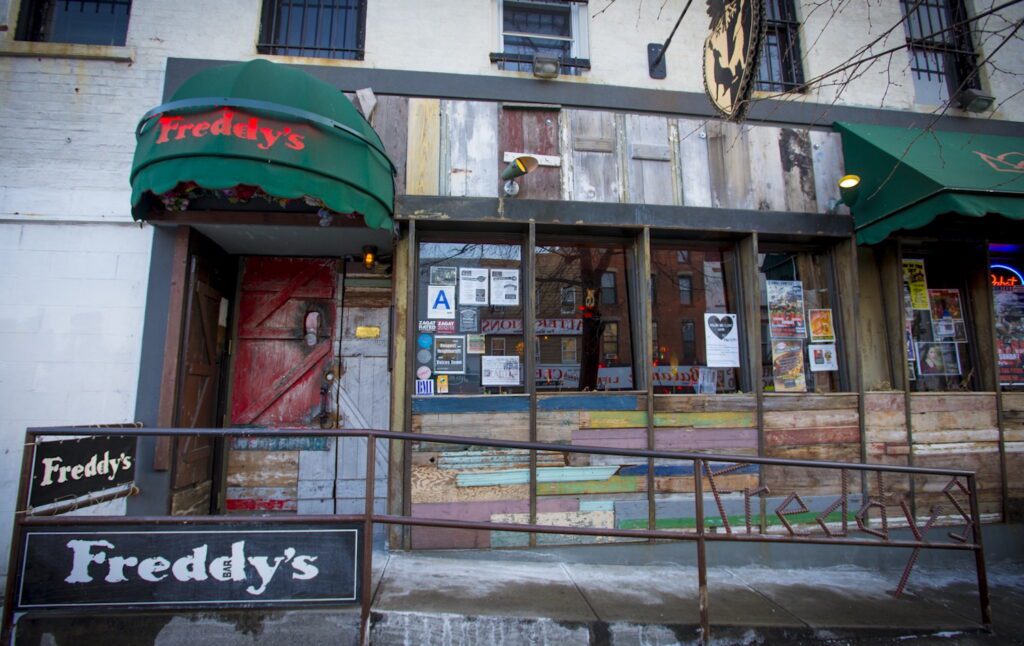
The “new” Freddy’s Bar, in its 14th year, is located on a sleepy commercial strip of 5th Avenue just above the Prospect Expressway and just below Greenwood Cemetery, once again in an odd border nether region. Its neighbors are appropriate utilities, like independent pet stores, dry cleaners, and dentist offices. Donald and two other former bartenders—Matt Kimmett and Matt Kuhn—bought the establishment from its former owner, who left New York when the old location was demolished and the eminent domain money came in. The salvaged bar was trucked from Park Slope south, the storefront was lined with torn-out barnhouse wood from the Catskills, and a crew of regulars with construction experience built out the interior unpermitted for a steady supply of PBR and cigarettes.
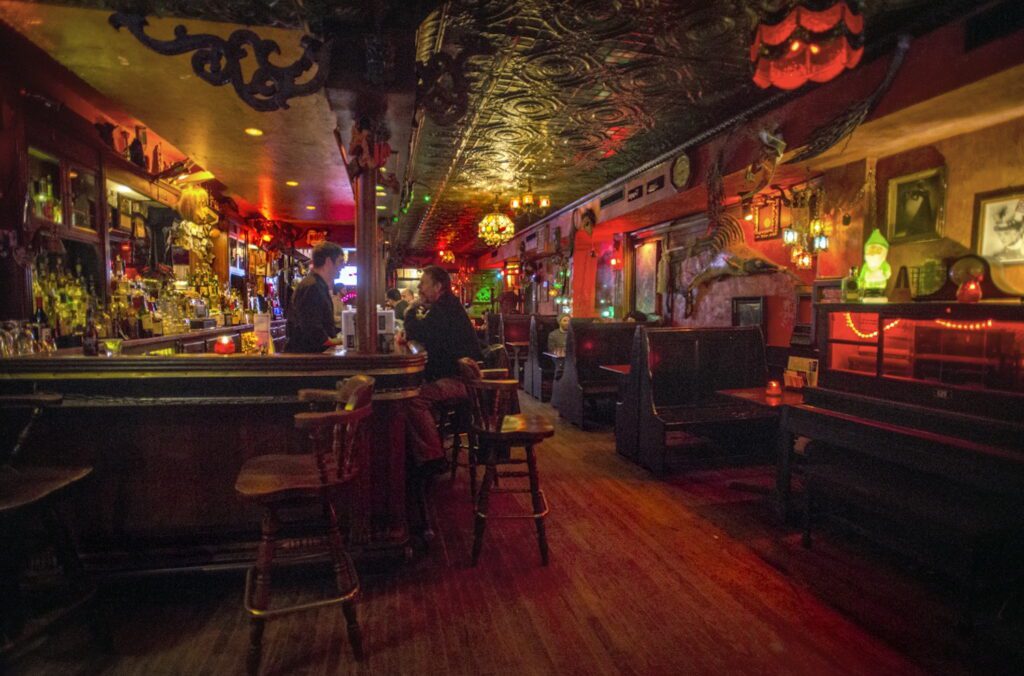
I show up for reporting on a Tuesday at happy hour, downing a $6 draft of Freddy’s Lager, made by local 5 Boroughs Brewery. There are two televisions on either side of the long bar. One plays the afternoon news (ABC for two and a half hours before Jeopardy), the other plays one of Donald’s alien sizzle reels. There’s a kitchen in the back of the bisected, U-shaped space with its own point of sale, which feeds into an event space reminiscent but far smaller than the last one. If you believe the many printed fliers taped to the window facing the street, it is occupied by events seven days a week. There’s an intimate backyard, and it’s a gorgeous early Spring day, but I hang out at the bar, where the vibe is a Deadwood saloon crossed with Disney’s Haunted Mansion.
Silk vines wrap around cement support beams, antique Tiffany lamps descend from a ceiling lined with ornate tin panels, the gallery of kitschy, Burton-esque American gothic has seemingly grown, including, but not limited to, clocks framed with baroque ironwork, a full ring of ancient jailers’ keys, novelty gnome lamps, and carved idols. It’s esoteric, strange, and beautiful crap, a worthless but intensely meaningful collection you amass over the course of a lifetime. “My vision was something like an ancient ship sitting at the bottom of an ocean on a different planet, in a different dimension. I just wanted something beautiful and old, but different,” O’Finn says. And it’s an aesthetic I’d argue he nailed.
Courtesy of Freddy’s Bar
Donald soft-retired upstate several years ago and doesn’t hang out much anymore, but I think he’d approve of the small crowd I joined that afternoon. Aretha Franklin is singing about her shitty exes, and so are the regulars. We are souls who look at home, drinking at 4 p.m. on a weekday, littered with feral Beards, open flannels, messy buns, acetate frames, gauges, pierced septums, wrist and neck tats, sitting by collections of fanned singles, and dog-eared humanities major classics, and guitars in soft cases and face down cell phones covered in band stickers and election stickers, and gin and tonics, and White Claws. Women are complaining in Midwest accents about Trump’s draconian immigration policies. It smells like the bar has carried on the time-honored tradition of closing the gate at 4 a.m., lifting the smoking ban, and keeping the party going for late-night service industry workers.
My bartender is a middle-aged Irish woman named Ellen, who started as a regular at the old Freddy’s when she moved to New York in 2002, then transitioned to a daytime bartender, and has held on ever since. While we’re talking, every guest who enters is greeted by their first name and a drink—no need to order. Ellen moved to South Slope along with Freddy’s years ago. “A lot of people got pushed out of the old neighborhood, and so did I. I’ve been struck by the ‘we’re selling the building’ lightning three times,” she tells me.
There is much to be bitter about when you consider the journey of Freddy’s Bar, but Donald sounds at peace with it. “We moved out during the transition of Park Slope, which became more like an extension of Manhattan as it lost a lot of its Brooklyn. And in doing so, we moved into a spot that I think is still very Brooklyn.”
If you’ve lived in the city long enough to have favorite bars, you may have suffered the indignity of watching the neighborhood around those bars change in ways that affected its culture. Or God forbid, perhaps one of them has gone viral, and is now littered by thrill-seeking tourists, or content creators, or just standard issue assholes, and maybe it helped you understand there are worse things than a place you love closing.
Freddy’s didn’t move on its own terms, but its forced ejection helped it escape a gentrification of the soul. Perhaps this is why it’s one increasingly rare institutions that retains the energy and values this borough once held, if only for a little longer.
The post 35,000 Nights at Freddy’s appeared first on BKMAG.
