
For Aquinas, a political community is not a contract between isolated individuals but a shared life in common. It is made up of people who, however varied, recognise enough common purpose to build and sustain a structure in which each has a place and role—sometimes honoured, sometimes hard or thankless, but always as part of a larger whole. The polity exists to secure a common good no one could reach alone: order, justice, safety, and the conditions for living well. Individuals do have rights in this community, but they are not free‑floating entitlements. They rest on, and are shaped by, corresponding responsibilities: to obey just laws, to contribute to public life, to care for neighbours, and, when necessary, to defend the community itself. The polity too has “rights”—to loyalty, to taxes, to service—but only because it owes in return the protection of the weak, impartial justice, and the maintenance of a shared order in which everyone can flourish.
Over centuries, our public language shifted from “what do I owe my community?” to “what does the state owe me?”. The older sense of membership in a common project gave way to a more contractual mindset: the state became a provider of benefits, and citizens became clients negotiating their claims. Today, much political debate speaks almost entirely in the idiom of rights and identities, and hardly at all in the idiom of duties and common good. We have grown used to listing what is due to us from everyone else, and far less to asking what we owe to the body we belong to and to those who share it with us. This is not a call for socialism or for a borderless global bureaucracy. It is a reminder that citizenship is a moral relationship, not a customer account.
What thinkers like Aquinas say about persons and polities, others extended to polities themselves. States do not live in a vacuum. They share a world in which certain basic rules—no conquest by force, respect for borders, minimal decency in war—make it possible for any of them to survive at all. In that sense, there is also a “community of states”, and it too has a kind of common good: a fragile order that restrains violence, allows cooperation, and protects each political community from simply being swallowed by its stronger neighbour. A state’s “sovereignty” is its right to govern itself, but it rests on more than might or recognition. It presupposes internal duties to its own population and external duties to other states: to refrain from unjust aggression, to honour basic promises, to respect the shared law of nations. Sovereignty is a trust, not a licence.
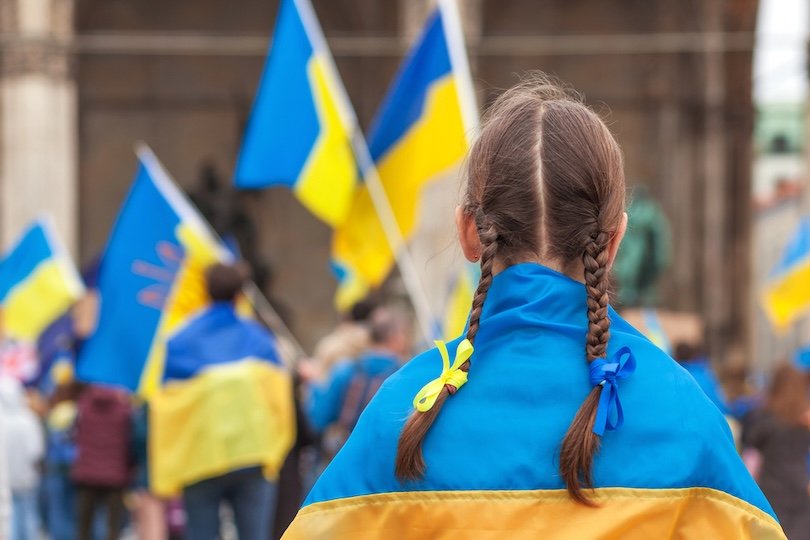
When we talk as if sovereignty were only a shield against all external criticism, we repeat at the international level the same mistake we have made domestically: rights without responsibilities. Seen in this light, Ukraine is not simply a distant country asking for aid. It is a political community, with its own language, culture, institutions, and shared life, trying to resist being broken and absorbed by a larger neighbour. The invasion launched against it is not a natural disaster inside its borders; it is a deliberate attempt to dismantle that common life, to replace its laws and leaders, and to redraw its frontiers by force. This violates both levels at once. Internally, it tries to tear apart the bond between Ukraine’s polity and its population, to erase the conditions in which its citizens can live as members of their own community. Externally, it rips up the most basic rules that make any international order possible: that states may not acquire territory by invasion, that civilians are not legitimate targets, that whole populations may not be deported at will.
Support for Ukraine is far closer to answering a neighbour’s call when his house is on fire than to writing a cheque to a far‑off charity. It is not a handout to keep a weak country limping along. It is standing beside another political community that is fighting, with its own blood and resolve, to preserve its people, institutions, and way of life. We are not doing something for Ukraine so much as doing something with Ukraine for the sake of the shared order that protects us as well.
Modern democracies live by short clocks. Governments come and go every four or five years, sometimes more quickly; in some countries the effective horizon is two years or less. With each turn of the wheel, support for Ukraine is reopened, relabelled, and reargued. Publics are invited to ask, repeatedly, whether Ukraine is still “worth it”. This has placed a cruel burden on Ukrainians themselves: not only must they fight, mourn, rebuild, and fight again; they must also continually justify their right to do so in the court of foreign opinion. They are made to explain, again and again, why they may wish to defend their own homes, why they resist occupation, why they seek not to exchange their flag for another’s. No healthy polity should have to defend, every electoral cycle, its claim to exist and to protect its people.
If we treat support for such a neighbour as a discretionary programme that can be switched on or off according to polling numbers, we hollow out our own idea of sovereignty. We teach the world that our commitments are never more solid than the next election night, and that when pressure comes, the rights of small states are negotiable. That is not only unjust to Ukrainians; it is short‑sighted for us.
The deeper question is not whether we feel sympathy for Ukraine this month, or whether this or that weapons system should be sent. It is whether we still believe that political communities—our own and others’—are more than platforms for private advantage. At home, this means recovering a language of duty as well as of rights: remembering that our claims on the community rest on our responsibilities to it and to one another. Abroad, it means recognising that helping a neighbour defend itself against naked aggression is not an optional kindness. It is part of what we owe to the wider order that makes any of our own rights meaningful. If we forget that, we may one day find ourselves in Ukraine’s position, looking outward for neighbours willing to see in our struggle not a distant quarrel, but a shared duty.
Further Reading on E-International Relations
