If you want to find better value when buying a house, avoid the real estate frenzy zone.
The real estate frenzy zone is the price range where the largest number of buyers can compete. It generally spans from the median home price plus about 50%. This is where demand is thickest, emotions run hottest, and buyers routinely overpay.
If you instead move up the housing price curve, just beyond the frenzy zone, demand drops sharply. Fewer qualified buyers means less competition, longer days on market, and better negotiating leverage. In many cases, you end up paying less per square foot for a better property.
Why the Real Estate Frenzy Zone Exists
The frenzy zone exists because of both math and human behavior. Buying real estate is one of the most emotional decisions people make, largely because home is where we spend most of our time. As a result, our hopes, identity, and dreams become deeply intertwined with where we live and sleep.
Homes priced near the median are affordable to the largest number of households, especially dual-income families. Lenders are comfortable underwriting these buyers, the bank of mom and dad are more willing to help with down payments, and buyers psychologically anchor to “reasonable” price points.
Homes priced below the median often sell instantly as first-time buyers with no experience compete aggressively. Homes priced modestly above the median also attract intense demand because buyers stretch, believing it is their “forever home.”
Of course, the challenge is having enough capital to afford a home above the frenzy zone. That may require stretching financially, selling higher-risk assets, or reallocating capital you hadn’t originally planned to use. Maybe you’ll have to work extra hard to get that promotion and pay raise before you submit offers. Alternatively, some buyers make their case to parents who are willing to lend the funds to help them clear the next pricing tier.
Lending Standards Make the Frenzy Worse
Tighter lending standards amplify this effect.
Banks increasingly require 720+ credit scores, substantial reserves, and 20% down payments. Jumbo loans are harder to obtain, especially for self-employed buyers or those with variable income.
As a result, competition collapses once prices exceed what most households can comfortably finance. This is where disciplined buyers can strike.
The last thing I want you to do is get into an intense bidding war and have buyer’s remorse for beating out a dozen other bidders who weren’t willing to pay what you paid.
My First Lesson in Avoiding the Frenzy Zone
In 2004, I was looking to upgrade from a two-bedroom condo to a three-bedroom, two-bathroom condo in San Francisco. I had purchased my first condo in 2003 for $580,000 and a year later, regretted not buying something larger as prices increased.
What I found was brutal.
Every three-bedroom condo priced between $900,000 and $1,400,000 was a feeding frenzy. Properties routinely sold for 10% to 20% over asking after multiple offer battles. After losing several times, I gave up. Emotionally, it was exhausting.
A Lucky Discovery Above the Frenzy Zone
Then one rainy weekend, I stumbled across a single-family home listed at $1,550,000, just above the real estate frenzy zone.
It sat on around the corner from a busy street, but it had three bedrooms, two bathrooms, an in-law unit, a backyard, and a deck. Most importantly, it had been sitting on the market for a month during the winter holiday.
There was almost no competition.
Instead of paying $1.4 million for a $1,300,000 condo at $1,100 per square foot, I bought the house for $1,525,000 at roughly $720 per square foot.
Moving up the price curve delivered a 35% discount per square foot.
Why Nobody Else Bought It
The house was poorly marketed by an out-of-town agent using a flimsy one-page flyer. It was not staged or cleaned, and the owners wanted a rent-back.
In 2004, mortgage rates were near 6%, household incomes were lower, and $1.5 million felt like an impossible psychological barrier. Even the Bank of Mom and Dad had limits.
This is how artificial price ceilings form.
At the time, I never thought I would be able to buy a single-family home in San Francisco given my age and income. Yet this was the cheapest house I could afford just above the frenzy zone, in the best neighborhood I could find. So I took a leap of faith and went all in, getting into contract before my 2004 year-end bonus hit my bank account in early 2005.
After putting down 20%, or $315,000, I would have had almost nothing left. Feeling house rich and cash poor was deeply uncomfortable. But I figured I was young enough at 28 to take the risk. If I lost everything, which I nearly did during the global financial crisis, I would simply grind my way back.
Thankfully, I survived the mass layoffs and ultimately sold the home in 2017 for a profit after nobody wanted to buy it when I first listed it in 2012, the year I retired from finance.
My Second Experience Avoiding the Real Estate Frenzy Zone
In 2019, as we were expecting our second child, we decided it was time to upgrade to a larger home. Coincidentally, a house two doors down was being prepped for sale. It had one additional level and roughly 700 more square feet, bringing the total to about 2,540 square feet. All three levels enjoyed panoramic ocean views, but, like our first home, it was another fixer.
Given the size and location, the listing agent planned to list the home at $1.98 million, hoping to whip up a frenzy and push the price to $2.1 million or higher. At the time, I knew that adding an extra level with comparable views would cost at least $750,000, if not more. From a replacement-cost perspective, the house struck me as excellent value. Further. the house also had about 350 sqft of living expansion potential.
Rather than jumping into a bidding war, I focused on building relationships. I connected with the listing agent and the two adult daughters who had inherited the home. I wrote each of them a thoughtful real estate love letter, explaining that our family was growing and that we hoped to renovate the house and make it our long-term home. We weren’t flippers. We were neighbors who wanted to preserve and improve the property.
In the end, the strategy worked. We purchased the home below the planned list price and avoided the competition entirely. It also helped that we paid cash. True to my word, we modernized the house, moved in, and still own it today.
The City Came After Me
I know we got a great deal because a year later, the city came after me for more money.
The assessor’s office questioned the purchase price, asked for photos documenting the home’s original condition, and even wanted to speak with the listing agent. The city ultimately reassessed the property at a value roughly 15% higher than what I paid to extract more property tax from me.
That fight alone might deserve its own post. It was a complete ordeal.
How the Real Estate Frenzy Zone Has Shifted
Today, the typical San Francisco homebuyer household earns between $400,000 and $800,000 a year. We’re generally talking about dual-income households, many of them in tech. At the same time, the role of the Bank of Mom and Dad in helping adult children buy homes has grown larger than ever.
The reason is straightforward: many of these parents have experienced extraordinary wealth creation over the past 20-plus years through stocks, real estate, and other asset classes. As a result, they now have both the willingness and the ability to help their children bridge the gap between income and today’s housing prices. For adult children with good relationship with their parents, housing affordability has also gone up.
Because of this dynamic, the frenzy zone has shifted upward – from topping out around $1.5 million in 2005 to roughly $3 million today. For three- or four-bedroom, two- or three-bath single-family homes on the west side of San Francisco, buyers in the $2–$3 million range are out in full force.
These buyers are typically fully preapproved, come in with $400,000 – $600,000 down payments, and still have another $100,000 or more in reserves. But the true X-factor is parental support.
Once prices push beyond $3 million, demand thins again as the buyer pool shrinks dramatically. Homes at that level often require $800,000 or more in liquid capital, which eliminates a large number of otherwise high-earning households. Even among top earners with wealthy parents, many hesitate to concentrate that much capital into a single asset far above the median price.
That hesitation is where opportunity begins, if you can afford it.
Example of Battling It Out in the Frenzy Zone Today
Pretend you are a real estate agent looking for a three-bedroom, single-family home or larger for your clients. The clients are a late-30s couple with a two-year-old who both work and earn about $600,000 a year, all in, with about $500,000 for a down payment. They also hope to have another child.
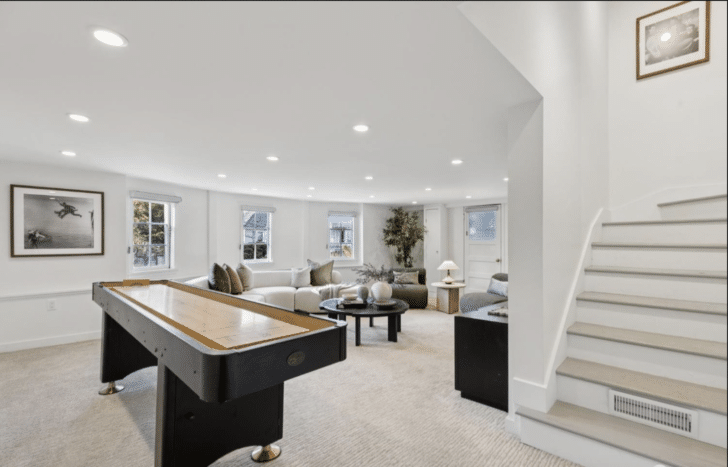
Below is a lovely three-bedroom, two-and-a-half-bath single-family home that listed for $2.495 million in the Inner Sunset neighborhood of San Francisco. It was likely remodeled within the past 15 years and includes an unwarranted game room on the ground level. While the home has no views, it sits on an almost double lot, approximately 4,617 square feet, which is a meaningful differentiator in the neighborhood. The walk score is great.
This would be an ideal home for a family of three, with one bedroom doubling as a guest room or home office. Even though the pandemic is long over, many professionals still work from home one or two days a week – one of the best lasting benefits of the pandemic for working parents. But ideally, this family wants four bedrooms.
At $2.495 million, the home was squarely in the real estate frenzy zone. Given the larger-than-average lot size, you’d reasonably expect it to command a premium relative to homes sitting on standard 2,500-square-foot lots. It also has two-car parking to boot.
Interestingly, the listing agent did not disclose interior square footage. Public records show the home as a two-bedroom, two-bathroom property with 2,525 square feet. However, the unwarranted game room on the lower level was nicely staged and entirely usable. In practical terms, the home likely offered closer to 3,000 square feet of livable space.
How Much Would You Offer for This Home?
If I were representing the buyer, I would have guided toward a maximum offer of $3 million, paired with a $900,000 down payment (+$300,000 help from parents), a 30-day close, and no financing contingency. The extra 500 square feet of usable space certainly adds value. But unwarranted space trades at a discount to permitted living area. Depending on the condition, we’re talking about a 30% – 90% discount.
Normally, I would recommend an inspection contingency. But with at least five other bidders in the mix, I likely would have advised waiving it to have a shot. I’ve purchased multiple homes without inspection contingencies by spending hours on-site with licensed professionals before committing. So that is what we’d do in this scenario while also highlighting realistic house-improvement expenses.
Surely, offering 20% above asking with a large down payment and no contingencies would keep us competitive. At the very least, we’d expect a counter.
Wrong like Donkey Kong!
The Final Selling Price Astounds
The house ultimately sold for 60% above asking, closing at $4.05 million. Based on the timeline – going into contract just three days after listing and closing two weeks later – I assume it was an all-cash transaction. Banks simply don’t fund purchases that quickly given underwriting and documentation requirements.
In multiple-bid situations, some buyers lose all sense of restraint. As their vision of living in the home starts to slip away, logic gives way to emotion. And when dreams are on the line, money becomes secondary, especially if you have plenty of it.
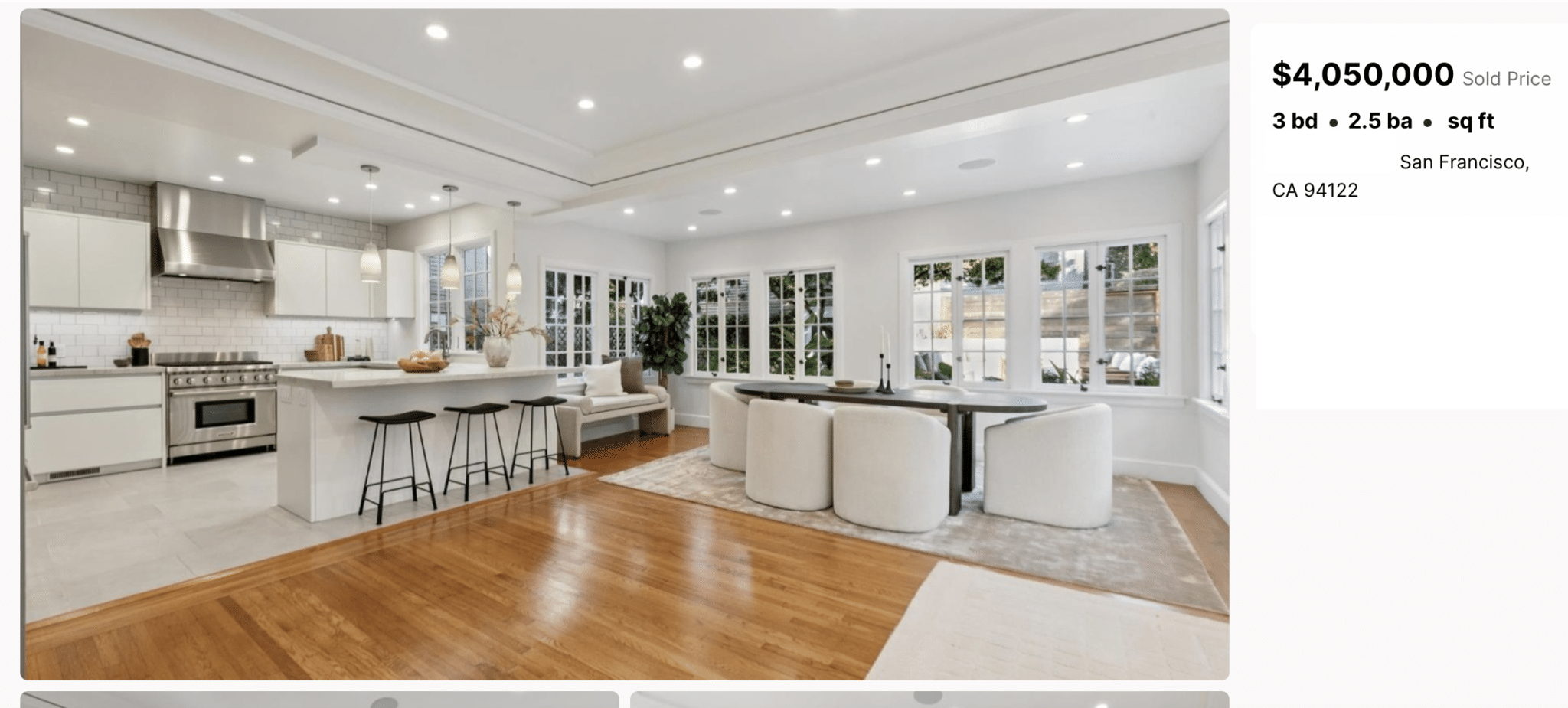
The buyers have effectively reset pricing for comparable three-bedroom, two-and-a-half-bath homes in the neighborhood. There’s a real possibility they bought at or near the top of the market and could experience a loss if they need to sell within the next three to five years.
On the other hand, if anticipated IPOs from companies like OpenAI, Anthropic, Databricks, SpaceX, and other major tech firms materialize, a new surge of liquidity could push San Francisco real prices to even higher levels. That’s the bet they’re making.
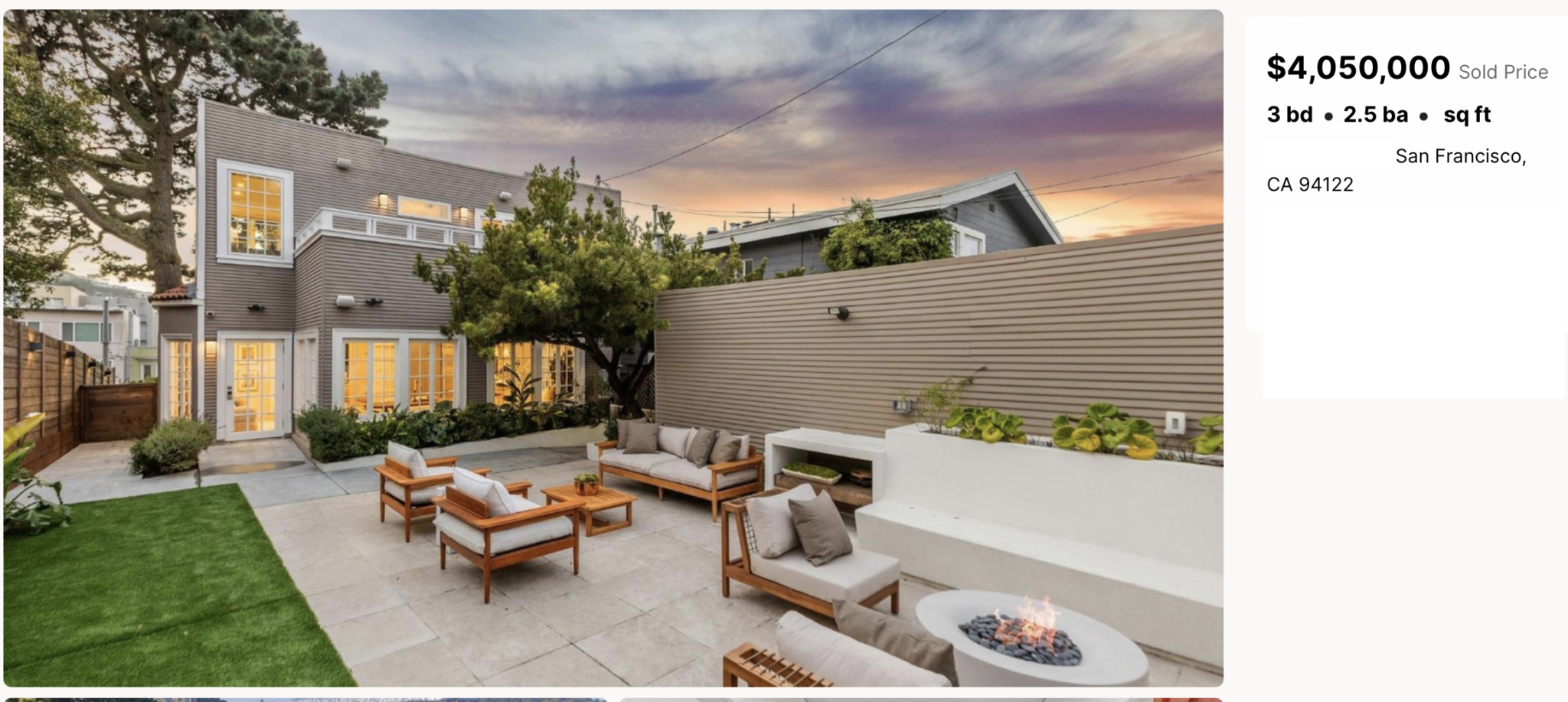
When my fictitious clients are disappointed after losing by $1.05 million, I try to reframe the outcome. Being that far off means we were never truly in the game to begin with. Strategically, I’d much rather guide buyers toward homes in the $3–$3.5 million range, where competition drops off sharply and rational pricing re-enters the picture.
That’s where opportunity tends to live.
Your Home Buying Mission
If you are buying near all-time highs, you must be strategic.
Avoid the real estate frenzy zone (median price + about 50%) where any dual-income household can compete. That is where value is lowest and risk is highest.
Instead:
- Move one price tier higher than you are comfortable with
- Look for stale listings that scare other buyers
- Use the spray n’ pray method to make multiple offers given each offer takes less than 5 minutes for you to sign
- Focus on price points that buyers resist psychologically
- Predict the Future Frenzy Zone for the neighborhood you want to buy
Common resistance levels include $500,000, $1 million, $1.5 million, $2 million, $2.5 million, $3 million, $3.5 million, $5 million and beyond.
If you are willing to move up the housing price curve, you will be surprised by how much better value you can find once you escape the real estate frenzy zone. Best of luck out there!
Readers, are you willing to look one tier above the real estate frenzy zone to find better value – just as you’re willing to eat lunch at 1:30 p.m. to avoid the crowds or leave after 7 p.m. to miss rush-hour traffic? Or will you try to buy in the price range everyone else can afford and simply hope your bid comes out on top? What’s the real estate price frenzy zone in your area?
Invest In Real Estate Without The Competitive Frenzy
After several years of underperformance, real estate is finally looking attractive, at least from a capital preservation perspective. Valuations have compressed, transaction volume remains muted, and many sellers are still anchored to yesterday’s prices. Historically, this is the phase when patient capital tends to do best.
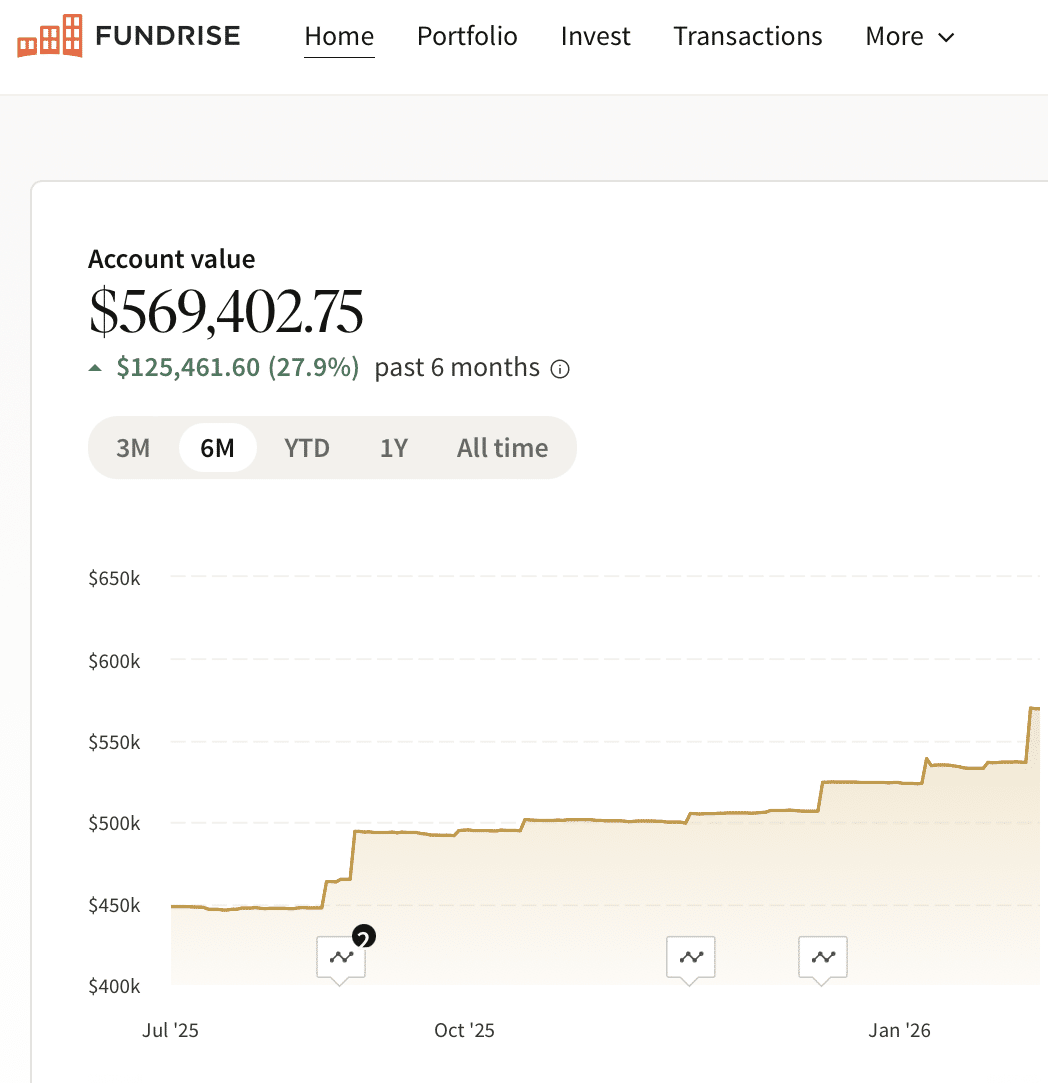
One option worth exploring is Fundrise, which enables you to invest passively in residential and industrial real estate across the country. With around $3 billion in assets under management, Fundrise focuses heavily on Sunbelt markets – areas with lower entry prices, improving fundamentals, and the potential to benefit as real estate cycles turn over the next several years.
For investors seeking more asymmetrical upside, Fundrise Venture offers exposure to private technology and AI companies such as OpenAI, Anthropic, and Databricks. Venture is inherently higher risk, but also where the most explosive growth tends to occur, especially as artificial intelligence reshapes productivity and the labor markets.