
The Trump administration’s recent release of “365 Wins in 365 Days” offers an intriguing empirical ledger of its first year back in power, cataloguing a “New Era of Success, Prosperity” (The White House 2026). At first glance, the document appears to be a standard bureaucratic report that offers a dense list of statistical achievements ranging from “negative net migration for the first time in 50 years” to “trillions in reshored investments” and the “largest homicide drop on record”. However, a closer reading reveals that this text functions less as a neutral policy review and more as a sophisticated messaging template designed to mobilize and project a specific political reality. Research on security discourse suggests that external dynamics often have no intrinsic quality that fixes their meaning as political events (Buzan et al. 1998). Instead, political leaders rely on narratives to make them intelligible. The “365 Wins” document performs precisely this function. Through the narrative practices of framing and mapping, it transforms bureaucratic data points into a causally related sequence with a clear moral arc. It simplifies the complexities of governance into a rigid moral story with heroes and villains, with rescue and recovery (Stone 1989, 299). This aligns with the structural definition of a policy narrative that includes a specific setting, a plot, characters, and a preferred policy outcome (Shanahan et al. 2011, 539). By framing almost every statistic within a dramatic ‘us versus them’ narrative, the White House turns policy outcomes into a domestic referendum on moral legitimacy (Mudde 2004, 544).
In the field of International Relations, the concept of strategic narrative illustrates how politicians mobilize support by imposing a coherent structure on complex events. Miskimmon, O’Loughlin, and Roselle (2013, 5) define strategic narratives as communicative tools with a “shared meaning of the past, present, and future” to shape the behaviour of domestic and international actors. Narratives that organize unconnected phenomena around themes, causality, arcs, and temporality often assign roles such as hero or villain to political actors to make sense of the political system (Miskimmon et al. 2013, 7). Olivier Schmitt (2018, 2) argues that the efficacy of a narrative depends on how it resonates with the established political beliefs of a political community. The “365 Wins” document exemplifies a narrative device by anchoring specific policy claims within a resonant domestic context of national emergency and necessary restoration in the US.
The text relies heavily on strategic contrast, with dozens of references to former President Joe Biden. These references establish a pervasive backdrop of supposed pre-Trumpian chaos in US politics. Against this constructed timeline of decline, these references provide a foundational frame for Trump’s role as a saviour of the US. For observers, citizens, and analysts alike, identifying this narrative mask is a crucial task. It is a governance tool that seeks to predetermine how voters interpret reality. By establishing a cognitive frame where the previous administration of Biden represents “invasion” and “non-enforcement”, and the current executive represents “urgency” and “strength”, the document attempts to render detailed policy critique irrelevant. Critically, the stakes of this type of document extend far beyond the specific claims it makes; it seeks to cement a worldview in which accountability is replaced by allegiance to a saviour narrative. This makes the “365 Wins” an extraordinary case study in how political power is consolidated through storytelling and narratives.
Constructing the Villain: “Biden-Era” as an Adjective for Failure
While a standard government report might rightfully reference a predecessor’s tenure to establish a statistical baseline, the “365 Wins” deploys the name Biden as a rhetorical weapon. The text invokes multiple variants such as “Biden”, the “Biden Administration”, or the “Biden-era” 39 times. The volume of repetition throughout transforms the former presidency into a persistent condition of failure. By contrast, references to other past presidents and politicians, such as Obama (2 times) and [Hillary] Clinton (1 times), are almost non-existent. This signals that the aim of the document is not a historical analysis, but a targeted delegitimization of the immediate political past. Clearly, this strategy relies heavily on temporal reframing and “performing crisis,” in which the crisis is actively constructed, and the hyphenated term “Biden-era” functions as an adjective synonymous with disorder (Moffitt 2015, 211). Throughout the achievement list, policy challenges are not described as systemic or complex, but as direct consequences of professional failure. Specifically, the document refers to the “Biden-era invasion” at the Southern border, “Biden-era non-enforcement” regarding violent crimes such as homicides, and “Biden-Era release incentives” that purportedly encouraged illegal migration into the US. By attaching former President Biden’s name to these crises and performing a “devil-shift”, the narrative removes any sense of nuance and frames them as deliberate deviations from the correct governance that the Trump administration must now rectify (Shanahan et al. 2011, 554).
Moreover, the construction of the villain extends beyond policy mismanagement into personal morality. In perhaps the most striking example of this personalization, win #243 explicitly celebrates the action of stripping “notorious crackhead and grifter Hunter Biden” of his Secret Service detail. The inclusion of this term, alongside the vitriolic language used to describe a president’s close family member, serves a distinct narrative function. It argues that the previous administration was not just incompetent, but in fact compromised at the level of drug abuse and corruption. The subtext is clear: a president who cannot control his own family cannot be trusted to govern the US. The strategic outcome of the relentless villain framing in the document is the creation of a permanent alibi for the Trump II administration. By defining the status quo ante as a period of catastrophe, the current administration absolves itself of the supposed stubborn “Biden-era” residue. Any successful action, hereby, is framed as a heroic reversal of that devastating legacy. Such rhetorical weaponizing aims to protect the Trump II administration from ever being objectively judged and always being compared against the curated image of the villain’s failure.
Constructing the Hero: Trumpian Rescue and Omnicompetence
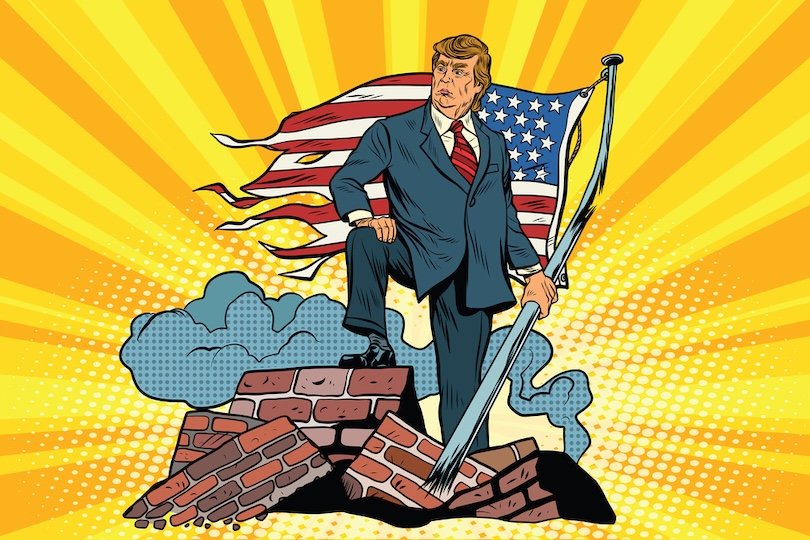
Against the backdrop of supposedly engineered chaos, the “365 Wins” position presents President Trump as the singular protagonist in a classic narrative of national salvation in the US. The opening lines of the text describe a rescue mission and declare that Trump returned to the presidency “with a resounding mandate to restore prosperity, secure the border, rebuild American strength, and put the American people first”. The choice of verbs – restore, secure, rebuild – established the hero frame from the very beginning. These are the words of a saviour pulling the US back from the brink of impending emergency. This framing also dictates the successes to follow as a result of decisive personal intervention by Trump. To validate Trump’s heroic arc, the document employs high-volume and hyper-specific metrics to construct mathematical irrefutability. Throughout, the text overwhelms the reader with precise figures: “2.6 million illegal aliens” removed, “$215 billion” in government savings, “129-to-one rate” of regulatory cuts, “cut fentanyl trafficking at the southern border by 56%”, “revoked over 100,000 visas tied to fraud, criminal activity, or national security concerns”, and “real GDP rising 4.3% in the third quarter of 2025”. The cumulative effect of this accounting of success is a quantitative shock-and-awe, where the reader is flooded by statistics that are too numerous and domain-specific to be scrutinized individually. This phenomenon is known as “techno-populism” (Bickerton and Accetti 2017, 200–201). Thereby, the text frames the Trump II administration as objectively efficient and creates technocratic certainty.
Crucially, this narrative of the Trump II administration’s competence portrays omnipotence, as Trump’s influence is supposedly limitless in scope and scale. The wins oscillate wildly between geopolitical triumphs and cultural grievances, suggesting a hero who is able to manage every macro and micro facet of American life. The same document that credits Trump with ending the Israel-Hamas war and brokering peace across multiple continents also trumpets an executive order to “end the use of paper straws” and a directive to “terminate all beagle experiments”. This indicates a flattening of the hierarchy of policy priorities, which reinforces the public image of President Trump, who is universally present and omnipotent. The language used in the text reinforces this singularity of agency at every turn, attributing wins solely to Trump’s transformative leadership.
The Policy Payoff: Why this Framing Matters for Governance
The construction of a rigid narrative structure in the “365 Wins” serves to create a permission structure for governance. By establishing a binary world of heroes and villains, the document simplifies the complex causality of national and international politics into a straightforward moral question. This emotional appeal offers voters a powerful form of psychological relief because it validates their anxieties about crime or inflation by pinning them entirely on former President Biden. As political scientist Alexandra Homolar (2022, 335) argues, such hero-villain narratives are uniquely powerful because they “grip” audiences through a “seductive rhythm of tragedy and triumph”. Meanwhile, the solution is presented as simple by putting faith and trust into the decisive will of the hero, Trump. The focus on Trump as the hero is a scientifically potent mechanism of psychological persuasion. As Harvard scholar Michael D. Jones notes, the hero variable is often the single most significant factor in how audiences process policy information. His research suggests that an audience grows more affectionate toward a hero the more they believe in the narrative and the more they can support the suggested policy direction (Jones 2014, 22). By saturating the document with 365 examples of Trump’s personal agency in US success, the voters are encouraged to accept the policy conclusions because they accept Trump as the hero in the projected narrative (Pitzer 2010).
The framing allows the administration to attribute every positive economic indicator solely to the executive leadership of Trump while dismissing every negative trend as the lingering residue of the previous Biden administration. For example, the document credits the President with creating “654,000 private-sector jobs” and increasing earnings to offset the “$2,900 in purchasing power workers lost under Biden”. However, such a narrative erases critical factors such as global market trends or post-pandemic recovery. Effectively, this influences the electorate to view the economy as a direct reflection of Trump’s will rather than a dynamic and complex system. Furthermore, the inherent moralization of the timeline fundamentally alters the nature of political accountability and oversight in US politics. When a previous administration is framed as the architect of an “invasion” or a “national border emergency”, it becomes possible to reframe radical executive actions under the Trump II administration as necessary restorative measures. Hence, it becomes logical to declare a “national border emergency on Day One” to mobilize resources and personnel without further legislation. As a consequence of the hero-villain narrative, bypassing the legislative branch transforms from a potential overreach of authority to a heroic necessity required to dismantle the villain’s legacy. Subsequently, any institutional pushback or oversight can be delegitimized as an attempt to protect the failed status quo of the Biden-era.
Conclusion: The Messaging Template of Trump II for the Future
Ultimately, “365 Wins in 365 Days” should not be read as a historic account or retrospective ledger. Rather, it represents a messaging template for how the Trump II administration intends to govern both domestically and internationally. It signals a strategy of permanent campaigning and constant over-communicating of successes to overwhelm audiences with information. Meanwhile, the MAGA movement is sustained by the constant re-litigation of the immediate past. By anchoring every policy decision in the hero-villain narrative, the White House ensures that the populist political energy of the election carries well into the governing term. Besides, this type of communication attempts to insulate the agenda of Trump II from the frictions and issues of normal politics.
For observers, citizens, and analysts, the challenge lies in looking past the emotional structure of the messaging template under Trump II. While the communication strategy presents a world where success is defined by the volume of regulations cut or the number of deep state actors stripped of security clearances, the reality of governance remains in the nitty-gritty details that the hero-villain narrative aims to obscure. To understand the true direction, both successes and failures, one must learn to read the messaging templates under Trump II not as proofs of victory, but as carefully constructed narratives with political objectives.
References
Bickerton, Christopher, and Carlo Invernizzi Accetti. 2017. ‘Populism and Technocracy: Opposites or Complements?’ Critical Review of International Social and Political Philosophy 20 (2): 186–206. https://doi.org/10.1080/13698230.2014.995504.
Buzan, Barry, Ole Wæver, and Jaap de Wilde. 1998. Security: A New Framework for Analysis. Lynne Rienner Pub.
Homolar, Alexandra. 2022. ‘A Call to Arms: Hero–Villain Narratives in US Security Discourse’. Security Dialogue 53 (4): 324–41. https://doi.org/10.1177/09670106211005897.
Jones, Michael D. 2014. ‘Cultural Characters and Climate Change: How Heroes Shape Our Perception of Climate Science’. Social Science Quarterly 95 (1): 1–39. https://doi.org/10.1111/ssqu.12043.
Miskimmon, Alister, Ben O’Loughlin, and Laura Roselle. 2013. Strategic Narratives: Communication Power and the New World Order. Routledge Studies in Global Information, Politics and Society 3. Routledge, Taylor & Francis Group.
Moffitt, Benjamin. 2015. ‘How to Perform Crisis: A Model for Understanding the Key Role of Crisis in Contemporary Populism’. Government and Opposition 50 (2): 189–217. https://doi.org/10.1017/gov.2014.13.
Mudde, Cas. 2004. ‘The Populist Zeitgeist’. Government and Opposition 39 (4): 541–63. https://doi.org/10.1111/j.1477-7053.2004.00135.x.
Pitzer, Andrea. 2010. ‘Michael Jones on Heroes, Villains and the Science of Narrative’. Nieman Storyboard, September 28. https://niemanstoryboard.org/2010/09/28/harvard-michael-jones-on-heroes-villains-and-the-science-of-narrative-and-policy-analysis/.
Schmitt, Olivier. 2018. ‘When Are Strategic Narratives Effective? The Shaping of Political Discourse through the Interaction between Political Myths and Strategic Narratives’. Contemporary Security Policy 39 (4): 487–511. https://doi.org/10.1080/13523260.2018.1448925.
Shanahan, Elizabeth A., Michael D. Jones, and Mark K. McBeth. 2011. ‘Policy Narratives and Policy Processes’. Policy Studies Journal 39 (3): 535–61. https://doi.org/10.1111/j.1541-0072.2011.00420.x.
Stone, Deborah A. 1989. ‘Causal Stories and the Formation of Policy Agendas’. Political Science Quarterly 104 (2): 281–300. https://doi.org/10.2307/2151585.
The White House. 2026. ‘365 WINS IN 365 DAYS: President Trump’s Return Marks New Era of Success, Prosperity’. The White House, January 20. https://www.whitehouse.gov/articles/2026/01/365-wins-in-365-days-president-trumps-return-marks-new-era-of-success-prosperity/.
Further Reading on E-International Relations
