
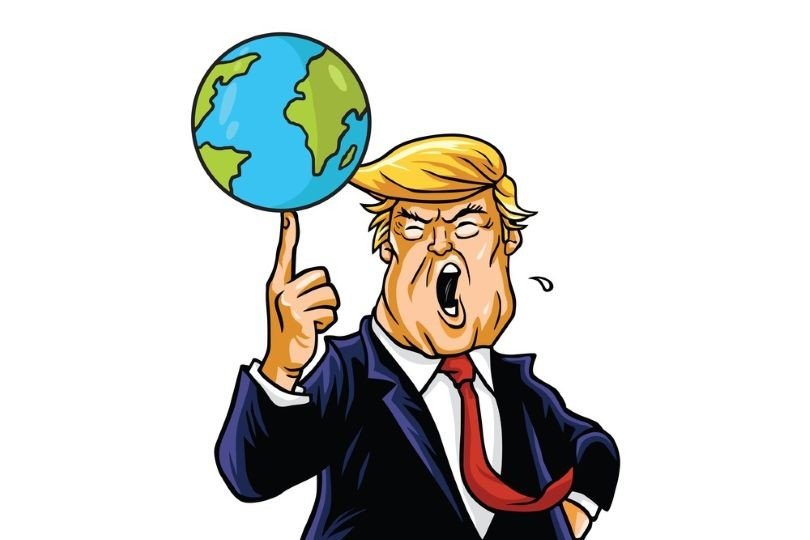
The US intervention in Venezuela and the reinterpretation of the Monroe Doctrine have been viewed in light of a crucial present-day question: Is this the final crisis of the Liberal International Order and, therefore, the end of international law? The Liberal International Order that emerged around 1945, with the UN and the OAS as its pillar organizations and a solid set of security, economic and human rights arrangements, is currently undergoing a long-term crisis.[i] The Trump Corollary of the Monroe Doctrine, based on a policy of military power, only deepens this skepticism and puts this legendary doctrine in sharp tension with international law. In fact, several analysts have rightly interpreted the intervention as essentially illegal under international law.[ii] Trump’s direct and explicit invocation of the Monroe Doctrine from his first Presidential term to the announcement of his second National Security Strategy reinstate this principle of US foreign policy traditionally associated with US hemispheric hegemony on the continent under the banner of a new 21st century policy of hard military power and intervention as a core strategy to address the challenges posed by China’s economic ascendancy and the European Union’s loss of global economic and political prominence.[iii] The situation has brought the resurgence of the Monroe Doctrine into tension with the crisis of international law, prompting everyone to interpret the former as a central cause of the latter.
Although it was never codified as a proper principle of international law, the Monroe Doctrine had a lasting impact on the international order of the 20th century and on international law, especially in Latin America. In this sense, it shaped the myth of US exceptionalism, providing a framework for projecting this nation as an institutional model and hegemonic architect in the configuration of the 20th-century Liberal International Order. The idea of US exceptionalism was a powerful belief among the political and legal elite of that country and inspired ideologically a reordering of the international order from a monistic perspective, projecting US legal and political institutions as a global model of international governance and global justice since the early 20th century.[iv] On the eve of the construction of the League of Nations, President Woodrow Wilson famously proposed by 1917 “that the nations should with one accord adopt the doctrine of President Monroe as the doctrine of the world,” bringing the myth of US exceptionalism to the central stage of the new emerging US-led international order.[v]
To analyze the intervention in Venezuela and the debate over the crisis of international law, it is worth reviewing the uses of the doctrine in order to understand how they reinforced the myth of US exceptionalism and how they also influenced the construction of international law in the Americas. Trump revived the myth of US exceptionalism, but his MAGA (Make America Great Again) Monroe Doctrine is not an expression of military force and international anarchy strictu sensu, nor is it the end of international law, but rather the restoration of a diplomatic principle of US exceptionalism as a crude and minimal but credible normative basis for this current international order in profound crisis.[vi]
The Monroe Doctrine, in most of its US variants from Monroe to Trump’s current version, was fundamentally linked to the myth of US exceptionalism and gave a major impulse to the consolidation and institutionalization of international law in Latin America.[vii] In its original formulation of 1823, following the formula of William Appleman Williams, the Monroe Doctrine was an anti-colonial and imperial principle, unilaterally proclaimed by the US.[viii] It was anti-colonial because it condemned European interventions in the Americas. It was imperial because it proclaimed that any European intervention on the continent was a threat to US interests, placing this nation as guardians of the continent. Although the Monroe Doctrine had no concrete effect on the codification of international law in the Americas, the continental debate over the meaning and scope of the doctrine provided the foundations for the practice of self-determination in Latin America and the construction of the Inter-American System and had a central influence on the US-led international order of the 20th century.[ix] This trajectory of the doctrine is essential for understanding its current return and rebirth.
At the beginning of the 20th century, Latin American jurists deployed the original version of the Monroe Doctrine to condemn European interventions in the region and build a distinctive continental international law that contrasted with that of Europe. The Drago Doctrine, formulated by Argentine Foreign Minister Luis María Drago in 1902 in the context of the intervention of Great Britain, Germany, and Italy in Venezuela, directly invoked the Monroe Doctrine to condemn the intervention of European powers to collect public debts and their intrusion into the continent.[x] A few years later, Chilean jurist Alejandro Álvarez drew on the Monroe Doctrine to formulate his theory about the existence of an American international law distinct from that of Europe, arguing that the Monroe Doctrine was a founding principle of American international law. If the European tradition of international law was based on monarchy, the balance of power, and intervention, American international law was founded on republicanism, solidarity, and non-intervention.[xi] According to Álvarez, the international law of the future was not in Europe, but in the Americas.[xii]
The Doctrine gave a strong impetus to the formation of a continental tradition of American international law precisely when international law became a profession in the region thanks to the work of jurists such as Drago and Álvarez. These precedents seem like relics of the past, but they show how this doctrine, now revived by Donald Trump, is not and has not been a complete rejection of international law and the international order in which we live but has instead contributed to shaping it by placing the Western Hemisphere and the Americas at its center. Curiously, Trump’s new National Security Strategy assumes the military and “economic stagnation” of Europe as a fait accompli of the present and thus calls for the urgent need of “restoring Europe’s civilizational self-confidence.”[xiii]
However, the US has always maintained its copyright over the Monroe Doctrine, and Trump’s Donroe Doctrine only reinforces this precedent by reinforcing the distinction between a European civilization in decline and an American continent hegemonically commanded by the US as the guiding force of the future international order. By 1904, the Roosevelt Corollary of the Monroe Doctrine established that the US reserved itself the right to intervene unilaterally and for “humanitarian” reasons in Latin America, especially in Central America and the Caribbean. In his Annual Message to Congress, President Roosevelt arrogated to the US “the exercise of an international police power” over the region in the name of the Monroe Doctrine and thus the right to intervene when there was “chronic wrongdoing” which can result “in a general loosening of the ties of civilized society.”[xiv] The Roosevelt Corollary can be considered an early and unilateral manifestation of humanitarian interventions.[xv] Notably, Trump’s MAGA Monroe Doctrine refers us back to this old interventionist precedent, based also on the myth of US exceptionalism as the global pólice power of the Western Hemisphere.
From the 1920s onwards, the Monroe Doctrine began to have a decisive influence on the new emerging US-led international order that was under construction. Not only was it invoked by Wilson as a doctrine for the world, but it was also introduced into Article 21 of the Covenant of the League of Nations, emphasizing that it was a “regional understanding” in which the League would not interfere. This emphasis on the doctrine as a “regional understanding” was made even though the US never joined the League, reinforcing the myth of exceptionalism: a central principle of its diplomacy was included in a Covenant of an international organization that the US contributed to forging more than any other nation but to which it did not assume any commitments.[xvi]
Latin American jurists and diplomats reacted to US interventionist practices and its predicament of political and legal exceptionalism and proposed the doctrine as a founding principle of American continental international law in line with a moderate version of the principle of non-intervention. By contrast, other jurists, notably the Mexican Isidro Fabela, were more radical and condemned any version of the doctrine in the name of a robust and absolute conception of the principle of non-intervention, arguing that the Monroe Doctrine was an elastic, unilateral, and interventionist principle to be rejected.[xvii]
These debates over the doctrine condemned in turn the Monroe Doctrine and contributed to laying the foundations of the Inter-American System on solid pluralist principles devoted to safeguarding the principle of non-intervention and the personality and sovereign equality of among states and their right to self-determination in the 1933 Montevideo Convention. With this pluralist basis, Latin America managed to discipline the US and safeguard its legal commitment to these principles in the auspicious context of Franklin Delano Roosevelt’s presidency in the 1930s.[xviii] The Montevideo Convention is one of the greatest achievements and legacies of Latin American international law to the Liberal International Order, which was motivated, among other things, by a political and legal debate over the meaning and scope of the Monroe Doctrine.[xix] The region’s other great achievement was the 1948 Bogotá Conference, which gave rise to the American Declaration of the Rights and Duties of Man (and Woman).[xx] The fact that Latin America has once again become relevant and a priority in such a brutal manner with through Trump’s Corollary and US intervention in Venezuela is worrying and disconcerting, but it also opens an opportunity, if not to discipline, at least to moderate the US and encourage itself to commit to minimal pluralist norms and values.
The current debate over the end of international law is important and should not be avoided. There is no point in cultivating a nostalgia for a return to the old Liberal International Order established in 1945, which began to fall apart since at least the 1970s. Nor is it worthwhile to approach this debate from the perspective of international law’s failure. The meaning of international law has been called into question and is currently undergoing profound changes.
The fact that Latin America has once again become relevant and a priority for the US provides an opportunity to rebuild and reestablish its end, that is, the fundamental meaning and objective of international law in 21st-century international politics, which has become arbitrary, unpredictable, and essentially belligerent. Assuming a moderating and pluralist role vis-à-vis the US is a mission as complex as it is costly for Latin America, but at least it is timely today, as it was in the 1930s. As Ingrid Brunk and Monika Hakimi have recently shown, the basic principle of international law condemning territorial annexations and interventions has been eroded by the Gaza War, Russia’s invasion of Ukraine, and now, I would add, the US intervention in Venezuela. In short, the great Powers of this day, such as the US and Russia, do not respect this minimal core principle.[xxi]
Perhaps the concern for international solidarity for the sake of human justice, the protection of human rights, and international security through humanitarian interventions and the responsibility to protect has gone too far to the point that we no longer care how and by whom it is administered. Since the 1970s, with the end of the decolonization process and especially after the so-called War on Terror in 2001, these concerns for solidarity have gone way too far, so far that the minimal pluralist principles of the international order based on consolidating order among states, condemning interventions and territorial annexations, and the safeguarding autonomy and self-determination of states have been overlooked.[xxii]
As Hedley Bull observed, international society is essentially anarchic, but it offers some basic guidance for the conduct and ordering among states through basic minimal norms such as the principle of non-intervention[xxiii] For international law to fulfill a robust and truly ambitious purpose of promoting global human rights and democracy and condemning the authoritarianism of Donald Trump and Nicolás Maduro at the domestic and international levels through friendly and peaceful international solidarity, it must be able to enforce and guarantee respect for minimal standards. But, as Nikolas Rajkovic stated in a recent article, international law is no longer able to place limits on the behavior of major powers such as the US and Russia. Instead of establishing firm restrictions, it has transformed the rules into instruments of elastic legality at the service of great Powers.[xxiv]
More importantly, international law has ceased to be substantive, pluralist, robust, and the guarantor of minimal standards of autonomy and pluralism among states, and has instead become arbitrary, malleable, fluid, vertical, and monistic, serving instead maximum and ambitious standards of solidarity that are difficult to implement effectively and consistently. Trump’s intervention in Venezuela and the rebirth of the myth of US exceptionalism are emblematic manifestations of this regressive transformation of international law.
Although they never had similar foundations, something similar has shaped the destiny of the Monroe Doctrine for many years – even more so since its recent drift into the Donroe Doctrine (which is undoubtedly a degeneration). The transition from Monroe to Donroe and Trump’s possible intervention in Greenland are alarming, but they are perfectly consistent with the transformations over the end and purpose of international law in the 21st century. Therefore, for now, the past continues to illuminate the future, and when it comes to facing the challenges of the 21st century, our spirit walks between the shadows and the lights of the 20th century.
[i] Daniel Deudney and Jonh Ikenberry. “The Nature and Sources of the Liberal International Order,” Review of International Studies 25 (1999): 179-196; Mark Mazower, Governing the World: The History of an Idea (London: Allan Lane, 2012); Juan Pablo Scarfi “The Latin American Politics of International Law: Latin American Countries´ Engagements with International Law and their Contradictory impact on the Liberal International Order,” Cambridge Review of International Affairs 35, No 5 (2022): 662-679.
[ii] See, for example, the excellent piece by Julian Arato and Justina Uriburu, Justina, “Trump’s Illegal Attack on Venezuela and Its Consequences,” EJIL:Talk! Blog of the European Journal of International Law, January 5, 2026. https://www.ejiltalk.org/trumps-illegal-attack-on-venezuela-and-its-consequences/
[iii] Francisco Urdinez, Economic Displacement: China and the End of US Primacy in Latin America (Cambridge: Cambridge University Press, 2025).
[iv] Juan Pablo Scarfi, The Hidden History of International Law in the Americas: Empire and Legal Networks (New York: Oxford University Press. 2017); Michael Ignatieff (ed.), American Exceptionalism and Human Rights (Princeton, NJ: Princeton University Press, 2005).
[v] Woodrow Wilson, “Address to Senate,” January 22, 1917. In Papers of Woodrow Wilson, November 20, 1916-January 23, 1917, vol. 40, ed. Arthur Link (Princeton, NJ: Princeton University Press, 1982), 538-539.
[vi] See, for example, O’Connor, Tom. 2025a. “Will Venezuela Be the First Target of Trump’s New MAGA Monroe Doctrine?,” Newsweek, August 30, 2025. https://www.newsweek.com/will-venezuela-first-target-trumps-new-maga-monroe-doctrine-2121883 (accessed on 30 October 2025), and Tom O’Connor, “South America Regime Change: How Past US Efforts Played Out.” Newsweek, October 26, 2025. https://www.newsweek.com/south-america-regime-change-how-past-us-efforts-playedout-10934742
[vii] Jay Sexton, The Monroe Doctrine: Empire and Nation in Nineteenth-Century America (New York: Hill and Wang, 2011); Walter LaFeber, “The Evolution of the Monroe Doctrine from Monroe to Reagan,” in Redefining the Past: Essays in Diplomatic History in Honor of William Appleman Williams, Lloyd C. Gardner (ed.) (Corvallis, OR: Oregon State University Press, 1986), 121-141.
[viii] Wlliam Appleman Williams, The Tragedy of American Diplomacy (New York: W. W. Norton & Company, 2009).
[ix] Juan Pablo Scarfi, The Hidden History of International Law in the Americas: Empire and Legal Networks (New York: Oxford University Press, 2017); Scarfi, “Latin America and the Idea of Peace,” in The Oxford Handbook of Peace History, Howlett, Charles F.; Peterson, Christian Philip; Buffton, Deborah D.; Hostetter, David L. (eds) (Oxford: Oxford University Press, 2023), 266-282.
[x] Juan Pablo Scarfi, “In the Name of the Americas: The Pan-American Redefinition of the Monroe Doctrine and the Emerging Language of American International Law in the Western Hemisphere, 1898–1933.” Diplomatic History 40, No 2 (2016): 189–218.
[xi] Alejandro Alvarez, “Latin America and International Law,” American Journal of International Law 3, No 3 (1909): 269–353.
[xii] Juan Pablo Scarfi, “The Monroe Doctrine in the Americas: Towards a Hemispheric Intellectual History.” Diplomatic History 47, No 5 (2023): 738–763.
[xiii] See National Security Strategy of the United States, November 2025 (Washington DC: Government of the United States of America, 2025), 6, 26. https://www.whitehouse.gov/wp-content/uploads/2025/12/2025-National-Security-Strategy.pdf
[xiv] Theodore Roosevelt, “Annual Message of the President to Congress,” December 6, 1904 in Papers relating to the Foreign Relations of the United States, 1904 (Washington, DC: Department of State, 1904), XLI.
[xv] Simon Chesterman, Just War or Just Peace: Humanitarian Intervention and International Law (Oxford: Oxford University Press, 2001); Juan Pablo Scarfi, “In the Name of the Americas: The Pan-American Redefinition of the Monroe Doctrine and the Emerging Language of American International Law in the Western Hemisphere, 1898–1933.” Diplomatic History 40, No 2 (2016): 189–218; Frank Ninkovich, “Theodore Roosevelt: Civilization as Ideology.” Diplomatic History 10, No 3 (1986): 221-245.
[xvi] Juan Pablo Scarfi, “Denaturalizing the Monroe Doctrine: The Rise of Latin American Legal anti-Imperialism in the Face of the Modern US and Hemispheric Redefinition of the Monroe Doctrine,” Leiden Journal of International Law 33, No 3 (2020): 541–555; Ignatieff (ed.), American Exceptionalism.
[xvii] Isidro Fabela, Los Estados Unidos contra la libertad, estudios de historia diplomática americana: Cuba, Filipinas, Panamá, Nicaragua, República Dominicana (Barcelona: Talleres Gráficos Lux. 1920).
[xviii] Juan Pablo Scarfi, “The Latin American Politics of International Law: Latin American Countries´Engagements with International Law and their Contradictory impact on the Liberal International Order.” Cambridge Review of International Affairs 35, No 5 (2022): 662-679; Greg Grandin, Greg. 2012. “The Liberal Traditions in the Americas: Rights, Sovereignty, and the Origins of Liberal Multilateralism,” The American Historical Review 117, No. 1 (2012): 68-91.
[xix] Juan Pablo Scarfi, “The Montevideo Convention and its Predecessors,” in Latin American International Law in the Twenty-First Century, Alejandro Chethman, Alex Huneeus and Sergio Puig (eds.) (Oxford: Oxford University Press, 2025), 61-79.
[xx] Kathryn Sikkink, Evidence for Hope: Making Human Rights Work in the 21st Century (Princeton, NJ: Princeton University Press, 2017).
[xxi] See Ingrid Brunk and Monica Hakimi, “The Prohibition of Annexations and the Foundations of Modern International Law,” American Journal of International Law 118, No. 3 (2024): 417-467.
[xxii] See Hedley Bull, “The Grotian Conception of International Society,” in Diplomatic Investigations: Essays in the Theory of International Politics, Herbeert Butterfield and Martin Wight (eds.) (Oxford: Oxford University Press, 2019 [1966]), 71-94; William Bain, “Pluralism and Solidarism,” in International Society: The English School Cornelia Navari (ed.) (New York: Palgrave Macmillan, 2021), 95-108; Danilo Zolo, Victors’ Justice: From Nuremberg to Baghdad (London: Verso, 2020).
[xxiii] Hedley Bull, The Anarchical Society: A Study of Order in World Politics (Basingstoke: Palgrave Macmillan, 2022 [1977]).
[xxiv] Rajkovic, Nikolas. 2026. “Welcome Back to the Rule of Guns and Lawyers: A Tale of Two Ursulas, From Ukraine to Venezuela.” OpinioJuris, 7 January 2026. https://opiniojuris.org/2026/01/07/welcome-back-to-the-rule-of-guns-and-lawyers-a-tale-of-two-ursulas-from-ukraine-to-venezuela/
Further Reading on E-International Relations
