
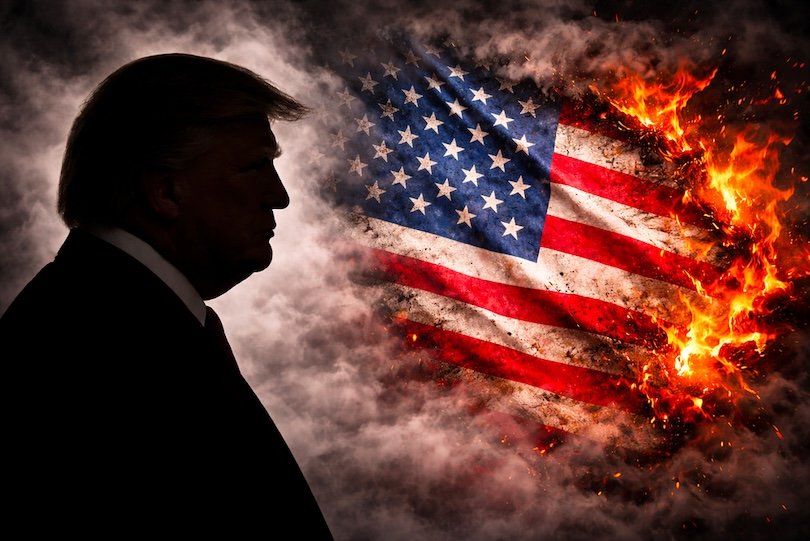
He would be constrained, Donald Trump said, only by his “own morality” (see NYT, 10 January 2026). If taking this statement seriously, then this is the hallmark of tyranny and of a tyrant. At the moment, many terms and concepts are used in scholarly and journalistic observations to characterise Trump, his politics, and the people around him – many of whom are firmer and smarter ideologues than him – such as fascism (recently in The Atlantic by Jonathan Rauch; January 25, 2026), totalitarianism, or authoritarianism (see recently in the NYT by David Brooks, January 23, 2026). While all of them capture some important aspects, I want to suggest another concept because something seems to be missing in their characterisations: the aspect of the arbitrariness of politics and the self-obsessed corruption in his style of government and how he selects his inner circle. This suggests the concept of tyranny and Trump as the person of the tyrant.
For instance, the murder of two white, middle class US citizens, shot by a federal law enforcement agency (Immigration and Customs Enforcement, ICE) and the further deaths of an estimated 32 people in custody o the ICE since 2025 (The Guardian, 28 January 2026) are not only terrible crimes committed by government agents and a contempt of human life but further makes no sense in ideological terms. And to portrait them, from the current administration’s perspective, as “collateral damage” (so the interpretation, not justification, of the US administrations view in ABC News, 26 January 2026), would not only be dehumanising, but underplaying the mere arbitrariness of politics, evidenced by endless shifts and irrational volte faces of Trump and his administration that do not seem to follow any form of rationality, independent where one stands ideologically.
These deaths are “just” one example; the permanent turn-arounds in trade tariffs, the emotional explosions on social media, or the sheer imperceptible granting and taking of loyalty other examples. The rivalry between the US and the USSR during the Cold War, for instance, followed a tangible rationality as brutal as it was. Just look at the many photographs of Richard Nixon and Leonid Brezhnev. While being fierce enemies and masters of the Cold War and its Proxy Wars, the photos reveal the shared rationality of some comradery and evil mischief. Trumpian politics does not seem to follow such an overarching rationality, but complete erraticism, while all the signs diagnosed by Rauch – demolition of norms; glorification of violence and leadership; might is right; politicized law enforcement; dehumanization; police-state tactics; undermining elections; attacks on news media; territorial and military aggression; blood-and-soil nationalism; mobs and street thugs; and the production of an alternative reality through propaganda –nevertheless apply. But they apply not with ideological coherence and consistency, but arbitrarily. Trump can be best friend with a black person while at the same time breeding white supremacism; he can pretend being best mates with an obvious arch enemy, and, in the very moment, this looks credible (e.g., his appearance with New York City Mayor Zohran Mamdani). But it is inconsistent and arbitrary (apart from being morally corrupt, but this shall not be the focus here), thus the deepest property of tyranny.
It is helpful to hark back to Plato (Republic) and Aristotle (Politics, Rhetoric, Nicomachean Ethics) to enhance our understanding of this form of government. They describe tyranny as the absolute worst form of impure regimes, next to oligarchy and democracy (understood as direct government), and aristocracy, monarchy, timocracy (or polity) as ‘good’ forms of government. The criterion for ‘good’ and ‘bad’ government is the intention of those who govern: do they govern for the common good of a commonwealth, or according to their own interests? Following this logic, we can even have a ‘good monarch’ when their intentions, decisions, and the implementation of their policies are for the common good and in the common interest of the community. Better would be, however, if many make decisions on “war and peace”, “alliances”, “legislation”, “penalties of death, exile, and confiscation of goods”, and on “choosing of officials, and the scrutiny of their conduct on expiry of tenure” (Aristotle, Politics, Book IV.14).
Tyranny is the form of government, however, close to monarchy, where one person decides, but it is unleashed as the tyrant rules without law and only in their own interest and for personal gain. It is thus the corruption of kingship and uses all those tools that are listed above as traits of fascism. Is law the guarantor of coherency, consistency, and reliability of decision making (thus is the core definition of the rule of law), then tyranny as rule without law opened the door to arbitrariness and erraticism, thus Trump’s ‘no constraint beyond own morality’ is a blatant, but perfect (self-)description of a/the tyrant.
It is interesting to look at two further aspects: the rise of a tyrant, and his fall. Aristoteles writes that tyrants often originate as demagogues who gained some people’s support by pitching groups against each other and dividing society up into constructed binaries such as the “poor” against the “wealthy”; the “elites” against the “real people”; “nationals” against so-called “foreigners”, etc. Trump’s hate speeches and mockery against minorities, enemies/disloyals, or any ‘arbitrary other’, is a best example of this. Ultimately, Aristotle says, tyrants would fabricate identities and suppress those parts of the people identified as ‘foes’ (again, according to quite arbitrary criteria, mostly ‘loyalty’) as poor and uneducated as well as controlling them by fear. They would also distract them from politics by daily tasks and entertainment (the Roman motto panem et circenses [“bread and circuses”] receives a nearly tragic reality in our age of cheap television and social media). This seems to epitome in a TV host as president who then recruits many of his courtiers from the entertainment industry. Nothing could be more illustrative of the distraction from a politics that would engage seriously, i.e., with expertise, and compassionately with the many questions a commonwealth is challenged by, than the decline of politics as TV show (see also Will Dunn in the New Statesman, 1-7 August 2025). The consumption of politics as TV show fits neatly with Aristotle’s further description of the tyrant (Nichomachean Ethics, 1149a 10-16) and the rationale that maintains tyrannies: they are reduced to living by “sense perception alone”, i.e., bar of reason, prudence, or common morality.
And herein, in the absence of reason and prudence, lies, as much as this is a characteristic for the rule of the tyrant, also the reason for their fall from rule. Because reason, prudence, and common morality (the condition of solidarity, trust, and empathy) are replaced with fear and oppression (speak the roving around of masked ICE-henchmen; the misuse of the Department of Justice to prosecute political enemies; or the unashamed threatening of individuals who oppose Trump’s interests and tirades). Oppression and fear, and we can add rising living costs, will ultimately, so Aristotle hopes, cause people and parts of the regime (military, for example) to revolt.
This hope is based, however, on the existence of civil courage in citizens. And here the picture is mixed: while there are positive signs of civil courage, for example “Moms against ICE” (Education International, 27 January 2026), there are also negative, or from the perspective of civil courage incomprehensible, ones: They relate to the support of Trump, one may better speak of sycophancy, by the so-called Tech elite that profited from liberal employment, trade, and immigration politics for decades and indulged in a apparently liberal lifestyle. I think of the likes of Jeff Besoz, Mark Zuckerberg, Tim Cooke, or Sundar Pichai (33 of them attended a dinner at the White House on 4 September 2024), not to speak of erstwhile right-wingers like Peter Thiel, Elon Musk, or Larry Ellison: Maybe living by “sense perception alone” – as Aristotle warned us, a characteristic that applies to the aforementioned as well as to digital media consumers in general and that certainly applies to ‘televised politics’ in modern mass societies (so brilliantly analysed by Neil Postman in Amusing Ourselves to Death) – smuts and risks to destroy politics as common, compassionate, and thoughtful concern? And maybe in the wake of this the attitude and skill of protest and civil disobedience as political virtues become unfashionable, obscure, and vanish?
Modern mass society and its leaders have self-inflicted a tragedy of existential, Sophoclean scope: the odes of elderly citizens (most famous in “Ode to Man”) can only urge caution, empathy, and prudence as philosophical commentary against the irrationalities of unleashed power, hubris, and personal greed triggering thoughtlessness that prevails the world.
Further Reading on E-International Relations
