
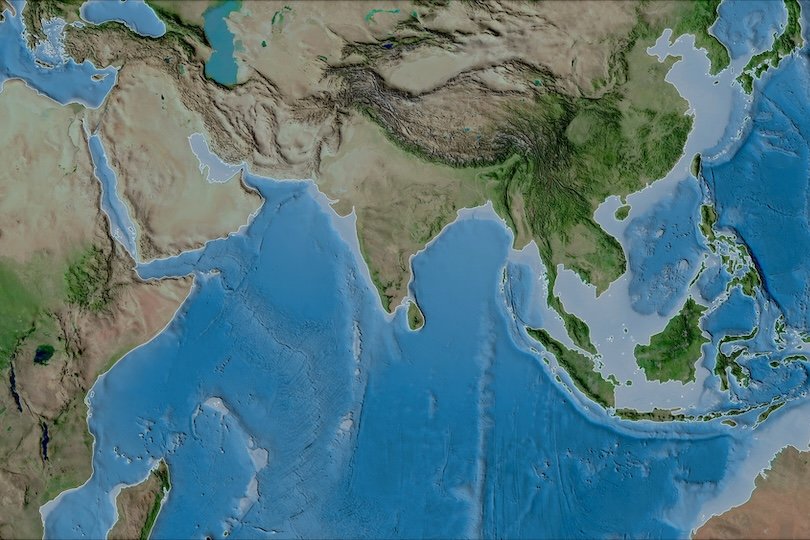
The UK government has agreed to recognise the sovereignty of Mauritius over the Chagos Archipelago, a colonial possession of the UK in the Indian Ocean, and to take a long lease from Mauritius of Diego Garcia, its largest island, and home to a US military base. The UK government maintains that its agreement with Mauritius will allow the Diego Garcia Base to maintain its important strategic role in the future, but critics in the UK and the US disagree. They insist that it is a mistake for the UK to give up its sovereignty over the Archipelago, because its agreement with Mauritius could open the door to Chinese spy ships, a Chinese base on one of the Chagos Islands, restrictions on nuclear weapons on Diego Garcia, and compulsory inspections to check for compliance. But critics overlook or understate the actual provisions of the agreement, which allow the UK and the US unrestricted rights to patrol the Chagos Archipelago, give the UK a veto over spy ships, foreign bases and even civilian development, and allow the presence of nuclear weapons, without requiring compulsory inspections. While the ultimate guarantor of the security of the US Base on Diego Garcia is US hard power, legitimacy still matters. Through the Chagos agreement the UK offers a legitimacy for the US presence on Diego Garcia that it has lacked to date, in the eyes of adversaries and allies alike.
The UK’s agreement with Mauritius recognises the latter’s sovereignty over the British Indian Ocean Territory, also known as the Chagos Archipelago, or Chagos Islands. It includes a 99-year lease to the UK of Diego Garcia, which is intended to ensure business as usual for its strategically important UK/US base. There is a price to be paid for this; over the 99 year period, the UK will pay Mauritius a total of around £3.4 billion in 2025/26 prices.
President Trump commented recently that the deal is “an act of great stupidity.” This appeared to cast doubt on the support given to the agreement by the White House and the State Department in May 2025, and led to a pause in the parliamentary process in the UK for its ratification. Then President Trump seemed to be backing the agreement once more, and the State Department repeated its endorsement, but the very next day President Trump took to social media to attack the agreement again, saying : “Prime Minister Starmer should not lose control, for any reason, of Diego Garcia, by entering a tenuous, at best,100 Year Lease.” The UK government was reported as planning to resume the ratification process after the State Department’s published re-endorsement, but as having paused for further thought after President Trump’s latest comments. The present writer suggested recently that an extended pause in the ratification process would be the least bad response the UK government could make if President Trump expressed serious opposition to the agreement going forward, and that a take-over of the Chagos Islands by President Trump could not be ruled out.
President Trump’s suggestion that committing to the Chagos agreement would mean losing control of Diego Garcia reflects criticisms made both in the UK and the US to the effect that the agreement would be a poor substitute for UK sovereignty, would weaken the effectiveness of the US base, and cede a strategic advantage to China. But these criticisms gloss over generally-perceived weaknesses in the UK’s claim to sovereignty, the actual substance of the Chagos agreement, and the political context which led to it being negotiated in the first place.
The starting point for analysis is the fact that virtually every national government in the world regards the UK’s past claim to sovereignty over the Chagos Islands as having been overtaken by the modern law and practice of decolonisation. In an earlier article the present writer discussed events which led to allies in NATO and the Indo-Pacific refusing to back the UK’s claim to sovereignty over the Chagos Islands in a United Nations vote on the issue in 2019. Only three countries, all led by acolytes of President Trump at the time, voted with the UK and the US. That was the turning of the political tide that led to Conservative Prime Minister Rishi Sunak starting talks with Mauritius in 2022 on sovereignty over the Chagos Archipelago and the future of the US Base on Diego Garcia, and to Sunak’s Labour successor Sir Keir Starmer signing an agreement on those issues with Mauritius in May 2025. Opponents of the deal say that it is a mistake for the UK to give up its sovereignty because it would, for example, allow Mauritius to open the door to Chinese spy ships, and even a Chinese military base on an island in the Chagos Archipelago.
Such arguments rest on an unconvincing premise – that Mauritius and China would give more credence to claims to sovereignty which they reject and which are almost universally regarded as discredited, than they would to a treaty regarded by Mauritius as binding, and which would provide generally-recognised legitimacy for the UK/US base on Diego Garcia. In any event, the Chagos agreement directly addresses the threat from foreign forces, spy ships and military bases. It provides that the presence of members of foreign security forces anywhere in the Chagos Archipelago would require authorisation by the UK as well as Mauritius (Annex 1, 3(d)). The reference to foreign security forces covers “civilian” as well as “military” members of those forces, and this wording seems aimed at threats such as Chinese spy ships, which might be manned by civilians under what is sometimes referred to as a China’s “civil-military fusion strategy.”
If the UK informs Mauritius about activities in the Archipelago that require joint authorisation but have not been authorised, then “the parties agree, and shall cooperate as necessary, to prevent or otherwise bring to an end such activity” (Annex 1, 9). This wording allows unilateral as well as joint action, and international law permits the use of proportionate force to remove uninvited foreign forces or ships engaged in spying from the area of an archipelago itself, though not beyond an archipelago and its territorial waters but within its 200-mile exclusive economic zone.
Trump ally Andrew Hale wrote recently that the Chagos deal would make it much easier for the Chinese to spy on Diego Garcia, because the US “would have no influence on the more than 60 islands around the base at Diego Garcia, on which Mauritius plans to build settlements and infrastructure with Chinese assistance.” This criticism overlooks safeguards in the Chagos agreement for the UK and the US, which restrict the freedom of action of Mauritius, as well as foreign powers. The consent of the UK would be needed for structures and buildings anywhere in the Chagos Islands (Annex 1, paras. 4(b), 6, esp. 6(f), Annex 3, para. 5), which would cover anything from a holiday home to a military base, even if that base were Mauritian. If Mauritius did pivot to China and started to build a military base in the Archipelago, that would be a breach of the Chagos agreement that the UK would entitled to prevent or otherwise bring to an end, and Mauritius would be bound to cooperate as necessary (Annex 1,9). If the UK used force in such circumstances, the agreement provides that such force would not be a ground for Mauritius to terminate the agreement (Art.15), as is explained below. That is not to say that the UK would necessarily veto all civilian development, since under the agreement Mauritius is free to resettle Chagossians – expelled by the UK between 1968 and 1973 – on islands other than Diego Garcia (Art. 6), and the UK might want to facilitate such resettlement on humanitarian grounds.
Mauritius has also agreed to neither authorise nor undertake the placing of maritime installations, sensors or artificial islands anywhere in the Archipelago and its exclusive economic zone, unless the UK agrees (Annex 1, 4(a)). The UK and the US will be well placed to detect and confront any suspect or unauthorised activities in the Chagos Archipelago beyond Diego Garcia, and in its 200-mile exclusive economic zone, since the Chagos agreement allows unrestricted overflight, navigation and undersea access for UK and US aircraft and vessels (Annex 1, 3(a) and Art. 19). When it comes to Diego Garcia itself, the UK’s authority over the Island and its US base will cover a zone of 12 miles surrounding the island, which includes airspace and seabed and subsoil (Art. 19). The UK will have control over the conduct and deployment of armed operations and lethal capabilities on Diego Garcia, and will administer and police the island (Art. 2 and Annex 1). The UK can authorise the US to operate the base jointly with it, which is the main object of the exercise (Art. 2(5)).
Mauritius retains some “rights and authorities” over Diego Garcia, such as in respect of fishing and the environment, but they can only be exercised with the consent of the UK (Art. 2(3) and Annex 3). Mauritius would also need UK permission to position maritime installations, sensors or artificial islands between 12 and 24 miles of Diego Garcia (Annex 1, 3(f)). Mauritius and the UK agree not to undermine the secure and effective operation of the Base, and to cooperate to that end (Art. 3(2)(b)). This pledge can affect the interpretation of other provisions of the Chagos agreement, such as the duty of the UK to “expeditiously inform Mauritius of any armed attack on a third State directly emanating from the Base on Diego Garcia” (Annex 1, 2). It follows that an appropriate reading of “expeditiously” would be “as soon as possible but not so soon as to assist an adversary.”
The base on Diego Garcia faces towards archipelagic waters, in an approximately west-northwesterly direction. It follows that no amount of UK sovereignty over Diego Garcia could shield it from surveillance from spy ships navigating in the exclusive economic zone of the Archipelago beyond the 12-mile limit to the north, east and south of the Island. The same is true of US bases on coasts in a number of countries, including the US itself. Naval bases in Georgia, Virginia and Connecticut have in the past received the attention of Russian spy ship Viktor Leonov, sailing outside the US 12-mile limit. The UK is bound under the Chagos agreement to comply with international law in its implementation (Art.4), which would commit the UK to ensuring that attacks launched from Diego Garcia by the US are confined to lawful acts of individual or collective self-defence. International law would apply to the UK in any event, however, and the political Code currently applicable to UK government ministers refers to an “overarching duty” to comply with international law.
One important restriction could apply to the military use of the Diego Garcia Base, and that relates to nuclear weapons. The lease of Diego Garcia authorises the UK to exercise the “rights and authorities” of Mauritius on Diego Garcia (Art.2(1)). Mauritius, however, has agreed to prohibit the “stationing” of nuclear weapons on its territory, including the Chagos Islands, under the Treaty of Pelindaba (Art. 4(1)). Since Mauritius has renounced any right or authority to station nuclear weapons on Diego Garcia, it might be said that the UK is in the same position under the lease, and cannot station nuclear weapons there either. This is the conclusion reached by the Deputy Prime Minister of Mauritius, Paul Berenger.
Under the Treaty of Pelindaba, the transport on land or in internal waters of nuclear weapons amounts to the stationing of nuclear weapons (Art. 1(d)). This could catch the movement of nuclear weapons from one warship to another or from one aircraft to another. On the other hand, the Treaty of Pelindaba would allow visiting warships or aircraft carrying nuclear weapons to be exempted (Art. 4(2)). The right to exempt is a “right or authority” transferred to the UK under the lease of Diego Garcia. It is the long-standing policy of the UK and the US neither to confirm nor deny the presence of nuclear weapons. No doubt this policy will continue in respect of Diego Garcia. There is equally no doubt that there is a legal basis for the temporary presence of nuclear weapons on Diego Garcia, which is sufficient to enable a nuclear-armed attack to be launched from the base.
There is, however, a broader view that could be taken of the rights of the UK and the US vis-à-vis nuclear weapons on Diego Garcia. It is that Article 7 of the Chagos agreement maintains the status quo ante vis-à-vis nuclear weapons, since it provides that “nothing in this Agreement shall affect the status of existing international obligations or arrangements except as expressly provided for in this Agreement” (emphasis added). The UK and the US might consider that existing arrangements as regards nuclear weapons remain unchanged, that there is no express provision for changing that position, and continue to refuse to comment on the presence or absence of nuclear weapons on Diego Garcia.
The Treaty of Pelindaba also requires parties to give “full and free access” to their territory for the purposes of nuclear inspections. The UK – and therefore the US – would not be bound by these obligations, however, because the Chagos agreement rules out imposing any obligations on the UK under a treaty to which it is not a party – and the UK is not a party to the Treaty of Pelindaba. However, the Chagos agreement does recognise that some “rights or authorities” of Mauritius over Diego Garcia may be retained rather than transferred to the UK, either expressly, or impliedly (Art. 2(4)). It might be argued that Mauritius retains the authority to give “full and free access” to nuclear inspectors visiting Diego Garcia. But even if that is right, it would lead nowhere. As noted above, the Chagos agreement provides that rights or authorities retained by Mauritius over Diego Garcia are to be exercised only with the consent of the UK (Annex 3, paras. 7 and 5). The appropriate conclusion is that nuclear inspections could not be forced on the UK and the US on Diego Garcia.
One UK think-tank critical of the Chagos agreement and in favour of retaining UK sovereignty argues that although Mauritius has no express right to suspend the Chagos agreement, it might in the future purport to do so, on the pretext that a breach by the UK legally entitled it to take what are known in international law as non-forcible counter measures. It is true that the UK and Mauritius might disagree about compliance with the Chagos agreement, as regards, say, an issue concerning nuclear weapons on Diego Garcia, or the response of UK/US patrols to activities within the Chagos Archipelago. But such differences are channelled into a disputes procedure which relies exclusively on political settlement, and is worded to exclude any implication that one party might refuse to comply in full with the agreement in response to a perceived violation by the other.
The procedure for settling disputes over the interpretation or application of the Chagos agreement is the Joint Commission, which comprises representatives of both parties. All decisions of the Commission require the agreement of both parties. If the Commission fails to resolve a dispute, that dispute shall be resolved “exclusively” by negotiations between Mauritius and the UK “at an appropriately high level.” It is difficult to see how it would be easier for Mauritius to find a legal pretext to break the Chagos agreement, which it will have ratified and regard as binding, than it would be for it to find a pretext for infringing UK sovereignty over the Chagos Islands, which it regards as legally discredited, as indeed do most national governments around the world.
Nevertheless, what if Mauritius did contravene the Chagos agreement, by, for example, claiming that a US attack from Diego Garcia had been in breach of international law, and that accordingly it was justified in authorising a foreign military base or spy ships in the Archipelago? In legal terms, the UK and the US would remain entitled under the agreement and in accordance with international law to prevent any steps to install a military base in the Archipelago, and to remove uninvited foreign forces and vessels from the area. Mauritius would be left with the procedure under the Chagos agreement to resolve its differences with the UK through appropriately high level political negotiations, and would have no grounds to terminate the agreement. Which leads us to the question of the circumstances in which Mauritius could lawfully claim to terminate the Chagos agreement. These circumstances are narrow and precisely defined.
The only grounds for Mauritius to terminate the agreement would be failure by the UK to pay the rent it has promised, an armed attack or threat of an armed attack by the UK on the territory of Mauritius, or an armed attack on the territory of Mauritius emanating from Diego Garcia (Art. 18). It is significant that the reference to an “armed attack” excludes not only action in self-defence, but “action undertaken with the consent of the Republic of Mauritius,” which clearly includes action consented to by Mauritius under the Chagos agreement itself. If Mauritius sought to set up a military base in the Archipelago, or to undertake any development without the consent of the UK, action taken by the UK to prevent that would not amount to an armed attack on the territory of Mauritius even if it involved the use of military force. It might be added that it is only an armed attack on the territory of Mauritius that could lead to steps by Mauritius to terminate the agreement, and an armed attack on, say, a Mauritian Coast Guard vessel, might be a breach of the agreement if contrary to international law, but it would not be a breach which could trigger termination of the agreement. If Mauritius ever did seek termination, and the matter could not be resolved by the Joint Commission, it would be open to the UK to trigger a binding procedure for arbitration. It is agreed that the decision of the arbitrators would be final, and complied with by the parties. If the UK did not initiate arbitration, the agreement would be terminated.
It is US hard power, rather than the Chagos agreement or any successor to it, that will ensure that the Diego Garcia Base can continue to play its role in the Indian Ocean and beyond, both in the near term and for as long as any future US President considers it to be of strategic value. But legitimacy still matters – both to cement the support of allies, and to increase the political risks of adversaries. Through the Chagos agreement the UK has offered universal legitimacy for the US presence on Diego Garcia and in the Chagos Archipelago. That is a step forwards rather than backwards, in terms of realpolitik as well as in terms of compliance with international law.
Further Reading on E-International Relations
