
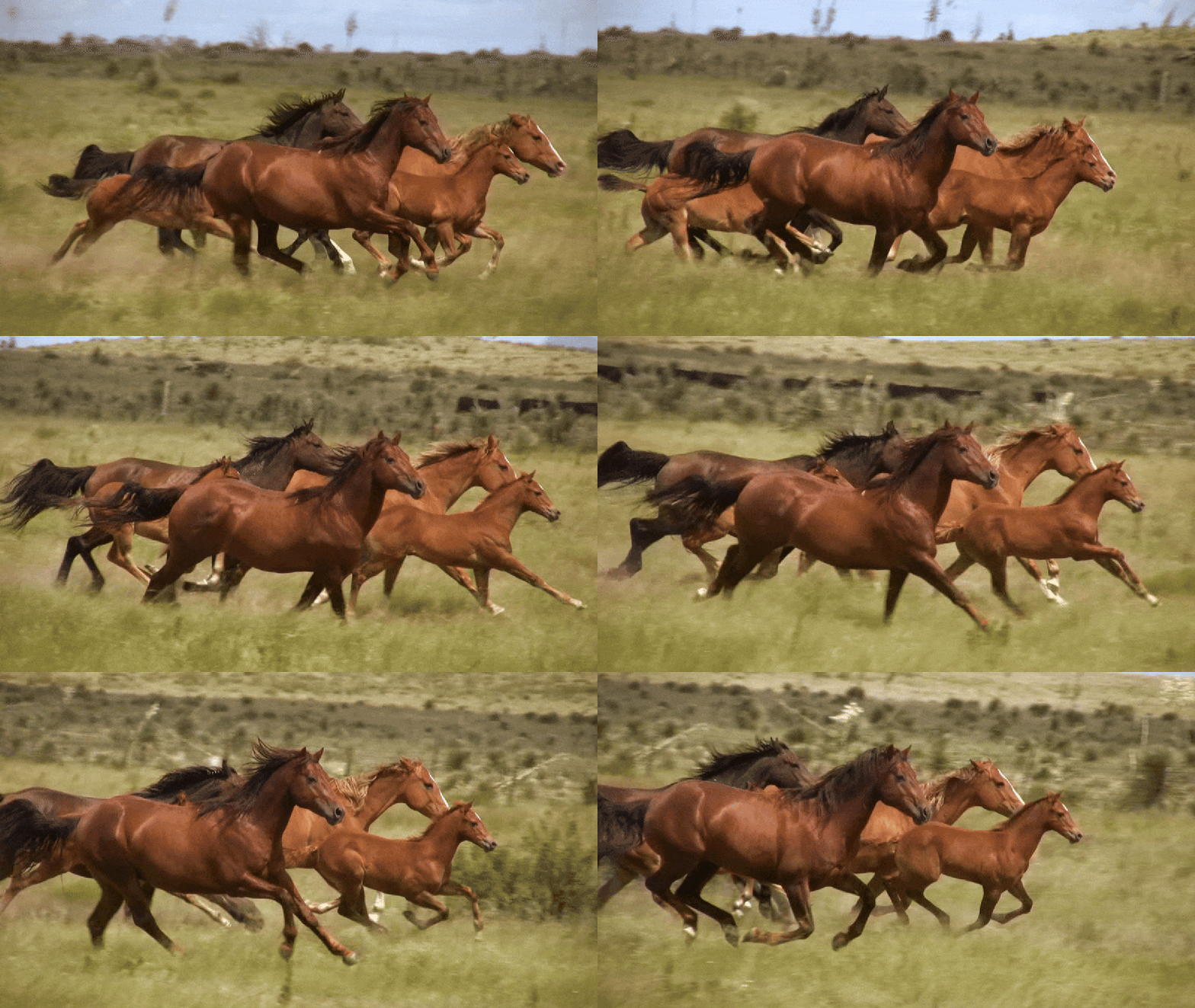
The new moon on February 17 marks the start of the Lunar New Year, which is celebrated in many Southeast and East Asian countries. According to the Chinese zodiac, it’s also the start of the Year of the Horse, offering a perfect excuse to whinny about the science of horses and their animal relatives.
Domestic horses are the most famous members of the genus Equus, which also includes a wild relative called the Przewalski’s horse, in addition to three species of asses and three species of zebras. All trace their roots to North America, which was home to the very oldest known horse relatives up to 55 million years ago. But horses went extinct on the continent at the end of the last ice age; modern equids all hail from Africa and Eurasia, where domestication also occurred.
That development changed history for humans and horses alike. Horses carried many civilizations to their heights, only to find themselves something of an anachronism in modern society. Tellingly scientific investigation into horse behavior is mere decades old, says Sue McDonnell, an equine behavioral scientist at the University of Pennsylvania’s School of Veterinary Medicine.
On supporting science journalism
If you’re enjoying this article, consider supporting our award-winning journalism by subscribing. By purchasing a subscription you are helping to ensure the future of impactful stories about the discoveries and ideas shaping our world today.
Scientific American spoke with McDonnell and Sarah King, a behavioral ecologist at Colorado State University, who specializes in horses and other equids, to highlight some of the most interesting science around these year’s star animals.
READ MORE: The Surprising New History of Horse Domestication
Horses are highly social
Domestic horses have three basic needs: freedom, forage and friendships with other horses. That’s because the social nature of these animals runs very deep.
Turn horses loose, and something remarkable happens, McDonnell says. “They immediately reassemble in the social structure that they had when we first domesticated them,” she says. In that structure, each herd includes several so-called harems consisting of one stallion and a handful of mares and their offspring, plus a “bachelor band” of younger related males that faces down threats to the herd.
Studies have shown that the stallions with the most foals are also the ones with friendly relationships with their mares, not those who rely on aggression and violence. “Horse society really is held together by affiliative bonds,” King says.

PeopleImages/Getty Images
Don’t look down on hooves
For domestic horse owners, hooves are a headache—they’re prone to splintering and require regular trimming and shoeing. But those problems only arise because of the hard surfaces domestic horses must walk on. Horses in the wild “have zero problems,” McDonnell says.
And the hooves of these horses go through seasonal changes in response to local climate and surfaces, she notes. In spring and fall horses tend to develop longer hooves, which act “like little skis” to help animals navigate softer ground. In winter and summer, when the ground is harder, and animals don’t move as much, hooves naturally become shorter.
The mixed landscape of wild equid conservation
Of the wild equid species, King is most worried about the critically endangered African wild asses (Equus africanus), which live around the horn of Africa. “They’re in a very inhospitable environment—there’s real deserts there—and of course, there’s a lot of political issues in that part of the world as well,” she says. The animals are also hunted for food and medicine and must compete with livestock for foraged food.

Thorsten Spoerlein/Getty Images
In contrast, their distant cousins, the Przewalski’s horses of Central Asia, are rebounding after becoming extinct in the wild as of the 1960s. After a careful program of breeding in zoos, scientists began reintroducing the horses to the wild in the 1980s. And now, King notes, some populations are fully self-sustaining. “They are a real conservation success story,” she says.
READ MORE: The Last Wild Horses Are Finally Returning to Their Natural Habitat
Horses really can smell human fear
This one won’t surprise people who have dealt extensively with horses, but research published last month experimentally proves that horses can smell human fear. “Our emotions are central when interacting with horses,” said study author Plotine Jardat, a horse behavior and welfare researcher at France’s National Research Institute for Agriculture, Food and Environment, to Scientific American at the time.
Better research about exactly how human emotions affect horse responses is vital for animal welfare, McDonnell says. For example, defensive behavior in a horse can easily be misinterpreted as aggression, she notes, and that can make people fearful—which, the new research shows, can further put the horse on edge, resulting in a tricky feedback loop.
READ MORE: Horses Can Smell Your Fear, Bizarre Sweat Study Finds
AI may help owners take care of their horses
Horses have spent millennia evolving to avoid predators, and this has left them loath to show signs of pain or weakness around humans, McDonnell says. In recent years veterinarians have begun trying to get around this by poring through video footage to look for cues that a horse is ailing. Once a horse is alone, she says, “you can detect a lot of subtle behaviors indicating discomfort.”
But it’s not a quick technique. That’s why McDonnell is working with artificial intelligence specialists to train a system that can skim through horse footage to hunt for the small cues veterinarians pick up on but much faster than any human could.
Horses communicate more creatively than you might think
If cats meow and ducks quack, horses stereotypically neigh—but they also whinny and nicker and huff and squeal, and those noises have been, for the most part, overlooked. “We’re beginning to understand that there’s probably a lot more communication going on in those noises,” King says. “Understanding the context and what those noises mean, I think, is really interesting.”
