
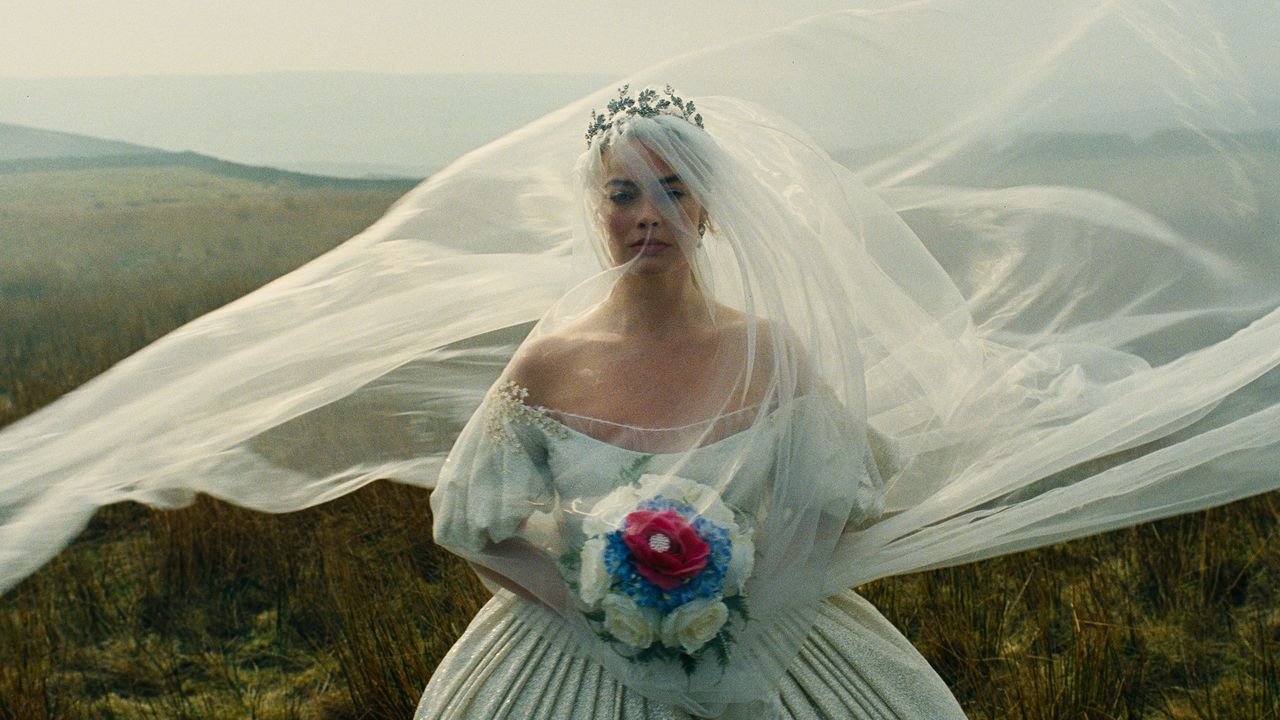
“Wuthering Heights” extrapolates, too, of course. The many truncations and excisions have been detailed copiously, including by my colleague Justin Chang. What Fennell chiefly adds is something that could hardly have been in a novel published in 1847: sex. The relationship between Catherine and Heathcliff, apparently unconsummated in Brontë, is a hot-blooded affair in the movie. Even if its heat is more suggested than unleashed, Fennell renders the pair’s emotional and sexual freedom, too, as signalled in a scene in which Catherine masturbates and Heathcliff, catching her in the act, licks her fingers. What made Fennell’s 2023 melodrama, “Saltburn,” more than just the twisty tale of a social-climbing schemer working his wiles is the seductive power that its interloping protagonist exerts—by way of his own viscous pleasures and secret kinks. In her “Wuthering Heights,” the bonds of cruelty and affliction in Heathcliff’s later relationship with Isabella are turned into an explicitly B.D.S.M. dynamic, in which Isabella delights. (No need for her to escape in Fennell’s version, as she does in the book.)
The effect is to demythologize Brontë. If all that impeded the characters’ sex lives in the book were the law and decorum of the author’s day, why not tell something like the truth? If one revisits the past to dispel myths, one worth dispelling is that of a lost era of chastity. But that’s not what Fennell does. Instead of lifting the lid off history and anchoring the adapted parts of “Wuthering Heights” in the specifics of the period when they’re set (roughly from the American Revolution to the French one), Fennell turns history decorative, decks it out in material fantasies so awkward that it’s unclear whether they are deliberate anachronisms or whether they’re just off.
The overwhelming silliness of the movie falls short of camp—it’s neither intentionally self-parodic nor exaggeratedly theatrical. On the contrary, even its most outlandish and grotesque inventions are portrayed tastefully, with a sheen of aesthetic refinement that turns the most intensely emotional moments into emblems of emotion. The film’s pictorial expression remains under the top. Fennell’s “Wuthering Heights” isn’t a bad adaptation, just a banal movie, no worse in what it takes from Brontë than in what it tacks on.
Nonetheless, I’m sympathetic to Fennell’s effort, because what she really appears to be adapting is less Brontë than a cinematic genre that has more or less fallen into oblivion: the romantic drama. Though mediocre in itself, “Wuthering Heights” is a kind of placeholder, a symbol of an entire swath of filmmaking that now hardly exists but has been newly brought back to the fore by the ample and ubiquitous archive of streaming. Such movies were long known in Hollywood as “women’s pictures” (even if many of the romantic agonies afflicted the movie’s men, too). The genre’s supreme artists were John M. Stahl (from the silent era through the nineteen-forties) and Douglas Sirk (in the nineteen-fifties), and they were joined by other directors of similar ambition and accomplishment, such as Frank Borzage and George Cukor. Their melodramas of heartbreak and redemption, as in Stahl’s “Only Yesterday” (based on a novella by Stefan Zweig), Sirk’s “All That Heaven Allows,” filled with wild coincidences and fervent confessions, are what could be called tearjerkers. These movies have the extraordinary merit of putting the passions of love and the obstacles to relationships front and center, balancing personal desires and social obligations on an equal footing, and thereby lending bourgeois life the grandeur of tragedy.
Few of the best movies of this past year feature much in the way of romance. “Sinners” indeed includes one of the year’s great love stories but keeps it fragmentary, secondary, and, ultimately, symbolic. “The Mastermind” and “Hedda” are downright bitter about love. “The Phoenician Scheme” is a vision of paternal love, and what remains of romantic love is retrospective, a tale of mourning along with a vengeance plot; “One Battle After Another,” too, is a paternal story that starts with a significant but superficially sketched romantic relationship. “Marty Supreme” is driven by romance, and the thinness of its central couple’s relationship—the one that begins and ends the movie—is compensated for by its thematic implication of a bond of ineffable absoluteness, a passion beyond words. In this regard, “Marty Supreme,” set in 1952, reminds me of one of that era’s great movies, “Rear Window,” in which Alfred Hitchcock offers, in a monologue spoken by the superb character actress Thelma Ritter, a definitive credo of transcendently carnal love. But, “Marty Supreme,” true to its title and its eponymous character, isn’t a women’s picture; the romance, sharply conceived though it is, is ultimately little more than a series of obstacles on the protagonist’s athletically existential journey.
