
The World Economic Forum, which has met annually in Davos, Switzerland, since 1971, revealed—through remarks by Canadian Prime Minister Mark Carney—the contested nature of the contemporary international order, even among global political and economic elites themselves. In his speech, Carney drew attention to the farce of the “rules‑based liberal international order,” whose reach, he argued, has never been truly universal but rather selectively imposed on less powerful states within the international system. According to the Canadian Prime Minister, this farce has sustained the illusion of the survival of an order that had already come to an end with the retrenchment of the role played by the United States after World War II as a provider of global public goods, both in the financial and security domains. For Carney, it is urgent to name this farce and to seek new grammars and “collective investments in resilience” through concerted actions among middle powers, including Canada. Carney received a standing ovation for his speech, which immediately gained global visibility and circulation, projecting the Canadian Prime Minister among Western elites as a visionary anticipating the contours of a new international order in the making.
The spotlight cast on Carney merely illuminates what Dipesh Chakrabarty termed the “inequality of ignorance”: the Global North’s privilege of ignoring much of the experience, production, and accumulation of knowledge in the Global South. The dissonant notes of Carney’s speech in Davos resonated with scholars, policymakers, and activists from the Global South, allowing us to affirm that we are at the forefront of discussions about the farce of the liberal international order constructed by the Global North and about the consequent reproduction of its privileges. Rather than representing the locus of backwardness and dysfunction—as portrayed in Western mainstream media and academia—the Global South represents the future: a space of innovation where alternatives are daily rehearsed, experienced, and debated. Yet this effervescence of ideas is rendered invisible and erased by the geopolitics of knowledge that, since colonial times, has authorized and amplified certain voices—such as that of a Canadian leader in Davos—while disauthorizing others, even when more numerous, such as those of the Global South.
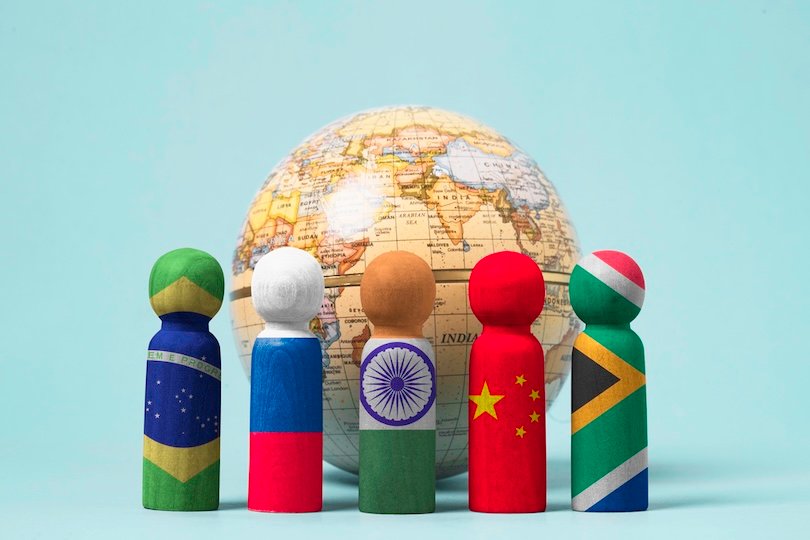
BRICS can be understood precisely as one of these spaces of institutional innovation and political articulation of alternatives to the liberal international order. BRICS is a grouping of emerging economies—Brazil, Russia, India, China, South Africa, Egypt, the United Arab Emirates, Ethiopia, Iran, Indonesia, Saudi Arabia, an invited member still pending full formal accession—whose main purpose is to promote the transformation of the global governance system established after World War II through the reform of traditional financial institutions such as the International Monetary Fund (IMF) and the World Bank. It also seeks to contribute to the construction of a multipolar order that reflects the distribution of power in the twenty‑first century and offers greater decision‑making power to countries of the so‑called Global South. Since 2009, the grouping has held annual meetings chaired by one of its member states. The first BRIC Summit—without South Africa—was held in 2009 in Yekaterinburg, Russia.
However, BRICS did not emerge in 2009 as a tabula rasa; rather, it emerged imbued with memories and lessons from previous struggles conducted within various movements, groupings, and deliberative arenas of the “Third World,” such as the Non‑Aligned Movement, the Group of 77, and demands for a New International Economic Order (NIEO), among others. It is worth noting that all these spaces were permeated by demands for a revision of the liberal international order, which excluded less developed countries from international decision‑making and whose norms—such as sovereignty, proclaimed as universal—were routinely violated by great powers, not accidentally but as what Stephen Krasner termed “organized hypocrisy.”
It should be recalled that much of the Global South was still under colonial rule when the liberal international order was designed and institutionalized in the post‑World War II period. Looking at the design of its institutions—such as the UN Security Council and the Bretton Woods Institutions (IMF and World Bank)—it becomes evident that they were structured by inequality, as great powers arrogated to themselves the privilege of veto power, which in practice allows them to invalidate the decisions of the majority of states in the international system. In the case of the Security Council, the victorious powers of World War II granted themselves permanent seats and veto power on the premise that the body’s efficiency depended on the military capacity and special responsibility of the great powers for maintaining order. The prevailing view is that a more democratic Security Council would compromise the body’s efficiency. Yet what we have today is an institution that is neither representative nor efficient. It is scandalous that, even today, when more than half of the world’s conflicts take place on the African continent, no African country is represented on the Council as a permanent member. Africa thus continues to be treated as an object of intervention—a topic rather than a subject with decision‑making power or an intelligible voice. Or, to use Carney’s expression, Africa is not at the table but on the menu.
BRICS has adopted a divergent vision: efficiency and representativeness are two sides of the same coin, thereby challenging the notion that the powerful possess an exceptional capacity to foresee and shape the world’s future. In line with critical and feminist authors such as Du Bois and Cynthia Enloe, the periphery is seen as better able to diagnose international problems, since it directly experiences the system’s inequalities and contradictions. Yet this vision is not free of contradictions. For example, Brazil has consistently called for the democratization of the Security Council and has pressed for the inclusion of the issue in BRICS declarations. However, when the time came to expand the number of full BRICS members beyond the original five, Brazilian diplomacy showed hesitation, fearing that expansion could transform BRICS into a new G77, create coordination problems, hinder consensus, and reduce Brazil’s influence within the grouping.
If the post‑World War II period was seen as a turning point giving rise to a new international order—one that, as Carney suggests, enabled countries like Canada to prosper—for the “Third World”, these promises never materialized. For this group of countries, the new order retained much of the old colonial order in terms of material and epistemic inequality. These countries remained subject to the international division of labor as commodity exporters, and their voices and aspirations were systematically disauthorized by political and economic elites.
Even so, these states were sufficiently adept to mobilize the rules of the new order in their favor. This became visible in the UN General Assembly, where, as a majority, they coordinated and voted for resolutions promoting a “new international economic order” (NIEO) aimed at ending structural inequalities embedded in the post‑war economic, financial, and trade architecture. The NIEO articulated an alternative model of development oriented toward transforming the colonial division of labor through industrialization, productive diversification, economic sovereignty, and practices of restitution for centuries of colonial exploitation and resource drain. This redirection of institutions toward the agenda of developing countries was also evident in the General Agreement on Tariffs and Trade (GATT) and its successor, the World Trade Organization (WTO), which, although guided by liberal rationality, were reshaped under collective pressure from the “Third World.” As early as the 1960s, developing countries organized within UNCTAD and the G77 demanded equity in international trade rules, resulting in the inclusion of Special and Differential Treatment (SDT) in their constitutive agreements. SDT constituted an important victory for these countries, as it recognized that the post-war order was asymmetric, requiring greater flexibility, time, technical support, and capacity-building for developing countries to implement trade agreements.
Ironically, today BRICS has become one of the main defenders of a rules‑based international order—albeit one that is qualified, reformed, and democratized. In BRICS declarations, we find support for sovereignty and territorial integrity, multilateralism, the centrality of the United Nations, and a rule‑based multilateral trading system, alongside calls for reform of the Security Council and Bretton Woods Institutions. What we witness today is that it is precisely the United States—one of the main architects of the “liberal international order”—that has been declaring its obituary.
In Gramscian terms, we are witnessing a transition from an old order that has not yet died but is agonizing, and that, as Carney notes, is nostalgically remembered by much of the Western elite. Indeed, it is still easy to identify significant segments of the European population that long for the return of the old normal, characterized by the liberal international order, by the welfare state — which exported its contradictions to the periphery of the international system — and by the sense of security provided by the transatlantic alliance, materialized in NATO, which guaranteed them material and psychological comfort. Yet the United States, under Trump’s leadership, has chosen to detach itself radically from that order, proclaiming it “obsolete.”
To this end, the United States has withdrawn from 66 international organizations, 33 of them linked to the UN, launched a tariff offensive against both rivals and allies, and has increasingly, and without hesitation, resorted to force to impose its will, as exemplified by the interventions in Iran in 2025 and in Venezuela in 2026. Yet there is one aspect of this order that the United States refuses to relinquish: the hegemony of the dollar, largely guaranteed by the Bretton Woods Institutions, which reproduces the centrality of a dollarized financial system. Trump warned BRICS countries not to continue playing the ‘de-dollarization’ game if they did not wish to become targets of a 100 percent tariff. BRICS countries’ efforts to increase the use of local currencies in trade transactions were perceived as an existential threat to the country, prompting Trump to declare that the ‘dollar is king’ and that no one can challenge it without facing severe consequences.
In Gramscian terms, these desperate actions by the United States can be read as ‘morbid symptoms’ of a declining hegemonic power. Realist theorists such as Edward Carr and Hans Morgenthau also warned that the effective use of force by a great power, far from being a sign of strength, signals its weakening, insofar as it reveals that the power in question has become incapable of imposing its will by other means, such as persuasion.
In this dispute over the contours of the new world order, BRICS countries are at the forefront. The main ideas advanced by Carney are present in BRICS discussions and in the foreign policy orientation of the group’s member states, such as the search for diversification, the combination of ethics and pragmatism, and the establishment of issue-based coalitions with partners who share sufficient common ground to act together, without the expectation that all will share the same values.
‘Collective investments in resilience’ advocated by Carney in place of self-help constitute precisely the core of one of the axes of the next BRICS Summit, to be held in India in the second half of the year. This axis aims at ‘strengthening economic, social, and institutional resilience to navigate global uncertainties, supply chain disruptions, health challenges, and climate risks.’ Indeed, navigating turbulent waters has been a historical learning process for states and peoples once colonized, who, over the years, have developed different strategies in the pursuit of autonomy in the face of the neocolonial and imperial dynamics of the great powers, which, as we have seen, have never recognized sovereignty as a norm in the periphery of the international system.
Faced with the turbulent context of Trump’s second term, which has spared neither allies nor rivals with its aggressive unilateralism, countries of the Global North—historically dismissive of the knowledge, experiences, and strategies of the Global South—have increasingly turned to diversifying partnerships to reduce their vulnerabilities, setting aside many of the narcissistic objections to forging alliances with states that have “different” political and economic systems. According to Carney, Canada has been resorting to a new decentralized strategy, forming alliances “issue by issue, with partners who share enough common ground to act together,” which, as he notes, “in some cases (…) will be the vast majority of nations.” In this way, it has been building a dense network of connections through trade, investment, and culture to deal with future challenges and opportunities. Moreover, Carney proposes the creation of a third-party locus with impact, capable of circumventing rivalry between the superpowers, reproducing—without attribution—the logic of the Non-Aligned Movement, which, during the Cold War, advocated the creation of a third autonomous space in relation to the disputes between the United States and the Soviet Union.
Indeed, the strategies proposed by Carney have received different names: “non-alignment” during the Cold War and, in the post-Cold War period, “active non-alignment” and “multi-alignment,” both heirs of non-alignment but adapted to new configurations of power. As TK Arun notes: ‘The strategy that Carney outlined has been called Non-Alignment from Nehru’s time.’
The concept of active non-alignment has been further developed by Latin American political scientists who, in 2021, published the book “El no alineamiento activo y América Latina”, which formulated new strategies for navigating an increasingly globalized and interdependent world. According to Jorge Heine, in this context, a more flexible approach is required than that prescribed by the Non-Aligned Movement during the Cold War, which ideally sought to maintain equidistance between the United States and the Soviet Union. Under this new approach, rapprochement with either the United States or China is not rejected a priori, provided it is grounded in national interests and each course of action is evaluated on its merits rather than on abstract principles. The game becomes more complex as it unfolds across multiple fields and requires assessing which powers offer the most favorable conditions for each specific project. Brazil’s foreign policy under President Lula’s third term has been cited as an example of “active non-alignment.” To give one example, after Brazil became the target of Trump’s tariff offensive, which imposed fifty-percent tariffs on the country, it launched the “Plano Brasil Soberano,” (Brazil Sovereign Plan) combining emergency compensation measures for the most affected sectors with a strategy of market diversification aimed at reducing excessive dependence on both Washington and Beijing while expanding trade partnerships with the European Union, Arab countries, and the Global South.
The notion of multi-alignment was first advanced by India, inspired by the Non-Aligned Movement and grounded in the need to diversify relations to avoid excessive dependence on power poles. India, for example, is part of BRICS, a vocal platform for developing countries; it is also a member of the Shanghai Cooperation Organization (SCO) — which includes China — while simultaneously participating in the Quadrilateral Security Dialogue (Quad) with the United States, Japan, and Australia—aimed at containing China in the Indian Ocean — alongside other bilateral and multilateral arrangements.
In a Foreign Affairs article published in December 2025, Tanvi Madan had already anticipated the appropriation of the doctrine of multi-alignment by Global North states under U.S. unipolarity. Indeed, it is no mere coincidence that two agreements—between the European Union and Mercosur, and between the EU and India—that had stalled for more than twenty years were unlocked precisely after U.S. threats to annex Greenland and distance itself from NATO.
The Western world long showed little confidence in the durability of the BRICS grouping, largely because it adopted Western institutions such as the European Union as its point of reference. Using such institutions as benchmarks for evaluating BRICS, the grouping was understood in terms of what it lacked: institutional density and convergence in domestic governance models. Yet reading BRICS as a lack overlooks the alternative trajectory of its member states relative to that of the great powers. As we have seen, these countries have been systematically subjected to foreign interference in their domestic affairs and therefore value institutions characterized by high levels of informality and resistance to rigid obligations and imperative conditionalities that might limit their autonomy.
One illustration of this flexibility is the positioning of BRICS countries regarding the recent Peace Council launched in Davos, from which Canada was disinvited following Carney’s speech. Eight Muslim countries, acting collectively, decided to join the Council; among them are Indonesia, Egypt, and the United Arab Emirates—three new BRICS+ members—as well as Saudi Arabia, invited to BRICS but not yet formally admitted. Brazil, for its part, seeking to preserve its autonomy in the face of the new Monroe Doctrine announced by Trump for the Western Hemisphere, imposed two conditions: that, to join the Council, a Palestinian representative be included, and that the Council focus exclusively on Gaza. China justified its refusal by emphasizing the UN’s centrality, but it avoided escalation, reflecting its reluctance to provoke Trump at a time when trade negotiations were pending. Modi has kept his response open, partly to avoid displeasing the United States.
These divergent positions reflect pragmatic approaches calculated by each actor or group of actors, given the risks and opportunities associated with each choice. In this sense, Brazil’s position cannot be measured by the same criteria that guided the entry of countries such as Egypt, which has long played a central mediating role in regional diplomacy in Gaza, or the United Arab Emirates and Saudi Arabia, which seek to project themselves as competent international mediators in the Middle East. Such moves should not be interpreted as signs of geopolitical alignment with Washington, but rather as an attempt to influence the transition process in Gaza from within.
Despite predictions of a short lifespan, BRICS has not only proven resilient but has also doubled its number of full members, adding further heterogeneity. Differences in political models, development paths, languages, and currencies among its members have been re-signified. Far from being seen—as developed by Naeem Inayatullah and David Blaney—as a “problem” in the traditional sense of Western modernity, they have instead come to be viewed as a strength of the grouping. Although the expansion in membership has made achieving consensus more difficult, members have worked with an achievable consensus without forcing alignment across all dimensions. At the same time, a vision of a flexible BRICS has prevailed—one that does not impose conditions on its members but rather general principles, such as the rejection of unilateral sanctions imposed outside multilateral arrangements, including the UN Security Council and the WTO. It is noteworthy that flexibility, the search for possible consensus, and the need to engage with difference are increasingly recognized by the Global North as survival strategies, perhaps because it now finds itself in an exceptional situation of vulnerability that is, in fact, the regular and everyday condition of developing countries.
Further Reading on E-International Relations
