
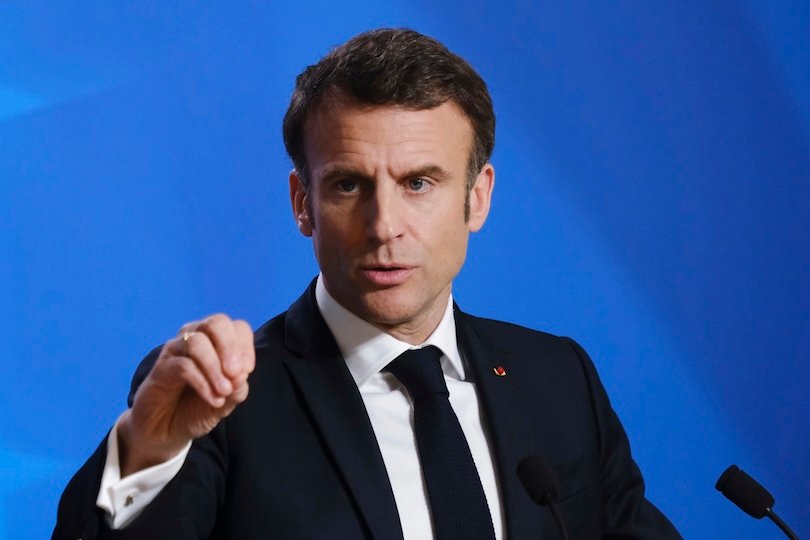
On December 21, 2025, addressing French forces stationed in the United Arab Emirates, Emmanuel Macron told his soldiers that France now confronts an era of predators: “In the era of predators, we must be strong to be feared, and particularly strong on the seas”. For a liberal democratic president to identify the international system as predatory and announce his nation’s intention to be feared marks a striking departure from the vocabulary that has governed European politics since 1989. More significant is what followed. Macron announced that France would acquire a new nuclear-powered aircraft carrier, binding future governments to a forty-year commitment to global power projection. The question is whether this represents rhetorical provocation or systematic alignment of realist language with material policy. Five months earlier, on July 13, 2025, Macron had addressed France’s armed forces at the Hôtel de Brienne with a different formulation. “To be free in this world you must be feared. To be feared you must be powerful”. The statement compressed into two sentences what Machiavelli argued across The Prince (1513) and the Discourses (1517). Liberty rests not on law or virtue but on the capacity to inspire fear in rivals. Fear requires power. Power requires an armed force. The chain is circular and self-reinforcing. Without power there is no fear. Without fear there is no freedom. For a liberal democratic president to articulate this logic marked conceptual rupture with liberal internationalism. Liberal theory since Kant has argued that law can replace force, that institutions can displace fear, that cooperation through norms makes deterrence obsolete. Macron’s formula eliminated institutions entirely from the causal chain linking freedom to power. He returned to classical realism’s insistence that survival depends on the capacity to threaten harm.
But July remained primarily philosophical. Macron articulated the realist principle without announcing new force structure, major operational deployments, or concrete validation that material policy would align with realist language. The formula raised the question whether France would back realist rhetoric with realist capability. The December speech provided the answer. Where July spoke philosophically of being feared, December identified the threat directly through biological metaphor. The predator metaphor carries specific theoretical weight. It positions the international system not as a competitive arena where states pursue advantage within rules, but as a Hobbesian state of nature where predation defines interaction. Predators do not compete under shared norms. They hunt. The prey cannot negotiate with predators or appeal to law. They can only achieve security through power sufficient to deter predation. In Leviathan (1651), Thomas Hobbes described the state of nature as a condition where life is solitary, poor, nasty, brutish, and short precisely because no overarching authority constrains behaviour. In such conditions, security depends entirely on capability to threaten harm to potential aggressors. Biological metaphor applied to international politics eliminates any space for liberal institutionalism’s faith in normative constraint. There are no institutions in the food chain.
France’s strategic position became clear through the language. France is not a predator but potential prey that must become strong enough to avoid predation. Waltz (1979) described defensive realism in these terms. States seek security, not domination. But security in anarchic systems requires capability to inflict costs on rivals. The distinction matters. Offensive realism argues states maximize power to achieve hegemony. Defensive realism argues states seek sufficient power to deter aggression. Macron was articulating defensive realist logic. France does not aim to dominate Europe or project hegemonic power globally. France aims to make itself too dangerous to attack, too costly to coerce. The predator metaphor specifies the threat environment requiring this defensive posture. When the international system operates according to predatory logic rather than institutional constraint, security depends on demonstrated capacity for violence.
But this realist turn raises immediate questions about liberal democracy itself. If France speaks like realists, deploys forces like realists, and designs military structures on realist assumptions, what remains distinctively liberal about its international behaviour? The answer lies in the direction of coercion (Deudney, D. & Ikenberry, 2021). Liberal democracies can maintain constitutional constraints, rights protections, and rule of law internally while practicing realism externally. The critical difference from authoritarian regimes is that liberal democracies project fear and force outward to deter external threats while limiting state power internally to protect citizens. Authoritarian regimes project fear and force inward to coerce their own populations while claiming defensive posture externally. Macron’s formula that France must be feared is outward-facing. It aims to deter external predators to preserve domestic liberty. The domestic-international boundary preserves liberal character even when international behaviour follows realist logic.
That distinction faces sustained competitive pressure. Democracies facing existential threats have historically suspended liberal constraints temporarily. The durability of outward-only coercion depends on whether leaders can maintain the boundary between external deterrence and internal repression. In The Concept of the Political (1932), Carl Schmitt argued that liberalism seeks to neutralize the political system by displacing antagonism into law, economics, and morality. But the “political” cannot be neutralized because the friend-enemy distinction persists regardless of institutional design. When Macron stated that France must be feared, he acknowledged that enmity remains constitutive of international politics. Being feared presupposes enemies who must be deterred. European discourse had long claimed integration would abolish such antagonism. Macron reintroduced it. The question becomes whether liberal democracies can sustain friend-enemy politics indefinitely without it reshaping domestic norms. This tension would become more acute when Macron moved from philosophical principle to material commitment.
December demonstrated how France validates its commitments. Macron invoked French operations repeatedly. The mechanisms producing credibility are clear. Not norms, treaties, dialogue, or institutions. Rather demonstrated capacity and proven willingness to use force. When Abu Dhabi faced Houthi drone and missile attacks in 2022, France responded immediately with Rafales and CROTALE batteries. When conflict erupted in June 2025 during the Iran-Israel escalation, France deployed air reinforcements and an air defence frigate. Macron told forces that confidence demonstrates itself through facts. Alliance in this model means states that share risks and deploy force together when threatened. The relationship is transactional in the realist sense. Each party provides security to the other through credible commitment demonstrated in crisis, not through shared values or institutional integration.
This conception of alliance carries implications for the liberal-realist tension. Transactional security provision based on demonstrated commitment rather than shared norms pushes liberal democracies toward viewing partnerships through purely strategic calculation. The UAE relationship proves durable not because France and the UAE share political systems or values. One is a secular republic, the other Islamic monarchy. They share interest in regional stability and opposition to Iranian expansion and Houthi attacks. Shared interest generates alliances based on mutual security provision. France showed willingness to deploy combat power when the UAE faced attack. The UAE reciprocated by purchasing 80 Rafale fighters and granting France permanent basing. Each action validates the other’s commitment. Trust derives from facts rather than values. The question becomes whether liberal democracies can sustain this purely transactional approach to partnerships without it bleeding back into domestic political culture. When external relations operate according to strategic calculation divorced from normative considerations, does this gradually reshape how domestic politics operates?
But December’s most significant moment was the announcement of material commitment backing the realist logic. Macron declared that France would acquire a new aircraft carrier. The decision, he explained, followed comprehensive examination and aligns with the two most recent military programming laws. The carrier will be nuclear-powered, built by 800 suppliers of which 80 percent are small and medium enterprises. The announcement does more than validate realist rhetoric materially because it creates a temporal lock.
By announcing the program publicly, specifying construction timelines, and naming industrial partners, Macron bound not just his own government but future governments to a forty-year commitment. The carrier will operate into the 2070s. Political leaders who will inherit this decision have not been born. Cancellation becomes nearly impossible given sunk costs, industrial employment, and alliance commitments built around carrier deployment. Material commitments constrain future strategic choices through temporal lock. France in 2065 will project power globally because France in 2025 made carrier procurement irreversible. The decision operates as strategic doctrine in steel and nuclear reactors rather than policy documents that can be revised. Future French leaders will speak of deterrence and fear not because they choose realist language, but because they command realist capability that makes other vocabulary implausible.
The temporal lock intensifies the liberal-realist tension in ways that extend beyond immediate policy. A forty-year commitment to global power projection capability embeds realist logic into French strategic culture for generations. Leaders in 2045 inheriting this capability will face pressure to use it. The carrier demands missions that justify its expense. Autonomous global power projection capability makes France less dependent on allies for basing and permissions, but also less constrained by multilateral decision-making. The drift toward unilateral action becomes structurally easier. France in 2045 will face pressure as the realist turn reshapes strategic culture. Power projection capability meant to deter external threats could normalize executive autonomy in ways that erode domestic constraints. The carrier commits France not just to military capability but to a strategic mindset for forty years. That mindset emphasizes threat assessment, capability requirements, demonstration of resolve, and willingness to use force.
France cannot inspire fear in rivals without credible power. France cannot project credible global power without carrier capability. Aircraft carriers represent one of the most expensive and sophisticated forms of military power. They enable sustained operations far from home territory, project air power without requiring allied bases, demonstrate technological sophistication and industrial capacity, and signal long-term commitment given that carriers operate for four decades. Carriers also align with December’s geographic framing. Macron told forces that their missions extend from the Suez Canal to Australia. From the eastern Mediterranean through the Red Sea, across the Indian Ocean to the Indo-Pacific, French forces maintain presence and conduct operations. Carriers make this global reach possible. Without carrier capability, power projection at these distances becomes dependent on allied bases and permissions. With carriers, France maintains autonomous capability to deploy air power wherever its interests require.
The carrier reflects middle power strategy in multipolar competition. Too small to compete with the United States or China in aggregate power, France lacks the population, economy, and territory of superpowers. France remains too globally engaged to accept purely regional power status. French interests span Europe, Africa, the Middle East, and the Indo-Pacific. Permanent overseas territories in the Caribbean, South America, and Pacific require protection impossible without power projection capability. The carrier represents middle power logic. France cannot match American or Chinese carrier fleets numerically. But it can maintain a credible presence in specific theatres through sophisticated systems compensating for limited mass. One nuclear carrier with Rafale fighters provides more capability than a dozen conventional vessels. Quality substitutes for quantity when resources constrain numbers.
French pursuit of strategic autonomy follows from this position. Strategic autonomy in Macron’s formulation does not mean abandoning NATO or opposing EU defense integration. France remains in NATO and supports European defense cooperation. But strategic autonomy means independent capability to project power and inspire fear without requiring American authorization or support. When Houthi attacks threatened Abu Dhabi, France responded with its own aircraft under French command according to the French national decision. No consultation required. No permission sought. Autonomous capability enabled autonomous action. This is defensive realism applied to middle power constraints. Waltz argued that states in anarchic systems must provide for their own security because no higher authority guarantees it. For middle powers, this means selective power projection in spaces where their specific capabilities matter. France cannot provide continental security alone. But France can project power in the Middle East and Indo-Pacific where sophisticated systems and operational experience give France influence disproportionate to aggregate power.
France occupies a specific position compared to other European states. Large enough to field sophisticated systems independently. Rich enough to sustain defence spending around two percent of GDP. Technologically advanced enough to produce nuclear weapons, carriers, and advanced aircraft domestically. But not large enough to provide continental security alone or compete with superpowers globally. Selective power projection responds strategically to these constraints. France cannot be everywhere. It chooses specific spaces where presence serves national interests and where French capability makes difference. The Middle East and Indo-Pacific receive priority because they intersect multiple French interests. Energy transit through the Red Sea and Strait of Hormuz. Protection of overseas territories in the Indian and Pacific Oceans. Partnership with Gulf states that purchase French weapons. Competition with China for influence in a region where no single power dominates. The carrier enables this selective presence. Without carrier capability, France would need allied bases for every operation. With carrier capability, France can sustain operations in spaces where allies may not grant basing or where relying on allied permission would compromise autonomy. The carrier is expensive, but it purchases freedom of action. For a middle power pursuing strategic autonomy, that freedom justifies the cost.
This middle power logic creates additional pressure on the liberal-realist boundary. Middle powers pursuing strategic autonomy face constant tension between capability requirements and resource constraints. The temptation to maximize military effectiveness by reducing domestic oversight or streamlining decision-making processes increases when resources are limited and threats are multiple. France must maintain sophisticated capability across nuclear deterrence, conventional forces, intelligence services, and cyber operations while operating on a budget fraction of what superpowers command. This pressure could encourage centralization of authority, reduction of legislative oversight, or expansion of executive prerogatives in national security matters. French democratic institutions face forty years testing this boundary. The carrier commits France to bearing these pressures for decades.
Macron’s 2025 trajectory reveals exhaustion of liberal internationalist language among European leaders facing geopolitical pressure. Liberal vocabulary since 1989 has emphasized cooperation, norms, and institutions as mechanisms for managing international politics. The language assumed that major war was obsolete in Europe, that economic interdependence made conflict irrational, that institutional frameworks could constrain power, and that normative persuasion would eventually integrate rival states into rule-based order. Each assumption has fractured. Russia’s invasion of Ukraine demonstrated that major war remains possible and that economic interdependence does not prevent it. China’s military buildup and assertiveness in the Indo-Pacific show that rising powers do not necessarily accept existing institutional constraints. American political instability under Trump and uncertainty about future commitments reveal that the hegemon guaranteeing liberal order may no longer be reliable.
Under this pressure, liberal language becomes inadequate to describe strategic reality. Leaders face a choice. They can maintain linguistic consistency by continuing to speak of cooperation and institutions while quietly practicing deterrence and power politics. Or they can acknowledge reality by adopting realist language that accurately describes how security is actually achieved. Macron chose acknowledgment. Material conditions constrain discourse. When the international system reveals itself as predatory rather than cooperative, when security depends on deterrence rather than norms, leaders must either describe this reality accurately or maintain increasingly implausible liberal rhetoric. The gap between liberal language and realist practice eventually becomes unsustainable. Cognitive dissonance emerges when stated principles contradict observed behaviour. Macron resolved the dissonance by aligning language with practice.
But France is not alone in confronting these pressures. The pattern extends across European states facing renewed great power competition. What distinguishes France is capability to validate realist rhetoric with material commitment. Most European states lack resources, technology, or political will to acquire aircraft carriers, maintain global military presence, or project power autonomously. They can adopt realist language, but they cannot back it with realist capability. France can. The carrier announcement demonstrates that France possesses industrial capacity, financial resources, and political determination to translate realist principle into realist power. This distinguishes serious realist turn from rhetorical drift. Many leaders speak of threats and deterrence. Few commit to forty-year programs costing billions and requiring sustained industrial mobilization. The temporal lock Macron created through the carrier decision makes France’s realist turn irreversible in ways that rhetoric alone could never achieve.
July 2025 established the realist principle. Freedom requires fear, fear requires power. December added explicit predator logic and material validation through carrier announcement. Throughout the year, systematic alignment emerged connecting realist rhetoric, force structure decisions, operational deployments, and strategic geography. The pattern reveals not rhetorical posturing but deliberate recalibration of French strategic doctrine. Macron moved from philosophical statement in July to biological metaphor in December to material commitment binding future governments. Each step reinforced the previous one. Philosophy became doctrine. Doctrine became capability. Capability became temporal lock.
The era of predators was always reality. Liberal language merely obscured this reality during the unipolar moment when American hegemony made European great power competition obsolete. Now that multipolarity returns and American guarantee becomes uncertain, European leaders confront a choice between maintaining implausible liberal rhetoric and acknowledging realist conditions. Macron chose acknowledgment. But acknowledgment through material commitment rather than rhetoric alone creates different consequences. Leaders who speak realist language while maintaining liberal force structures can reverse course if conditions change. Leaders who commit to forty-year carrier programs cannot. The temporal lock transforms reversible policy into irreversible trajectory.
This linguistic and material turn could produce clearer strategy or self-fulfilling prophecy depending on whether liberal democracies can maintain the distinction between external deterrence and internal repression. Realist language abroad while preserving constitutional constraints at home requires sustaining a boundary that democracies facing existential threats have historically struggled to maintain. The carrier guarantees France will have power to inspire fear for decades. Whether France sustains the liberal democratic commitment to direct that fear only outward is the question Macron’s realism leaves unanswered. Power projection capability meant to preserve domestic liberty through external deterrence could normalize patterns of executive autonomy and strategic unilateralism that gradually erode the very constitutional constraints that distinguish liberal democracies from authoritarian regimes.
The temporal lock Macron created in 2025 will test this boundary across forty years of multipolar competition. Leaders in 2045 or in 2065 inheriting the carrier will face different threats, different rivals, different constraints than Macron faced in 2025. But they will command the same capability and inherit the same strategic logic embedded in that capability. Macron solved the problem of aligning rhetoric with capability. He created the problem of sustaining liberal constraints under prolonged realist practice. The first problem admitted solution through procurement and industrial mobilization. The second problem admits no technical solution. It requires political will, institutional resilience, and cultural commitment sustained across generations. The carrier commissioned in 2038 will operate for forty years under strategic conditions Macron cannot foresee, commanded by leaders who inherit his embedded logic without choosing it. But it will carry the logic Macron embedded in December 2025. That logic is Hobbesian, defensive, and realist. Whether it remains liberal depends on choices France has not made.
References
Deudney, D. & Ikenberry, G.J. (2021). Getting Restraint Right: Liberal Internationalism and American Foreign Policy. Survival, 63(6), 63-100.
Hobbes, T. (1904). Leviathan: Or the Matter, Forme & Power of a Commonwealth, Ecclesiasticall and Civill. University Press.
Machiavelli, N. (1993). The prince (1513). Hertfordshire: Wordsworth Editions.
Machiavelli, N. (2024). Discourses on Livy (1517). University of Chicago Press.
Macron, E. (2025, July 13). Discours du Président de la République aux armées depuis l’Hôtel de Brienne. Retrieved from https://www.elysee.fr/emmanuel-macron/2025/07/13/discours-aux-armees-depuis-lhotel-de-brienne
Macron, E. (2025, December 21). Discours du Président de la République devant les forces armées françaises engagées aux Emirats arabes unis. Retrieved from https://www.elysee.fr/emmanuel-macron/2025/12/22/deplacement-aupres-des-forces-armees-aux-emirats-arabes-unis
Waltz, K. (1979). Theory of International Politics. Reading, MA: Addison-Wesley.
Further Reading on E-International Relations
